
Amur catfish
Large freshwater catfish native to East Asia
The Amur catfish is a carnivorous species found in rivers and lakes across East Asia. It grows large, supports local fisheries and aquaculture, and is valued as a sport fish despite some population declines.
- Grows up to 150 cm and weighs 40 kg
- Nocturnal hunter with long sensory barbels
- Farmed extensively in East Asia for food
- Least Concern globally but threatened in Taiwan
What it is
This large catfish has a robust, elongated body with smooth, scaleless skin. Its colour ranges from olive-green to yellowish-brown, marked by irregular white spots on the sides and a white stomach. The head is broad and flat, featuring a terminal mouth filled with small, sharp teeth. Distinctive long barbels extend from the mouth corners. Adults have one pair of maxillary barbels longer than the head and one shorter pair on the lower jaw. Juveniles possess an extra pair of lower barbels that disappear as they mature.
Where it lives
The species inhabits freshwater catchments across East Asia. Its distribution includes China, Japan, the Korean Peninsula, Taiwan, the Russian Amur Basin, and northern Vietnam. It prefers slow-moving rivers, irrigation canals, and lakes with dense grass cover. These environments provide shade and shelter, suiting its resting habits. The fish thrives in water temperatures between 20 and 27 degrees Celsius. It may migrate downstream to find suitable environmental conditions if displaced.
How it lives
As a nocturnal predator, this catfish hunts at night and rests in caves or shaded areas during the day. Its poor floating ability, caused by bladder enlargement, restricts it to swimming near the bottom. It feeds on aquatic insects, crustaceans, and smaller fish, expanding its mouth to swallow larger prey. Natural predators include monitor lizards, otters, birds of prey, and other fish. The species adapts well to various freshwater habitats provided there is adequate cover and water flow.
Breeding and life cycle
Reproduction occurs in warmer months, typically spring or early summer, often following rainy periods. Females release dispersed eggs to reduce juvenile mortality. Fertilised eggs have a distinct green hue, with larger eggs showing higher survival rates. Hatching takes about 27 hours in warm water, extending to 48 hours in colder conditions. Populations show a sex ratio skewed toward females. Mating rituals in some groups, such as the Biwa population, involve chasing and enfolding by the male.
Fish and people
This fish holds commercial value in eastern Japan and serves as a protein source in mountain villages. Aquaculture is common, though historical issues with cannibalism among fry required new techniques to boost production. Anglers target it in rivers and lakes across East Asia for sport due to its large size. While widely farmed, natural populations have declined in recent decades. It remains a significant part of local diets and recreational fishing activities in the region.
Status and threats
The International Union for Conservation of Nature lists the species as Least Concern across its entire range. However, regional assessments indicate pressure on local stocks. The 2012 Taiwanese Red List of Fresh Water Fishes categorises it as Near Threatened. Natural populations have decreased significantly over the past few decades, prompting reliance on farming. Conservation efforts focus on managing wild stocks while supporting sustainable aquaculture practices to meet demand.
Questions people ask about Amur catfish
How big does the Amur catfish get?
It typically reaches 30 to 60 cm but can grow up to 150 cm in length. Large specimens may weigh between 30 and 40 kg.
What does the Amur catfish eat?
It is a carnivore that feeds on aquatic insects, crustaceans, and smaller fish. It hunts at night near the bottom of rivers and lakes.
Is the Amur catfish endangered?
Globally it is listed as Least Concern. However, it is considered Near Threatened in Taiwan, and wild populations have declined in recent decades.
Good reading and sources
The facts on this page come from the Wikipedia article "Amur catfish", written by its contributors and used under the CC BY-SA 4.0 licence, and from its Wikidata record (CC0). EveryFish rewrote the text in its own words, with AI assistance, and compares every page with the article to make sure no passage is copied. It may be reused under the same CC BY-SA 4.0 licence with a link back.
It may contain mistakes, and figures change over time. Nothing here is investment or buying advice. If something is wrong, tell us. Last refreshed 2026-11-15.
Like Amur catfish
All catfishes 🇺🇸 United States and 2 moreChannel catfish
A widespread North American freshwater catfish, prized for food and sport.Catfish · Rivers and lakes · 1819
 🇧🇩 Bangladesh and 2 morePangas catfish
Large shark catfish from South Asian rivers and estuaries.Catfish · Rivers and lakes · 1822
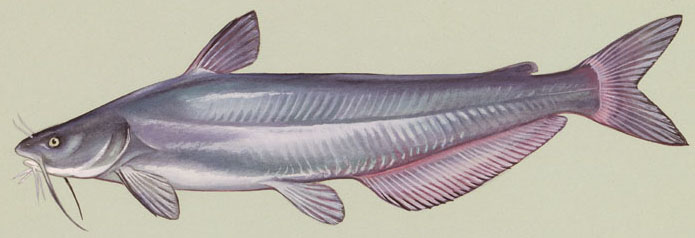 🇺🇸 United StatesBlue catfish
A large North American catfish known for its size and invasive spread in eastern US waters.Catfish · Rivers and lakes
 🇧🇷 Brazil and 4 moreRedtail catfish
A large South American catfish known for its red tail and popularity in the aquarium trade.Catfish · Rivers and lakes
More from Siluridae
All of them 🇧🇩 Bangladesh and 4 moreButter catfish
Asian sheatfish valued for delicate flesh and fish balls.Catfish · Rivers and lakes
 🇧🇩 Bangladesh and 4 morePabdah catfish
Small spotted freshwater catfish from South AsiaCatfish · Rivers and lakes
 🇺🇦 Ukraine and 4 moreWels catfish
A large freshwater catfish native to Europe and Western Asia, known for its size and bottom-feeding habits.Catfish · Rivers and lakes · 1758
 🇯🇵 JapanGiant Lake Biwa catfish
Large predatory catfish endemic to Lake Biwa in JapanCatfish · Rivers and lakes · 1961