
Pangas catfish
Large shark catfish from South Asian rivers and estuaries.
The Pangas catfish is a large species native to fresh and brackish waters in Bangladesh, India, and Pakistan. It supports commercial fisheries and aquaculture in Southeast Asia despite facing pressure from overfishing and habitat loss in its home range.
- Grows up to 300 cm in standard length
- Breeds in estuaries during the rainy season
- Farmed in Thailand, Cambodia, and Vietnam
- Listed as Least Concern by IUCN
- Native to India, Bangladesh, and Pakistan
What it is
This fish belongs to the shark catfish family. It grows very large, reaching between 150 and 300 centimetres in standard length. The body features a dorsal fin with two spines and seven soft rays. Its anal fin contains 29 to 32 soft rays. The eyes are small relative to its head size. The tail fins, known as caudal fins, are yellow in colour. It is a substantial freshwater and brackish water species found in South Asia.
Where it lives
The species inhabits fresh and brackish environments across Bangladesh, India, and Pakistan. It also occurs in Nepal. Reports of its presence in Myanmar and Southeast Asia were errors caused by misidentifying other similar species. It lives in rivers, lakes, estuaries, and coastal waters. This tolerance for varying salinity allows it to move between inland waterways and the sea.
How it lives
Its diet includes plant matter, shrimps, mollusks, and worms. While populations remain robust overall, numbers are dropping in major river systems like the Ganges and Brahmaputra. Overfishing for food and sport contributes to this decline. Pollution and dam construction further threaten its habitat. Despite these local pressures, the global population size keeps it listed as least concern.
Breeding and life cycle
Spawning takes place in estuaries. This reproductive activity coincides with the rainy season. The mixing of fresh and salt water in these zones provides the necessary conditions for breeding. Specific details on egg count or larval development are not provided in the available records.
Fish and people
It is a commercially important fish taken for food and sport fishing. Aquaculture operations farm this species in Thailand, Cambodia, and Vietnam. In its native range, heavy fishing pressure has reduced wild stocks. Dams and pollution add to the challenges faced by wild populations. It remains a key resource for local fisheries despite these environmental stresses.
Status and threats
The International Union for Conservation of Nature lists it as least concern. This classification reflects its continued robust population size across its range. However, declines are evident in specific areas such as the Ganges and Brahmaputra rivers. Threats include overfishing, habitat alteration from dams, and water pollution. Conservation efforts must address these localised pressures to maintain healthy stocks.
Questions people ask about Pangas catfish
How big does the Pangas catfish get?
It grows to a standard length of 150 to 300 centimetres. This makes it one of the larger freshwater catfish species in its native range.
Where does this fish live?
It is native to fresh and brackish waters in Bangladesh, India, and Pakistan. It also occurs in Nepal and lives in rivers, lakes, estuaries, and coastal areas.
Is it farmed for food?
Yes, it is commercially important. While wild populations face pressure, the species is farmed in Thailand, Cambodia, and Vietnam to meet market demand.
What does it eat?
Its diet consists of plants, shrimps, mollusks, and worms. It is an omnivore that feeds on both vegetation and small aquatic animals.
Good reading and sources
- Pangasius pangasius on WikipediaEncyclopedia
- More photos on Wikimedia CommonsPhotos
- Wikidata recordOpen data
The facts on this page come from the Wikipedia article "Pangasius pangasius", written by its contributors and used under the CC BY-SA 4.0 licence, and from its Wikidata record (CC0). EveryFish rewrote the text in its own words, with AI assistance, and compares every page with the article to make sure no passage is copied. It may be reused under the same CC BY-SA 4.0 licence with a link back.
It may contain mistakes, and figures change over time. Nothing here is investment or buying advice. If something is wrong, tell us. Last refreshed 2026-11-15.
Like Pangas catfish
All catfishes 🇺🇸 United States and 2 moreChannel catfish
A widespread North American freshwater catfish, prized for food and sport.Catfish · Rivers and lakes · 1819
 🇺🇸 United StatesBrown bullhead
A hardy North American catfish known for surviving poor water conditions.Catfish · Rivers and lakes · 1819
 WorldGiant catfish
Large estuarine catfish found across the Indo-Pacific.Catfish · Estuaries and mangroves · 1837
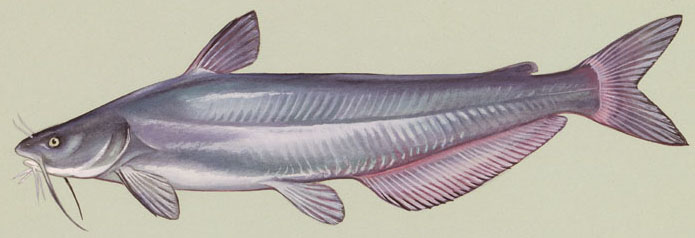 🇺🇸 United StatesBlue catfish
A large North American catfish known for its size and invasive spread in eastern US waters.Catfish · Rivers and lakes
More from Pangasiidae
All of them WorldPangasius
A genus of shark catfishes from South and Southeast Asia, widely farmed for food.Catfish · Rivers and lakes · 1822
 🇹🇭 Thailand and 2 moreGiant pangasius
A large freshwater catfish from Southeast Asia, now critically endangered due to overfishing and habitat loss.Catfish · Rivers and lakes · 1931
 🇹🇭 Thailand and 4 moreMekong giant catfish
A massive freshwater fish native to the Mekong basin, now critically endangered.Catfish · Rivers and lakes