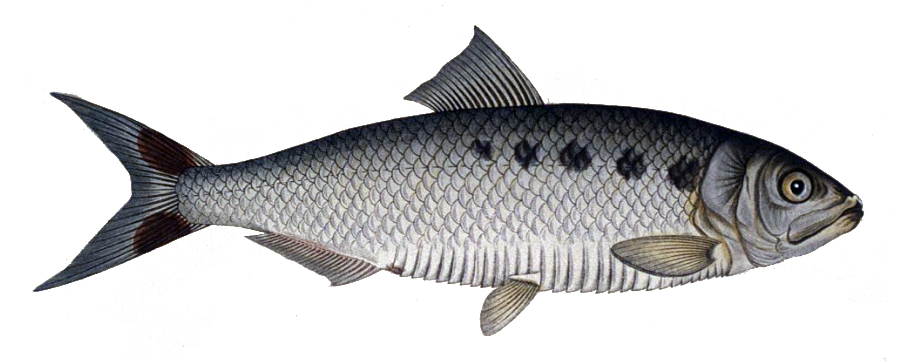
Allis shad
Anadromous Atlantic fish with a dark gill spot.
The allis shad is a migratory fish that lives in the sea but swims up rivers to breed. It inhabits the eastern Atlantic and parts of the Mediterranean. Overfishing and habitat loss have caused severe population drops, leading to critical endangerment status.
- Has a distinctive dark spot behind the gill cover.
- Migrates from sea to rivers to spawn once.
- Listed as critically endangered in 2024.
- Protected under European Community directives.
What it is
This fish belongs to the herring family and shares a similar shape. It lacks a lateral line and has a rounded belly with large scales. The back appears bluish-green, while the head is brownish with a golden tint on the gill cover. Flanks are silvery, often with a bronze hue. A key feature is a large dark spot behind the gill cover, sometimes followed by smaller spots. Adults usually measure between 30 and 60 centimetres.
Where it lives
The species inhabits the eastern Atlantic Ocean, ranging along European coasts and northwestern Africa. It enters the western Baltic Sea and the western Mediterranean. Breeding groups no longer exist in Morocco or Mediterranean Spain. The fish is becoming rare in France and other areas within its historical range.
How it lives
These fish spend most of their lives feeding in the sea. They are anadromous, meaning they migrate from saltwater to freshwater to reproduce. Some records suggest they can adapt to landlocked environments. They live alongside twaite shad and may hybridise with them. Juveniles face challenges adjusting to salinity changes when moving through brackish estuaries.
Breeding and life cycle
Sexual maturity occurs between three and seven years of age. Migration to spawning grounds happens from April to June. Most individuals reproduce only once before dying. Young fish appear in estuaries during July and August. The stay in these brackish zones can last up to six months as they prepare for sea life.
Fish and people
Historically, this fish was caught for food. Conservation efforts now limit fishing. France has imposed a moratorium in many watersheds since 2008. The species is protected under the Bern Convention and European Community Habitats Directive. Special conservation areas in Ireland protect known spawning sites.
Status and threats
Populations have dropped sharply due to overfishing, pollution, and habitat damage. Siltation and gravel mining destroy spawning beds. Dams block migration routes, forcing downstream spawning and increasing hybridisation risks. Climate change may further shrink their range. The IUCN listed it as critically endangered in 2024 after an 80 per cent global decline.


Questions people ask about Allis shad
What does an allis shad look like?
It resembles a herring with a bluish-green back and silvery flanks. A large dark spot sits behind the gill cover, sometimes with smaller spots following it. It has no lateral line and large scales.
Where do allis shad live?
They live in the eastern Atlantic Ocean, western Baltic Sea, and western Mediterranean. They migrate into rivers and estuaries to spawn but spend most of their lives at sea.
Why is the allis shad endangered?
Overfishing, pollution, and habitat destruction have reduced numbers. Dams block migration, and siltation harms spawning grounds. The global population fell by about 80 per cent in twenty years.
Good reading and sources
The facts on this page come from the Wikipedia article "Allis shad", written by its contributors and used under the CC BY-SA 4.0 licence, and from its Wikidata record (CC0). EveryFish rewrote the text in its own words, with AI assistance, and compares every page with the article to make sure no passage is copied. It may be reused under the same CC BY-SA 4.0 licence with a link back.
It may contain mistakes, and figures change over time. Nothing here is investment or buying advice. If something is wrong, tell us. Last refreshed 2026-11-15.
Like Allis shad
All herrings and sardines 🇮🇪 IrelandTwait shad
Anadromous herring-like fish with flank spotsHerring · Rivers and lakes
 🇹🇷 Turkey and 4 moreAnchovy
Small, oily forage fish found in oceans and some rivers worldwide.Herring · Coasts and shelves
 🇺🇸 United States and 1 moreAlewife
A small North American herring that migrates between sea and rivers.Herring · Coasts and shelves
 🇺🇸 United States and 2 moreAmerican gizzard shad
A silvery freshwater forage fish with a muscular gizzard.Herring · Rivers and lakes

