
Yellowtail scad
Small coastal jack of the Indo-Pacific with distinctive yellow fins.
The yellowtail scad is a small marine fish in the jack family, found across tropical Indo-Pacific waters. It supports local fisheries and is valued as food in Southeast Asia, where it is caught by nets and lines.
- Only member of the genus Atule
- Has a transparent adipose eyelid over the eye
- Reaches a maximum length of 30 cm
- Females release up to 161,000 eggs per batch
- Found from East Africa to Hawaii
What it is
This fish has an oval, compressed body similar to other scads. It features two dorsal fins, with the second having soft rays that end in finlet-like extensions. A key trait is the adipose eyelid, a transparent cover over the eye with a vertical slit for the pupil, which develops once the fish exceeds 10 cm. The upper body is olive green, fading to gold and then silver-white below. Faint grey bars run down its sides, and a black spot sits near the gill cover. The tail and dorsal fins are greenish-yellow.
Where it lives
It lives in tropical and subtropical zones of the Indo-Pacific. In the Indian Ocean, it ranges from South Africa up the east coast, including Madagascar, to the Red Sea and India. In the Pacific, it is common in Southeast Asia and Indonesia, extending to northern Australia and Hawaii. Records in Japan are rare. The fish stays in coastal waters, often schooling in bays with mangroves or over reefs at depths up to 80 metres.
How it lives
Young fish gather around floating objects like jellyfish or manmade structures. As they grow, their diet shifts. Juveniles under 150 mm mainly eat crustaceans, while larger adults prey almost entirely on small fish. They are pelagic predators that hunt in schools. The species is active in inshore waters, moving between natural and artificial shelters depending on availability.
Breeding and life cycle
Spawning occurs in open bay areas at least 10 metres deep. In Hawaii, this happens mostly between March and October, with significant yearly variation. Most spawning takes place in the morning. Females release batches of 63,000 to 161,000 eggs. The breeding stock in these bays is predominantly male. Egg and larval development has been documented in detail by researchers.
Fish and people
Fisheries target this species across its range using beach seines, gill nets, and hook-and-line methods. In Southeast Asia, it forms a large part of the pelagic catch, particularly from January to April. It is a prized food fish in some regions, prepared by boiling, steaming, frying, or drying and salting. Catch data from Saudi Arabia showed nearly 1,000 tonnes taken in 2001.


Questions people ask about Yellowtail scad
What does the yellowtail scad eat?
Diet changes with age. Juveniles between 91 and 150 mm feed mainly on crustaceans. Adults larger than 151 mm prey almost exclusively on small fish.
Where can I find yellowtail scad?
They are widespread in the Indo-Pacific, from East Africa and the Red Sea to Hawaii. They inhabit coastal bays, mangroves, and coral reefs up to 80 metres deep.
How big do yellowtail scad get?
It is a small species compared to other jacks. The maximum recorded length is 30 cm, but they are more commonly encountered at around 20 cm.
Is yellowtail scad good to eat?
Yes, it is a prized food fish in parts of Southeast Asia. It is prepared by boiling, steaming, frying, or preserved by drying and salting.
Good reading and sources
- Yellowtail scad on WikipediaEncyclopedia
- More photos on Wikimedia CommonsPhotos
- Wikidata recordOpen data
The facts on this page come from the Wikipedia article "Yellowtail scad", written by its contributors and used under the CC BY-SA 4.0 licence, and from its Wikidata record (CC0). EveryFish rewrote the text in its own words, with AI assistance, and compares every page with the article to make sure no passage is copied. It may be reused under the same CC BY-SA 4.0 licence with a link back.
It may contain mistakes, and figures change over time. Nothing here is investment or buying advice. If something is wrong, tell us. Last refreshed 2026-11-15.
Like Yellowtail scad
All other fish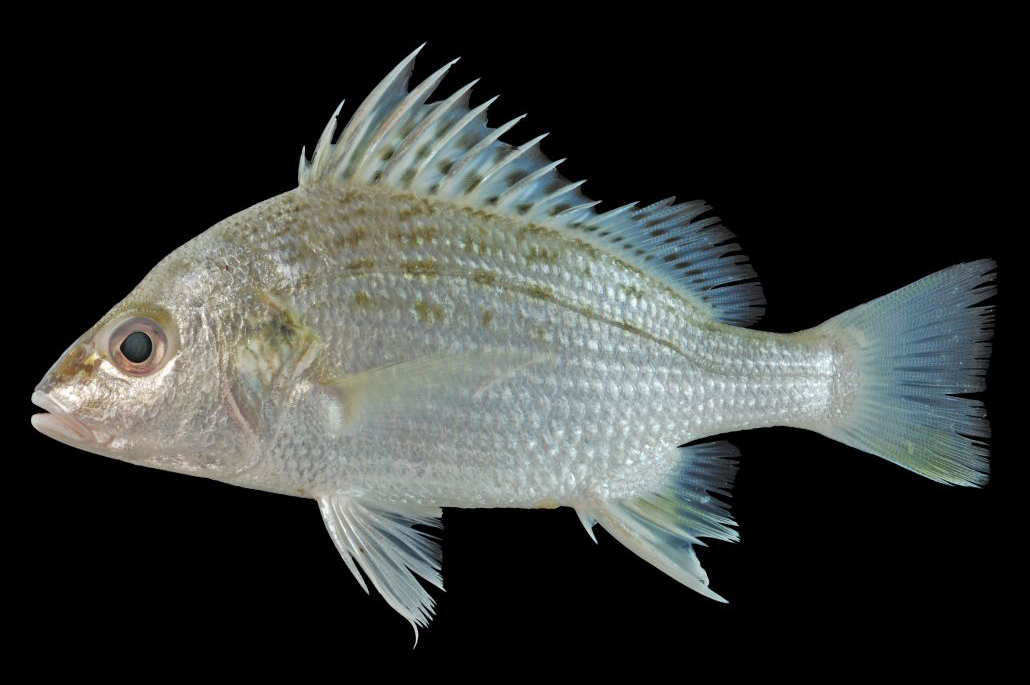 WorldJavelin grunter
A marine grunt found in the Indo-Pacific coastal waters.Other · Coasts and shelves · 1830
 WorldBigeye trevally
A large marine fish found in tropical oceans, known for its nocturnal hunting and distinctive dark dorsal fin.Other · Coasts and shelves · 1825
 WorldOrange-spotted grouper
A large Indo-Pacific marine fish prized for its flesh and known for changing sex.Other · Coasts and shelves · 1822
 WorldGreater amberjack
Large predatory jack found in warm seas worldwide.Other · Coasts and shelves · 1810
More from Carangidae
All of them 🇦🇺 Australia and 1 moreYellowtail amberjack
Large pelagic fish of the Southern Hemisphere oceansOther · Coasts and shelves · 1833
 WorldBluefin trevally
Large tropical marine predator with electric blue finsPerch-like · Coasts and shelves · 1833
 WorldBigeye scad
Tropical marine fish with large eyes and metallic blue skinOther · Coasts and shelves · 1793
 WorldShrimp scad
Tropical jack with a yellow tail found on reefs.Other · Coasts and shelves · 1775