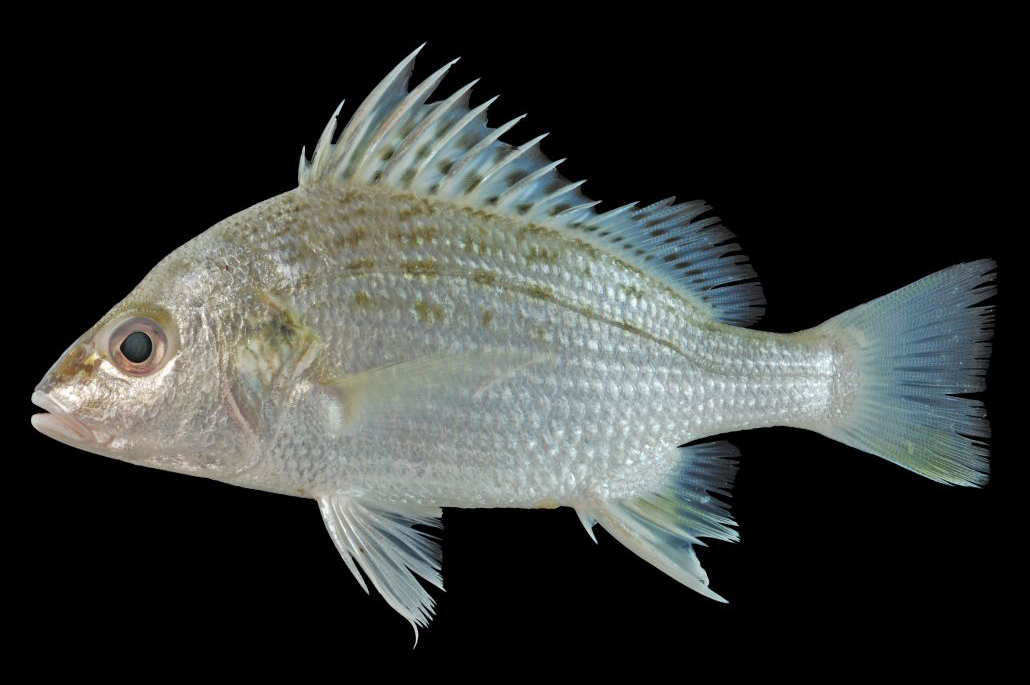
Javelin grunter
A marine grunt found in the Indo-Pacific coastal waters.
The javelin grunter is a marine fish native to the Indian and Pacific Oceans. It lives in coastal turbid waters and reefs from Africa to Australia. Fishers target it for food in regions like the Persian Gulf.
- Reaches a maximum length of 80 cm
- Found in turbid coastal waters and reefs
- Important commercial fish in the Persian Gulf
- Tolerates low salinity in estuaries
- Spawns in shoals near river mouths
What it is
The javelin grunter is a ray-finned marine fish belonging to the grunt family. It features a blunt head with a convex upper profile and a small mouth lined with brushlike teeth bands. Two pores and a central pit mark its chin. Adults display a plain golden green back and silver belly, while juveniles show bright silvery green backs with indistinct vertical bars made of dark spots. The dorsal fin contains twelve spines and thirteen to fifteen soft rays.
Where it lives
This species inhabits the Indo-Pacific region. Its range extends along the eastern African coast from the Red Sea to the Eastern Cape. It is present in the Persian Gulf and along southern Asia to China and Taiwan. In Australia, it lives along northern coasts from Exmouth Gulf to Moreton Bay. Island populations exist in the Comoro Islands, Madagascar, Seychelles and Farquhar Islands.
How it lives
These fish prefer turbid coastal waters with sandy or muddy substrates. They tolerate low salinity and enter estuarine environments. Individuals are often found near inshore shipwrecks, coral reefs and rocky reefs. They feed primarily on crustaceans but also consume fishes, molluscs, brittle stars, Lingula species and algae. They can dwell at depths reaching seventy-five metres.
Breeding and life cycle
Spawning occurs during the winter months. The fish form distinct pairs to reproduce and gather in shoals near river mouths. They are oviparous, meaning they lay eggs rather than giving birth to live young. This behaviour takes place in specific coastal zones where freshwater meets the sea.
Fish and people
Commercial fisheries target this species throughout the Persian Gulf. Fishers use bottom trawls, longlines, gillnets and traps to catch them. It is also taken as bycatch in shrimp fisheries. The catch is sold fresh or preserved through salting and smoking. It serves as an important food source in these regions.
Questions people ask about Javelin grunter
Where does the javelin grunter live?
It lives in the Indo-Pacific, from the Red Sea and eastern Africa to Australia and China. It prefers coastal turbid waters with sand or mud bottoms.
What do javelin grunters eat?
Their diet consists largely of crustaceans. They also feed on fishes, molluscs, brittle stars, Lingula species and algae found in their habitat.
How are javelin grunters caught?
Fisheries use bottom trawls, bottom longlines, gillnets and traps. They are also caught as bycatch in shrimp fisheries, particularly in the Persian Gulf.
Good reading and sources
- Pomadasys kaakan on WikipediaEncyclopedia
- More photos on Wikimedia CommonsPhotos
- Wikidata recordOpen data
The facts on this page come from the Wikipedia article "Pomadasys kaakan", written by its contributors and used under the CC BY-SA 4.0 licence, and from its Wikidata record (CC0). EveryFish rewrote the text in its own words, with AI assistance, and compares every page with the article to make sure no passage is copied. It may be reused under the same CC BY-SA 4.0 licence with a link back.
It may contain mistakes, and figures change over time. Nothing here is investment or buying advice. If something is wrong, tell us. Last refreshed 2026-11-15.
Like Javelin grunter
All other fish WorldOrange-spotted grouper
A large Indo-Pacific marine fish prized for its flesh and known for changing sex.Other · Coasts and shelves · 1822
 WorldHarry hotlips
A reef fish with swollen lips and leaf-like juveniles.Other · Coasts and shelves · 1802
 WorldShrimp scad
Tropical jack with a yellow tail found on reefs.Other · Coasts and shelves · 1775
 WorldOrbicular batfish
A round, silvery marine fish native to the Indo-Pacific.Other · Coasts and shelves
