
Tilapia
Common name for nearly a hundred species of cichlid fish native to Africa and the Middle East.
Tilapia refers to many species of freshwater cichlids from Africa and the Middle East. They are vital for artisanal fishing and global aquaculture due to their hardiness and fast growth.
- Pharyngeal jaws act as a second set of teeth for crushing food.
- Farmed tilapia production reached 1.5 million tonnes annually in 2002.
- They are mouth-brooders, carrying eggs and young in their mouths.
- Listed as one of the world's worst invasive alien species.
- Native to Africa and the Middle East, requiring warm water.
What it is
Tilapia is the shared name for roughly one hundred species within the cichlid family. These fish possess deep, laterally compressed bodies that allow them to navigate shallow waters with ease. Their most distinctive feature is a specialized set of pharyngeal jaws located in the throat. These bones fuse into a tooth-bearing structure that acts as a second pair of jaws, enabling the fish to crush and process food efficiently alongside their standard mouth jaws. Most species display a long dorsal fin and a lateral line that may break near the tail. While they vary in colour, some commercial strains have been bred for lighter flesh. They typically reach lengths of up to sixty centimetres.
Where it lives
These fish originate from Africa and the Middle East. They inhabit shallow streams, rivers, ponds, and lakes. Some species tolerate brackish water, such as the extreme conditions found in the Salton Sea where salt levels would kill other marine life. They require warm water and cannot survive in temperate climates, dying at temperatures between seven and seventeen degrees Celsius. Consequently, they remain confined to tropical and subtropical regions unless introduced artificially into heated environments like power plant discharge zones.
How it lives
Tilapia are efficient omnivores capable of eating algae, duckweed, and filamentous bacteria. This diet allows them to thrive in polluted or low-oxygen environments where other fish might struggle. They are known to consume mosquito larvae, which has led to their use in biological control programmes. In the wild, they often form schools. Predators include larger fish and birds. The fish exhibit mouth-brooding behaviour, carrying fertilized eggs and young fry in their mouths for several days after the yolk sac is absorbed. This protective strategy increases the survival rate of the offspring in turbulent waters.
Breeding and life cycle
Tilapia are prolific breeders, which can lead to rapid population growth if not managed. Commercial farms often produce only male fish to prevent overpopulation and ensure faster growth, as males mature quicker than females. This is achieved through hormonal treatment of fry or by using hybrid stock. Natural spawning involves the female carrying eggs in her mouth until they hatch. The young remain protected there for a short period before becoming independent. Selective breeding programmes have developed strains with improved cold tolerance and specific flesh colours.
Fish and people
Tilapia have been consumed for thousands of years, featuring prominently in Ancient Egyptian art and beliefs associated with rebirth. They are a staple in African artisanal fisheries and are widely farmed globally. In the United States, they are the fourth-most consumed fish, valued for their mild taste and low cost. They are commonly fried or broiled. The fish is also popular in the Philippines and Taiwan, where selective breeding has created local strains. Due to their adaptability, they are sometimes used in aquaponics systems. However, their introduction to new habitats has raised concerns about their impact on local ecosystems.
Status and threats
While native populations are generally stable, tilapia are listed among the world's worst invasive alien species in many introduced regions. They disrupt native ecologies in tropical and subtropical areas by outcompeting local fish for resources. In countries like Australia, South Africa, and parts of the United States, they are considered problematic invaders. Conservation efforts focus on preventing further spread rather than protecting the fish itself. In their native range, they face pressure from overfishing and habitat degradation, but their hardiness ensures their continued economic importance in aquaculture.


Questions people ask about Tilapia
What does the name tilapia mean?
The name comes from the Tswana word tlhapi, meaning fish, or potentially Greek roots referring to a distant fish. Scottish zoologist Andrew Smith established the genus name in 1840 based on these linguistic origins.
Why are tilapia considered invasive?
They reproduce rapidly and outcompete native species for food and space in tropical and subtropical habitats. Their ability to survive in poor water quality allows them to establish populations easily, disrupting local ecosystems in places like the United States and Australia.
Are tilapia good for human health?
They are a lean source of protein with low mercury levels. However, they contain lower omega-3 fatty acids and higher omega-6 fatty acids compared to other fish. Farming techniques can adjust their feed to improve their nutritional profile.
How do farmers control tilapia populations?
Commercial farms often produce all-male stocks because males grow faster and do not breed. This is achieved by adding hormones to feed or using hybrid species. This prevents the rapid population increase that occurs when females are present.
Good reading and sources
The facts on this page come from the Wikipedia article "Tilapia", written by its contributors and used under the CC BY-SA 4.0 licence, and from its Wikidata record (CC0). EveryFish rewrote the text in its own words, with AI assistance, and compares every page with the article to make sure no passage is copied. It may be reused under the same CC BY-SA 4.0 licence with a link back.
It may contain mistakes, and figures change over time. Nothing here is investment or buying advice. If something is wrong, tell us. Last refreshed 2026-11-15.
Like Tilapia
All cichlids 🇿🇦 South Africa and 4 moreMozambique tilapia
A hardy cichlid from southeastern Africa, now farmed globally and listed as a major invasive species.Cichlid · Rivers and lakes
 🇪🇬 Egypt and 4 moreNile tilapia
A hardy cichlid farmed globally for food.Cichlid · Rivers and lakes · 1758
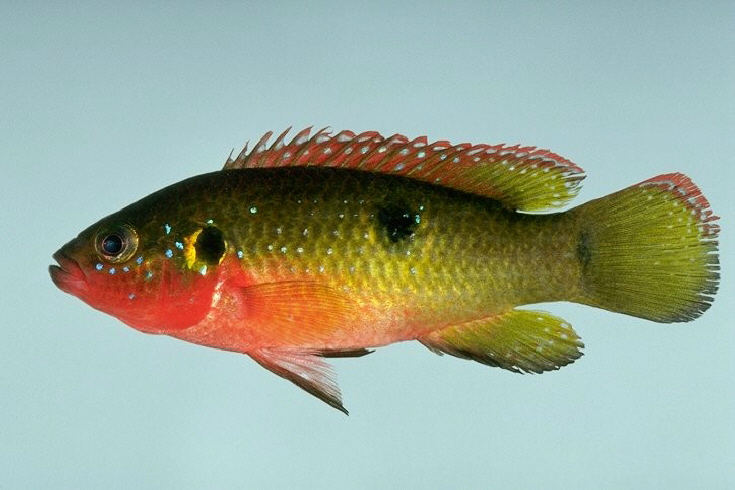 Sub-Saharan AfricaJewel cichlid
Brightly colored African cichlids kept in aquariums for their vivid breeding colours and parental care.Cichlid · Rivers and lakes
 WorldCichlid
Diverse freshwater fish family known for parental care and rapid evolution.Cichlid · Rivers and lakes · 1835
More from Cichlidae
All of them 🇧🇷 BrazilDiscus
Round, colourful cichlids from the Amazon basin.Cichlid · Rivers and lakes · 1840
 WorldUaru
A large South American cichlid from clear Amazon streams.Cichlid · Rivers and lakes · 1840
 🇧🇷 Brazil and 3 moreOscar
Large South American cichlid popular in aquariumsCichlid · Rivers and lakes · 1831
🇧🇷 BrazilPterophyllum
A genus of laterally compressed freshwater cichlids known as angelfish.Cichlid · Rivers and lakes · 1824