
Spiny dogfish
A temperate shark with dorsal spines and a long lifespan, heavily fished for food.
The spiny dogfish is a well-known shark species found in temperate waters worldwide. It has declined significantly due to overfishing but shows signs of recovery in some regions after management measures were introduced.
- Dorsal spines secrete mild venom for defense against predators.
- Gestation period lasts 18 to 24 months, one of the longest in animals.
- Stocks in the Northeast Atlantic declined by at least 95% due to overfishing.
- Males mature at 10 years; females take 16 years to reach sexual maturity.
- Meat is sold as huss in England and small salmon in France.
What it is
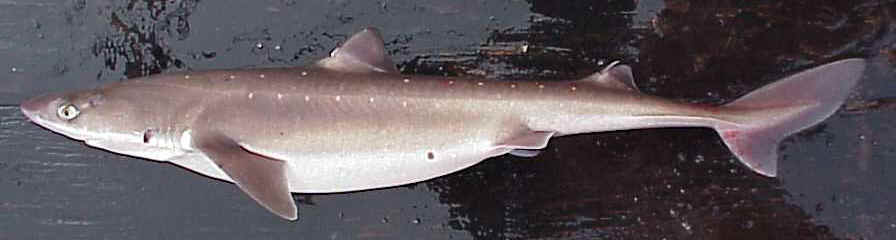
The spiny dogfish is a greyish brown shark with countershading. It has two sharp spines in front of its dorsal fins that secrete mild venom for defense. White spots cover its back, and it lacks an anal fin. Its tail is asymmetrical, known as heterocercal. Adults reach about 84 centimetres in length. This species lives in shallow coastal areas and further out at sea across most of the world's temperate zones.
Where it lives
It inhabits boreal-temperate waters globally. Most are found in the epipelagic zone at depths between 50 and 149 metres. Records show they can dive deeper than 700 metres. Northern Pacific populations are now classified as a distinct species called the Pacific spiny dogfish. They prefer cooler waters and are bottom-dwelling sharks.
How it lives
These sharks hunt in large packs numbering up to thousands. They are aggressive feeders consuming squid, fish, crabs, jellyfish, and other invertebrates. Their growth pattern is isometric, meaning young resemble adults. Males mature around ten years old at 60–65 cm. Females take sixteen years to mature, reaching 80–84 cm. They live on average thirty to forty years, though some reach seventy.
Breeding and life cycle
Reproduction occurs in winter in offshore waters. Gestation lasts eighteen to twenty-four months, one of the longest among organisms. Females produce large yellow eggs wrapped in a capsule called a candle. Pups develop inside the uterus, absorbing nutrients from a yolk sac. Litters contain two to twelve live young, averaging five or six depending on female size.
Fish and people
Spiny dogfish meat is sold in Europe, North America, New Zealand, and South America. In England, it is called huss and used in fish and chips. French markets call it small salmon, while German and Belgian sellers label it sea eel. Fins are processed into needles for shark fin soup. Bodies are ground for fertilizer, liver oil, and pet food. They are also popular dissection specimens in schools.
Status and threats
Populations have dropped sharply due to overfishing driven by European demand. The IUCN lists them as Vulnerable globally and Critically endangered in the Northeast Atlantic, where stocks fell by ninety-five percent. Management includes total allowable catch limits and minimum landing sizes. EU waters saw targeted fishing end in 2011. Recent assessments indicate recovery in EU and UK waters by 2023, allowing commercial fishing to resume.


Questions people ask about Spiny dogfish
What makes the spiny dogfish dangerous to handle?
It has two sharp spines before each dorsal fin. If captured, it arches its back to pierce handlers. These spines release a mild venom that causes pain and irritation to predators or fishermen.
How long does a spiny dogfish live?
They live an average of thirty to forty years. Some individuals have been observed living nearly seventy years. Age is determined by counting rings in vertebrae and dorsal spine centra.
Why is the spiny dogfish considered vulnerable?
Overfishing for European markets caused severe population declines. Stocks in the Northeast Atlantic dropped by ninety-five percent. Slow maturation and late reproduction make recovery difficult without strict management.
What are the common names for spiny dogfish meat?
In England, it is called huss or previously rock salmon. French markets sell it as saumonette. Belgium and Germany label it zeepaling and Seeaal. Greece calls it galéos, confusing it with another shark.
Good reading and sources
- Spiny dogfish on WikipediaEncyclopedia
- More photos on Wikimedia CommonsPhotos
- Wikidata recordOpen data
The facts on this page come from the Wikipedia article "Spiny dogfish", written by its contributors and used under the CC BY-SA 4.0 licence, and from its Wikidata record (CC0). EveryFish rewrote the text in its own words, with AI assistance, and compares every page with the article to make sure no passage is copied. It may be reused under the same CC BY-SA 4.0 licence with a link back.
It may contain mistakes, and figures change over time. Nothing here is investment or buying advice. If something is wrong, tell us. Last refreshed 2026-11-15.
Like Spiny dogfish
All sharks WorldSmooth hammerhead
Temperate hammerhead shark with a curved head marginShark · Coasts and shelves · 1758
 WorldBasking shark
The second-largest living fish, a slow-moving filter feeder found in temperate oceans worldwide.Shark · Coasts and shelves · 1765
 WorldPorbeagle
A fast, cold-water mackerel shark found in the Atlantic and Southern Hemisphere.Shark · Coasts and shelves · 1788
 WorldCommon thresher
The largest thresher shark, known for its whip-like tail used to stun prey in cool coastal and open waters.Shark · Coasts and shelves · 1788