
Reef triggerfish
Hawaii’s official state fish with a pig-like snout
The reef triggerfish is a colourful coral reef inhabitant found across the Pacific and Indian Oceans. It is famous for its long Hawaiian name and status as the official state fish of Hawaii since 2006.
- Official state fish of Hawaii since 2006
- Produces grinding, drumming, and snapping sounds
- Can swim backwards and hover in place
- Named after a Hawaiian pig god legend
- Tolerates low oxygen levels in warming reefs
What it is
This fish belongs to the triggerfish family and grows up to 30 centimetres long. It has a distinctive orange-brown back, white belly, and blue lips that resemble a pig’s snout. A small second dorsal spine locks the main spine upright, helping it wedge into crevices for protection. Its thick skin and strong teeth are adapted for scraping food from hard surfaces.
Where it lives
It inhabits coral reefs across the Western and Eastern Central Pacific Oceans. Its range extends through the Indian Ocean and into the Southeast Atlantic. These fish live in shallow waters, typically found at depths between zero and fifty metres. They prefer areas near living coral or sandy floors where they can forage safely.
How it lives
The reef triggerfish is a facultative omnivore, eating algae and small crustaceans like isopods. It uses its terminal mouth to scrape food off rocks and sand. This species produces four distinct sounds: grinding, drumming, grunting, and snapping. Drumming helps deter predators, while grinding signals territory ownership. It swims using flexible dorsal and anal fins, allowing it to hover or move backwards.
Breeding and life cycle
Males and females are both territorial. Males establish dominance to access multiple mates in a harem system, while females select spawning sites based on food availability and safety. Females invest energy in reaching maturity early, resulting in smaller sizes compared to males. Males focus more on physical growth to defend their territories and mates.
Fish and people
In 1985, it became the official fish of Hawaii, a title reinstated permanently in 2006. Hawaiian mythology links it to the pig god Kamapuaʻa, who transformed into the fish after a battle with the goddess Pele. Its thick skin symbolises armour against her waves. The fish appears in songs, films, and television shows, often referenced by its long Hawaiian name.
Status and threats
The International Union for Conservation of Nature lists it as Least Concern. However, climate change poses a threat to its coral reef habitat. Rising temperatures can lower oxygen levels in the water. Studies suggest this species can tolerate high levels of hypoxia, which may help it survive changing conditions better than other reef dwellers.


Questions people ask about Reef triggerfish
What does the Hawaiian name mean?
Humuhumunukunukuāpuaʻa translates to 'triggerfish with a snout like a pig'. It refers to the fish's prominent snout and blue lips. Locals often shorten it to humuhumu for ease of use.
Why does it make noise?
It creates sounds to communicate. Grinding signals territory ownership to other fish. Drumming vibrations warn off predators. Snapping occurs during conflicts with other triggerfish. These noises are produced using fins and jaw movements.
Is it dangerous to humans?
No, it is not considered dangerous. While it has strong teeth for scraping algae, it does not attack people. It is a popular subject for divers and aquarium enthusiasts due to its bright colours and unique behaviour.
Good reading and sources
- Reef triggerfish on WikipediaEncyclopedia
- More photos on Wikimedia CommonsPhotos
- Wikidata recordOpen data
The facts on this page come from the Wikipedia article "Reef triggerfish", written by its contributors and used under the CC BY-SA 4.0 licence, and from its Wikidata record (CC0). EveryFish rewrote the text in its own words, with AI assistance, and compares every page with the article to make sure no passage is copied. It may be reused under the same CC BY-SA 4.0 licence with a link back.
It may contain mistakes, and figures change over time. Nothing here is investment or buying advice. If something is wrong, tell us. Last refreshed 2026-11-15.
Like Reef triggerfish
All reef fish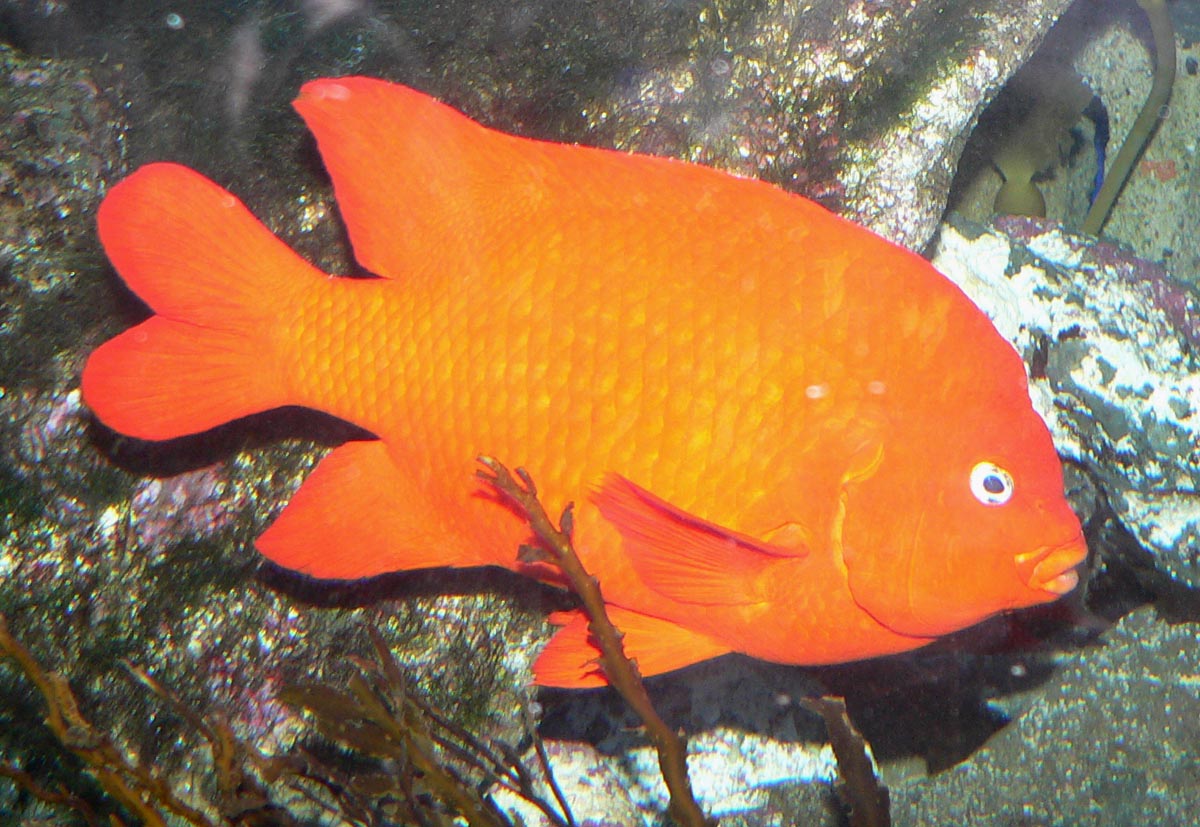 🇺🇸 United StatesGaribaldi
Bright orange damselfish and official marine state fish of California.Reef fish · Coasts and shelves · 1860
 WorldWhitetail dascyllus
A small Indo-Pacific reef fish with bold black and white stripes.Reef fish · Coasts and shelves
 WorldRegal blue tang
Bright blue reef fish with a yellow tail and black markings.Reef fish · Coral reefs
 WorldYellow boxfish
A bright yellow, cube-shaped reef fish with toxic mucus.Reef fish · Coasts and shelves · 1758
More from Balistidae
All of them WorldLagoon triggerfish
A small, territorial reef fish with precise swimming and maternal care.Reef fish · Coral reefs
 WorldQueen triggerfish
Large, colourful reef fish of the tropical Atlantic.Other · Coasts and shelves · 1758
 WorldClown triggerfish
A striking black and white reef fish with a locking dorsal spine.Other · Coral reefs · 1801
WorldTriggerfish
Armoured reef fish with a locking dorsal spineReef fish · Coasts and shelves · 1810