
Reef manta ray
Large coastal ray of the Indo-Pacific tropics
The reef manta ray is a large species of ray found in tropical and subtropical waters. It feeds on plankton near coasts and reefs. Scientists confirmed it as a distinct species in 2009. Overfishing for gill rakers has reduced its numbers significantly.
- Disc width reaches up to 5.5 metres
- Distinct Y-shaped head marking identifies species
- Largest brain ratio among cold-blooded fish
- Gestation period lasts 12 to 13 months
- Listed as Vulnerable due to overfishing
What it is
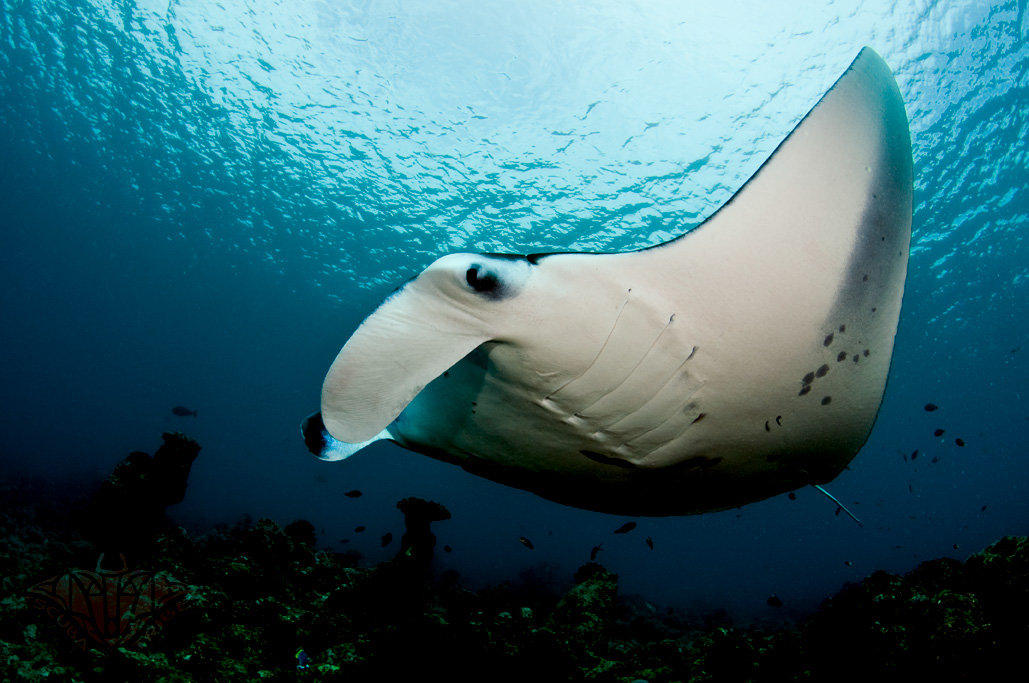
This ray has a flattened body with large triangular fins on each side. Two cephalic fins extend from the front. These structures roll into spirals for swimming or flare out to guide water into the mouth during feeding. The eyes and spiracles sit behind these fins. Five gill slits are located on the underside. A small dorsal fin sits on the back, and the tail is long and whip-like without a spine. The upper surface is dark blue or black with lighter patches on the head. The belly is white with unique spots that help identify individuals.
Where it lives
It lives in tropical and subtropical zones of the Indo-Pacific. Records exist for Hawaii, Fiji, French Polynesia, Micronesia, Bali, Komodo, Maldives, Mozambique, Australia, and the Philippines. Few sightings occur in the warm East Atlantic. It does not inhabit the West Atlantic or East Pacific. The animal stays near coasts, reefs, and islands. Short migrations follow zooplankton blooms. Cleaning and feeding sites remain close to shore.
How it lives
The ray filters seawater to catch zooplankton. It possesses the largest brain ratio among cold-blooded fish. Social communities form in specific populations. Individuals may dive to depths of 672 m to find food. Special blood vessels in the fins help manage heat in cold deep water. Escape speed reaches 24 km/h. Natural predators include tiger sharks, great hammerheads, bull sharks, false killer whales, and killer whales. Attacks may result in missing wing tips.
Breeding and life cycle
Females retain fertilized eggs inside the oviduct. Embryos feed on yolk initially, then on a milky secretion after hatching within the mother. No placental connection exists. Pups use buccal pumping for oxygen. Gestation lasts 12 to 13 months. Brood size is usually one, occasionally two. Newborns measure about 1.4 m in width and weigh 9 kg. They resemble adults and stay in shallow water for several years while growing.
Fish and people
Gill rakers are harvested for traditional Chinese medicine. Market demand drives fishing despite lack of scientific proof for medicinal value. The species holds cultural interest in regions like Hawaii where it is known as hāhālua. Photo identification projects help track individuals based on their unique ventral spot patterns. Captive breeding has occurred, including the birth of melanistic pups in aquariums.
Status and threats
The IUCN lists the species as Vulnerable. Populations have dropped sharply over the last twenty years. Low reproduction rates make recovery difficult. Females mature late and produce few offspring. Targeted fishing and bycatch cause significant harm. Conservation efforts focus on reducing demand for gill rakers and protecting key habitats.


Questions people ask about Reef manta ray
How can you tell a reef manta ray from an oceanic manta ray?
Look at the head markings. Reef mantas have a Y-shaped gradient of light patches on a dark background. Oceanic mantas have a T-shaped line between two distinct white areas. Reef mantas are also generally smaller and have different belly spot patterns.
What do reef manta rays eat?
They feed on zooplankton. They filter seawater through their large mouths using specialized gill rakers. Cephalic fins help channel water into the mouth while swimming or hovering near food sources.
Are reef manta rays dangerous to humans?
No, they do not have stinging spines or sharp teeth. Their tails are whip-like but lack the barbs found in stingrays. They are gentle filter feeders that pose no threat to swimmers or divers.
Why are reef manta rays vulnerable to extinction?
They grow slowly, mature late, and produce only one pup every few years. This low reproduction rate cannot compensate for losses from fishing. Demand for gill rakers in traditional medicine has increased hunting pressure significantly.
Good reading and sources
- Reef manta ray on WikipediaEncyclopedia
- More photos on Wikimedia CommonsPhotos
- Wikidata recordOpen data
The facts on this page come from the Wikipedia article "Reef manta ray", written by its contributors and used under the CC BY-SA 4.0 licence, and from its Wikidata record (CC0). EveryFish rewrote the text in its own words, with AI assistance, and compares every page with the article to make sure no passage is copied. It may be reused under the same CC BY-SA 4.0 licence with a link back.
It may contain mistakes, and figures change over time. Nothing here is investment or buying advice. If something is wrong, tell us. Last refreshed 2026-11-15.
Like Reef manta ray
All rays and skates WorldMangrove whipray
A spotted stingray of Indo-Pacific mangroves and reefs.Ray · Estuaries and mangroves · 1883
 WorldLionfish
Venomous marine fish of the genus Pterois known for striking stripes and invasive spread.Ray · Coral reefs · 1900
 WorldPink whipray
Large Indo-Pacific stingray with a long tail and pinkish hue.Ray · Coasts and shelves · 1906
 WorldChilean devil ray
A deep-diving oceanic ray with a boxy head.Ray · Open ocean
More from Mobulidae
All of them WorldGiant oceanic manta ray
The world's largest ray, a massive filter-feeding predator of tropical oceans.Ray · Coasts and shelves · 1827
 Latin America and the CaribbeanMunk's pygmy devil ray
Smallest devil ray in the eastern Pacific OceanRay · Coasts and shelves · 1987
 WorldDevil fish
A large Mediterranean ray with a spiny tail and horn-like flaps.Ray · Coasts and shelves
 WorldSpinetail mobula
Large pelagic ray with tail spines and cephalic hornsRay · Coasts and shelves