Redeye piranha
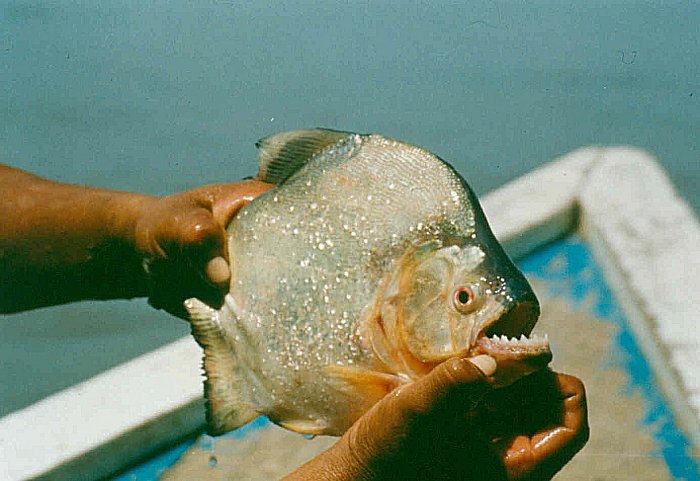
A large freshwater fish from South America with a rhombus-shaped body and red eyes.
The redeye piranha is the largest member of its genus and family. It inhabits major river systems in northern South America and feeds on plants, insects, and other fish.
- Largest species in the Serrasalmus genus.
- Body shape is distinctly rhombus-like.
- Eyes are always red regardless of body colour.
- Maximum recorded length is 61 centimetres.
- Feeds on plants, fruit, insects, and other fish.
What it is
This species stands out as the biggest fish within its group. Its body shape resembles a rhombus, giving it a distinct profile. Adults display solid colours ranging from grey to near black. Juveniles show mottled patterns that fade as they grow older. Regardless of body hue, the eyes remain red. Water clarity influences darkness; fish in Peru often appear jet black. The maximum recorded size reaches 61 centimetres in standard length. Typical adults measure about 32 centimetres. They can weigh up to three kilograms.
Where it lives
These fish inhabit northern South America, located east of the Andes mountains. Their range covers the Amazon and Orinoco drainage basins. They also live in the Essequibo River and other waterways across the Guiana Shield. Coastal rivers in northeastern Brazil host populations too. Historical records mention introductions to Florida, but these groups no longer exist there. The species thrives across diverse river environments within this broad geographic zone.
How it lives
Adults prefer deeper river channels and hunt near rapids or in deep stretches. Juveniles stay in calmer areas with dense vegetation. They act as opportunistic omnivores. Their diet includes plant matter, fallen fruits, insects, and smaller fish. They also nip scales and fins from other fish. Scavenging on carcasses is common behaviour. This species usually lives alone rather than in schools. They are not particularly sociable outside of breeding periods.
Breeding and life cycle
During reproduction, individuals become territorial. They guard a specific area surrounding their nest. The nest itself is constructed within thick aquatic vegetation. Detailed information regarding egg counts or larval development stages remains scarce in available records. Breeding behaviour focuses on site defence rather than complex social interactions.
Fish and people
Local communities may consume this fish as food. Its role in traditional diets varies by region. Scientific interest exists due to its status as the type species for its genus. Researchers study its taxonomy and potential species complex status. No significant aquarium trade presence is noted. Conservation efforts focus on habitat protection within its native range.
Status and threats
The International Union for Conservation of Nature lists this species as least concern. No immediate threats trigger higher risk categories. Population stability appears sufficient across its wide range. Habitat degradation could pose future risks. Current assessments do not indicate declining numbers requiring urgent intervention.


Questions people ask about Redeye piranha
What makes the redeye piranha unique?
It is the largest species in its genus and serves as the type species. Its rhombus-shaped body and consistent red eyes distinguish it from other piranhas. Adults turn dark grey or black, while juveniles are mottled.
Where does this fish live?
It inhabits northern South America east of the Andes. Major habitats include the Amazon, Orinoco, and Essequibo rivers. It also lives in Guiana Shield streams and northeastern Brazilian coastal rivers.
What does the redeye piranha eat?
They are omnivorous scavengers. Their diet includes plants, fallen fruits, insects, small fish, and fish scales. They also feed on animal carcasses found in the river.
How big do they get?
Standard length reaches up to 61 centimetres. Typical adults measure around 32 centimetres. Maximum weight recorded is 3.0 kilograms. Size varies based on local water conditions.
Good reading and sources
- Redeye piranha on WikipediaEncyclopedia
- More photos on Wikimedia CommonsPhotos
- Wikidata recordOpen data
The facts on this page come from the Wikipedia article "Redeye piranha", written by its contributors and used under the CC BY-SA 4.0 licence, and from its Wikidata record (CC0). EveryFish rewrote the text in its own words, with AI assistance, and compares every page with the article to make sure no passage is copied. It may be reused under the same CC BY-SA 4.0 licence with a link back.
It may contain mistakes, and figures change over time. Nothing here is investment or buying advice. If something is wrong, tell us. Last refreshed 2026-11-15.
Like Redeye piranha
All other fish 🇷🇺 Russia and 3 moreBurbot
A coldwater freshwater fish with a chin whisker, native to the Northern Hemisphere.Other · Rivers and lakes · 1758
 🇺🇸 United States and 2 moreGar
Ancient armored fish with lung-like swim bladders found in North American waters.Ancient · Rivers and lakes · 1758
 🇺🇸 United States and 2 moreLongnose gar
A primitive ray-finned fish with a long snout and armored scales found in North America.Other · Rivers and lakes · 1758
 🇺🇸 United States and 4 moreLargemouth bass
A large freshwater predator native to North America, prized by anglers and invasive in many regions.Other · Rivers and lakes · 1802
