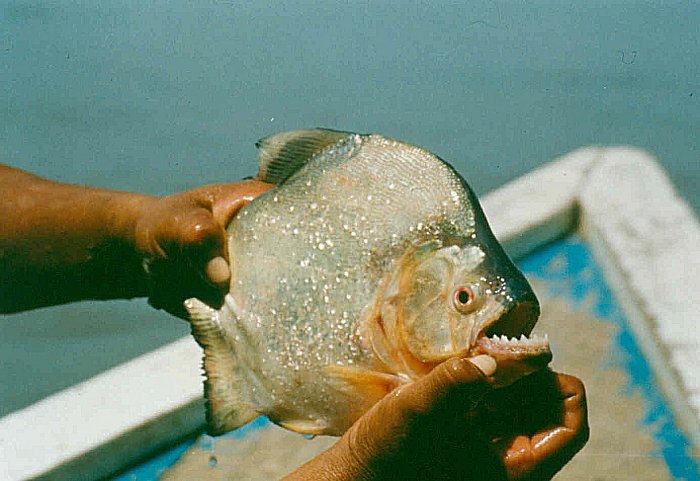
Tambaqui
A large freshwater fish from South America known for its heavy body and seed-eating habits.
The tambaqui is a large characin native to the Amazon and Orinoco basins. It plays a key role in dispersing seeds and is now widely farmed in tropical regions for food.
- Reaches weights of up to 44 kilograms.
- Disperses seeds from thirty-five percent of flood season trees.
- Can breathe atmospheric air when oxygen levels drop.
- Lives for up to sixty-five years.
- Hybridizes with Piaractus species in aquaculture.
What it is
The tambaqui is a substantial freshwater fish belonging to the characin family. It possesses a tall, laterally compressed body with a slightly arched back and large eyes. The lower half of its body is typically blackish, while the upper section varies from gray to olive depending on the water type. Unlike many related species, it has molar-like teeth designed for crushing hard plant materials rather than tearing flesh. This robust build makes it one of the heaviest scaled freshwater fish in South America.
Where it lives
This species originates from the Amazon and Orinoco river basins in tropical South America. It thrives in nutrient-rich whitewater rivers but is less common in blackwater streams. Fossil evidence indicates historical presence in western South America before Andean uplift. Today, human activity has expanded its range through introductions into Thailand, Puerto Rico, and various U.S. states where warm climates allow survival outside its native habitat.
How it lives
Adults generally live solitary lives but form large schools during migration periods. They spend the flood season in flooded forests before moving to main channels as waters recede. Their diet shifts with the seasons, relying heavily on fruits and seeds when available, and switching to zooplankton and insects during dry periods. They play a vital ecological role by consuming fallen fruit and dispersing viable seeds across the forest floor via their gut passage.
Breeding and life cycle
Spawning occurs in whitewater rivers between November and February. Adults migrate to these areas to reproduce along woody shores or grassy levees. Larvae develop in these nutrient-dense waters, while juveniles remain near macrophytes in floodplains until they reach sexual maturity at approximately sixty centimeters in length. The species can live for several decades, with some individuals reaching up to sixty-five years of age.
Fish and people
The tambaqui is highly valued in local markets for its meat, which commands premium prices. Wild stocks have suffered significantly from overfishing, leading to widespread adoption of aquaculture practices. In Brazil, it is a major farmed species due to its disease resistance and ability to thrive in low-oxygen environments. Hybrids with similar pacu species are also cultivated to improve temperature tolerance for farming operations.
Status and threats
Wild populations face pressure from intense fishing efforts, often resulting in the capture of immature fish. Conservation assessments classify the species as near threatened due to declining wild numbers. Management strategies increasingly focus on sustainable farming techniques to meet market demand without further depleting natural habitats. Genetic studies of farmed stocks suggest they maintain diversity comparable to wild counterparts.


Questions people ask about Tambaqui
What does a tambaqui eat?
During high-water seasons, their diet consists primarily of fruits and seeds, which can make up nearly ninety-eight percent of their intake. In lower water periods, they shift to eating zooplankton, insects, snails, and decaying plant matter to survive.
How big do tambaqui get?
They typically grow to about seventy centimeters in length. However, maximum recorded sizes reach one point one meters long and weigh forty-four kilograms, making them among the heaviest scaled freshwater fish in South America.
Why is the tambaqui important ecologically?
They act as crucial seed dispersers for numerous tree and liana species. By consuming fallen fruits and passing undamaged seeds through their digestive tracts, they help propagate plants across the Amazon basin after floodwaters recede.
Is the tambaqui safe to keep in an aquarium?
Juveniles are sold in the trade but require enormous tanks as they grow rapidly to massive sizes. They are not suitable for typical home aquariums due to their eventual adult dimensions and specific environmental needs.
Good reading and sources
The facts on this page come from the Wikipedia article "Tambaqui", written by its contributors and used under the CC BY-SA 4.0 licence, and from its Wikidata record (CC0). EveryFish rewrote the text in its own words, with AI assistance, and compares every page with the article to make sure no passage is copied. It may be reused under the same CC BY-SA 4.0 licence with a link back.
It may contain mistakes, and figures change over time. Nothing here is investment or buying advice. If something is wrong, tell us. Last refreshed 2026-11-15.
Like Tambaqui
All other fish Southeast AsiaGiant snakehead
A large freshwater predator from Southeast Asia known for air breathing and invasive potential.Other · Rivers and lakes
 🇺🇸 United StatesGuadalupe bass
A rare Texas endemic black bass prized by anglers for its fighting spirit.Other · Rivers and lakes
 🇺🇬 Uganda and 2 moreSilver cyprinid
A small pelagic fish from Lake Victoria that supports regional food security.Other · Rivers and lakes
 🇧🇷 BrazilBanded leporinus
A striped freshwater fish from the Amazon kept in home tanks and occasionally caught by anglers.Other · Rivers and lakes