
Victoria tilapia
A cichlid native to Lake Victoria with unique colour patterns.
The Victoria tilapia is an African cichlid found in Lake Victoria and nearby waters. It supports local fisheries and faces threats from invasive species. Males build complex mud structures for breeding.
- Males build complex mud bowers for courtship
- Some females show rare pale orange colour patterns
- Listed as Near Threatened by the IUCN
- Maternal mouthbrooder carrying eggs for weeks
- Native to Lake Victoria and its tributaries
What it is
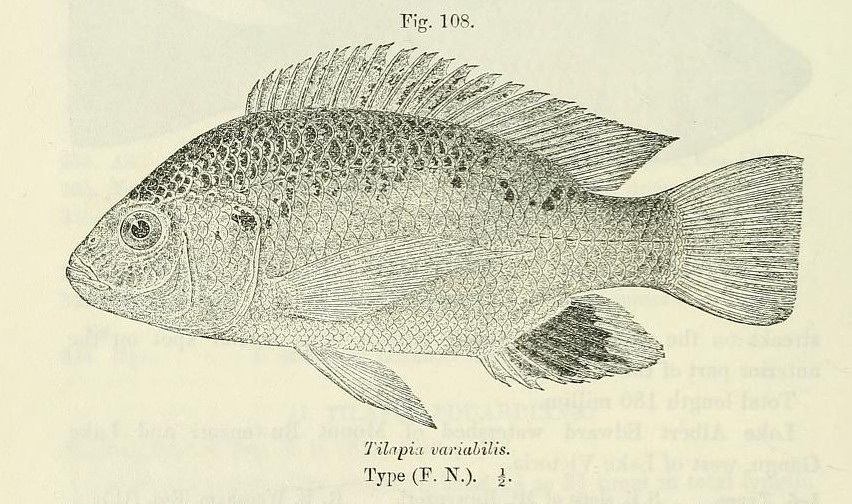
This fish is a cichlid species native to East Africa. It grows to a standard length of 30 cm. The body shape features a distinctive bump above the eyes. A long dorsal fin contains both spiny and soft rays. The lateral line is broken rather than continuous. Most individuals have typical dark scales, but some show a rare pale orange or white pattern with irregular dark blotches. This colour variation gives the species its scientific name. Mature males often appear black with red edges on their fins.
Where it lives
It lives in Lake Victoria and its tributaries. Specific habitats include Lake Kyoga, Lake Kwania, and Lake Bisina. The fish also inhabits the Victoria Nile above Murchison Falls. In the wild, it prefers shallow zones with rocks or weeds. This contrasts with related species that dominate deeper offshore waters. Recent surveys have found populations on rocky islands within the Tanzanian section of the lake. Satellite lakes without invasive species also support surviving groups.
How it lives
Young fish feed on plankton in the water column. Adults shift their diet to bottom sediments and biofilms on hard surfaces. They frequent shallow areas where vegetation or rocks provide cover. Juveniles display a dark spot at the base of the dorsal fin. This marking fades as they mature. The species shares its habitat with other tilapias but occupies different ecological niches. Predation by introduced species has altered its distribution significantly over recent decades.
Breeding and life cycle
Females carry eggs in their mouths for several weeks. This maternal care protects the young until they can feed independently. Males aggregate in shallow water to defend territories. They construct elaborate mud structures called bowers. These consist of a central platform surrounded by small pits and a larger outer wall. Females visit multiple males before choosing a partner. After spawning, she guards the fry in weedy areas. Fish in smaller water bodies may mature at a smaller size than those in the main lake.
Fish and people
Local fishers historically called this fish Maradadi. It remains important for commercial catches in the region. The species has potential for aquaculture due to its growth habits. Some individuals enter the aquarium trade because of their unique colour forms. The pale variants resemble red tilapias bred for farming. However, wild populations have declined due to competition and predation. Conservation efforts focus on protecting remaining stocks in isolated waters.
Status and threats
The International Union for Conservation of Nature lists it as Near Threatened. Population numbers have dropped due to the Nile perch introduction. Non-native tilapia species also compete for resources. Despite these pressures, the fish survives in satellite lakes free from exotics. Continued monitoring is necessary to track recovery in protected zones. Habitat degradation and overfishing remain ongoing concerns for its long-term survival.


Questions people ask about Victoria tilapia
What does the Victoria tilapia eat?
Juveniles feed on plankton floating in the water. Adults mainly consume bottom sediments and biofilms found on rocks and other hard surfaces in shallow areas.
How do Victoria tilapias reproduce?
They are maternal mouthbrooders. Females hold eggs in their mouths for several weeks. Males build complex mud structures to attract mates during the spawning process.
Why is this fish considered near threatened?
Populations have declined due to the introduction of predatory Nile perch and competing non-native tilapias. It survives best in lakes without these invasive exotic species.
Good reading and sources
- Oreochromis variabilis on WikipediaEncyclopedia
- More photos on Wikimedia CommonsPhotos
- Wikidata recordOpen data
The facts on this page come from the Wikipedia article "Oreochromis variabilis", written by its contributors and used under the CC BY-SA 4.0 licence, and from its Wikidata record (CC0). EveryFish rewrote the text in its own words, with AI assistance, and compares every page with the article to make sure no passage is copied. It may be reused under the same CC BY-SA 4.0 licence with a link back.
It may contain mistakes, and figures change over time. Nothing here is investment or buying advice. If something is wrong, tell us. Last refreshed 2026-11-15.
Like Victoria tilapia
All cichlids 🇨🇷 Costa Rica and 1 moreMidas cichlid
Large aggressive cichlid from Central AmericaCichlid · Rivers and lakes
 🇧🇷 Brazil and 2 morePeacock bass
Large predatory cichlids from South American rivers known for sport fishing and invasive impact.Cichlid · Rivers and lakes
 🇭🇳 Honduras and 3 moreJaguar cichlid
Large predatory cichlid from Central American lakesCichlid · Rivers and lakes
 🇺🇸 United States and 1 moreTexas cichlid
The only cichlid native to the United StatesCichlid · Rivers and lakes
More from Cichlidae
All of them 🇹🇿 Tanzania and 2 moreSingida tilapia
A cichlid fish native to the Lake Victoria basin in East Africa.Cichlid · Rivers and lakes
 Sub-Saharan AfricaPrincess cichlid
A cooperative schooling cichlid from Lake Tanganyika.Cichlid · Rivers and lakes
 WorldAuratus cichlid
Small, colourful cichlid from Lake MalawiCichlid · Rivers and lakes
 🇲🇼 Malawi and 2 moreMalawi eyebiter
Predatory cichlid from Lake Malawi known for its narrow body and unique feeding habits.Cichlid · Rivers and lakes