
Leedsichthys
Extinct Jurassic giant filter-feeding fish, the largest known bony fish.
Leedsichthys was a massive ray-finned fish that swam in Jurassic oceans. Named after collector Alfred Nicholson Leeds, it is the largest known member of the bony fish lineage, reaching lengths around 16.5 metres.
- Largest known ray-finned fish, reaching ~16.5 m.
- Filtered plankton using unique bone plate structures.
- Skeleton mostly cartilage, making fossils rare.
- Named after collector Alfred Nicholson Leeds.
- Fossils found in UK, France, Germany, Chile, Argentina.
What it is
Leedsichthys represents an extinct genus of pachycormid fish that inhabited seas during the Middle to Late Jurassic periods. It holds the distinction of being the largest known ray-finned fish and one of the biggest fish ever recorded. The animal possessed a large, wide head with bosses on the skull roof and toothless jaws. Its skeleton was unusual because many parts remained as cartilage rather than bone, which did not fossilize well. Fossil evidence reveals large, elongated pectoral fins and a tall vertical tail fin. The body lacked bony scales, and pelvic fins were absent. Recent research suggests the largest individuals reached approximately 16.5 metres in length, though historical estimates varied widely.
Where it lives
Fossils of this species have been discovered across multiple continents, indicating a widespread distribution in Jurassic oceans. Significant finds include locations in England, France, Germany, Argentina, and Chile. In Britain, remains appear in the Oxford Clay Formation near Peterborough. French specimens come from Normandy, while German fossils originate from Wallücke. South American discoveries include sites in Chile and Argentina. These occurrences span a temporal range of at least five million years, from the Callovian stage through the early Tithonian. The geographic spread suggests these animals thrived in various marine environments across the ancient world.
How it lives
Leedsichthys was a filter feeder that consumed plankton from seawater. It used a unique system of delicate bone plates attached to its gill rakers to strain food. These structures were more complex than previously thought, featuring rows of low teeth or fimbriations. The animal likely swam continuously to maintain water flow over its gills. The lack of preserved vertebrae makes understanding its swimming mechanics difficult. However, the stiff tail fin rays suggest powerful propulsion. The species belonged to a lineage of large filter-feeders that persisted for over 100 million years.
Breeding and life cycle
Details about eggs, young, or growth patterns are unknown due to the fragmentary nature of the fossil record.
Fish and people
The genus was named after Alfred Nicholson Leeds, a British collector who found the first remains in the 1880s. His discoveries were initially mistaken for dinosaur bones by experts like John Whitaker Hulke and Friedrich von Huene. Arthur Smith Woodward correctly identified them as fish in 1889. Later excavations, such as the 'Ariston' specimen found in 2001, generated significant media attention. These finds inspired documentaries and computer-generated reconstructions. The fossils are held in museums including the British Museum and the Hunterian Museum in Glasgow. The naming history includes a temporary change to Leedsia before reverting to Leedsichthys.
Status and threats
Leedsichthys is extinct, having disappeared at the end of the Cretaceous period. No conservation status applies as the species no longer exists. The primary challenge in studying it is the poor preservation of its skeletal elements. Cartilage did not fossilize, and hollow bones were often crushed or cracked. This has led to varying size estimates over time, from 9 metres to over 30 metres. Modern research using complete specimens like 'Ariston' has refined these estimates to around 16.5 metres. The misidentification of fossils as dinosaur bones delayed scientific understanding for decades.


Questions people ask about Leedsichthys
How big was Leedsichthys?
Recent research indicates the largest individuals reached approximately 16.5 metres in length. Earlier estimates ranged from 9 to over 30 metres, but better-preserved specimens have helped refine this figure.
What did Leedsichthys eat?
It was a filter feeder that consumed plankton. It used specialized gill rakers lined with delicate bone plates to strain food particles from seawater.
Why are Leedsichthys fossils hard to study?
Much of its skeleton consisted of cartilage, which does not fossilize well. Additionally, the bones it did have were hollow and easily crushed, leading to fragmented remains.
Who discovered Leedsichthys?
The genus is named after Alfred Nicholson Leeds, who collected the first fossils in the 1880s. Arthur Smith Woodward formally described the species in 1889.
Good reading and sources
The facts on this page come from the Wikipedia article "Leedsichthys", written by its contributors and used under the CC BY-SA 4.0 licence, and from its Wikidata record (CC0). EveryFish rewrote the text in its own words, with AI assistance, and compares every page with the article to make sure no passage is copied. It may be reused under the same CC BY-SA 4.0 licence with a link back.
It may contain mistakes, and figures change over time. Nothing here is investment or buying advice. If something is wrong, tell us. Last refreshed 2026-11-15.
Like Leedsichthys
All ancient fish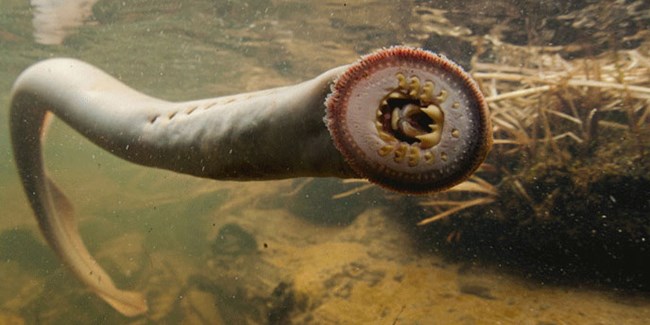 🇺🇸 United States and 1 morePacific lamprey
An anadromous parasitic jawless fish found along the Pacific Rim.Ancient · Rivers and lakes · 1872
 🇮🇩 IndonesiaIndonesian coelacanth
A rare brown deep-sea fish found in Indonesian waters.Ancient · Open ocean · 1999
 🇺🇸 United StatesCladoselache
Extinct Late Devonian shark-like fish known for well-preserved fossils and streamlined body.Shark · Coasts and shelves
 🇺🇸 United StatesPallid sturgeon
An endangered North American sturgeon species native to the Missouri and Mississippi river basins.Ancient · Rivers and lakes · 1905