
Indian anchovy
Small schooling fish used for food and bait in the Indo-Pacific.
The Indian anchovy is a small marine fish found across tropical waters of the Indo-Pacific. It supports local cuisines through frying and curries, while also serving as bait for tuna fisheries. Recent sightings suggest it has entered the Mediterranean Sea via the Suez Canal.
- Grows to a maximum length of 15.5 cm
- Used as bait in the tuna fishing industry
- Recently found in the Mediterranean Sea
- Popular snack when fried in Sri Lanka
- Feeds on plankton in tropical waters
What it is
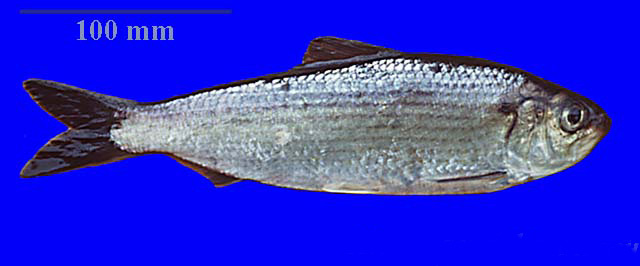
This ray-finned fish belongs to the anchovy family. Adults grow no longer than 15.5 cm. The body shows a translucent brown hue with a distinct silver stripe along the side. Two to six tiny, sharp scutes protect the belly area. The upper jaw bone ends in a point that touches the front edge of the gill cover. Dorsal fins carry 15 to 17 soft rays, while anal fins have 18 to 21.
Where it lives
Populations thrive in tropical zones of the Indo-Pacific. Their territory stretches from Madagascar and Mauritius in the west to Australia and Samoa in the east. They inhabit depths between 20 and 50 metres. In 2015, observers recorded them in the Mediterranean near Palestine. This expansion likely occurred through the Suez Canal. Similar local species may cause observers to miss them in adjacent waters.
How it lives
These creatures form schools in open water. They feed primarily on plankton drifting in the current. As oceanodromous swimmers, they move across marine environments rather than staying in one fixed spot. Their small size and schooling behaviour make them vulnerable to larger predators, which is why they are often caught for use as bait.
Fish and people
Markets in Sri Lanka sell this fish widely. Cooks prepare it by deep-frying pieces coated in flour and breadcrumbs. It also features in white curries made with coconut milk, or spicier versions with dry chilli gravy served with fresh coconut. Beyond direct consumption, fishermen use live or dead specimens as bait for tuna. It appears in various fish sauces and culinary products across Southeast Asia.


Questions people ask about Indian anchovy
How big does the Indian anchovy get?
Adults reach a maximum length of 15.5 cm. They are small fish with a typical anchovy shape, featuring a silver stripe along the flank and a pointed upper jaw.
Where can you find this fish?
It lives in tropical Indo-Pacific waters from Madagascar to Samoa. Recently, it was spotted in the Mediterranean Sea, likely having migrated through the Suez Canal.
Is the Indian anchovy eaten by people?
Yes, it is a common food fish in India and Southeast Asia. In Sri Lanka, it is often fried as a snack or cooked in coconut-based curries.
What do Indian anchovies eat?
They feed on plankton. As small schooling fish, they drift in tropical ocean currents at depths of 20 to 50 metres to filter these tiny organisms from the water.
Good reading and sources
- Indian anchovy on WikipediaEncyclopedia
- More photos on Wikimedia CommonsPhotos
- Wikidata recordOpen data
The facts on this page come from the Wikipedia article "Indian anchovy", written by its contributors and used under the CC BY-SA 4.0 licence, and from its Wikidata record (CC0). EveryFish rewrote the text in its own words, with AI assistance, and compares every page with the article to make sure no passage is copied. It may be reused under the same CC BY-SA 4.0 licence with a link back.
It may contain mistakes, and figures change over time. Nothing here is investment or buying advice. If something is wrong, tell us. Last refreshed 2026-11-15.
Like Indian anchovy
All herrings and sardines 🇺🇸 United States and 1 moreGulf menhaden
Small filter-feeding fish of the Gulf of MexicoHerring · Coasts and shelves
 🇺🇸 United States and 1 moreAlewife
A small North American herring that migrates between sea and rivers.Herring · Coasts and shelves
 🇺🇸 United StatesAtlantic menhaden
A silvery herring species found along the North American Atlantic coast.Herring · Coasts and shelves
 WorldSpotted sardinella
A small herring with golden spots found in the Indo-Pacific.Herring · Coasts and shelves
More from Engraulidae
All of them 🇹🇷 Turkey and 4 moreAnchovy
Small, oily forage fish found in oceans and some rivers worldwide.Herring · Coasts and shelves
 🇯🇵 Japan and 2 moreJapanese anchovy
Small schooling fish of the northwest PacificHerring · Coasts and shelves
 🇵🇪 Peru and 1 morePeruvian anchoveta
Small Pacific fish vital for fishmeal and growing food useHerring · Coasts and shelves
 🇮🇳 India and 3 moreMoustached thryssa
Small silver anchovy of the Indo-Pacific with a dark gill blotch.Herring · Coasts and shelves