
Hogfish
A western Atlantic wrasse with a pig-like snout.
The hogfish is a large wrasse found in the western Atlantic, from Canada to South America. It uses its elongated snout to root for food in reef sediments and changes sex from female to male as it matures.
- Only known member of the genus Lachnolaimus
- Changes sex from female to male at maturity
- Uses pig-like snout to root for buried prey
- Can detect light through its skin for camouflage
- Spawning occurs from November to June in Florida
What it is
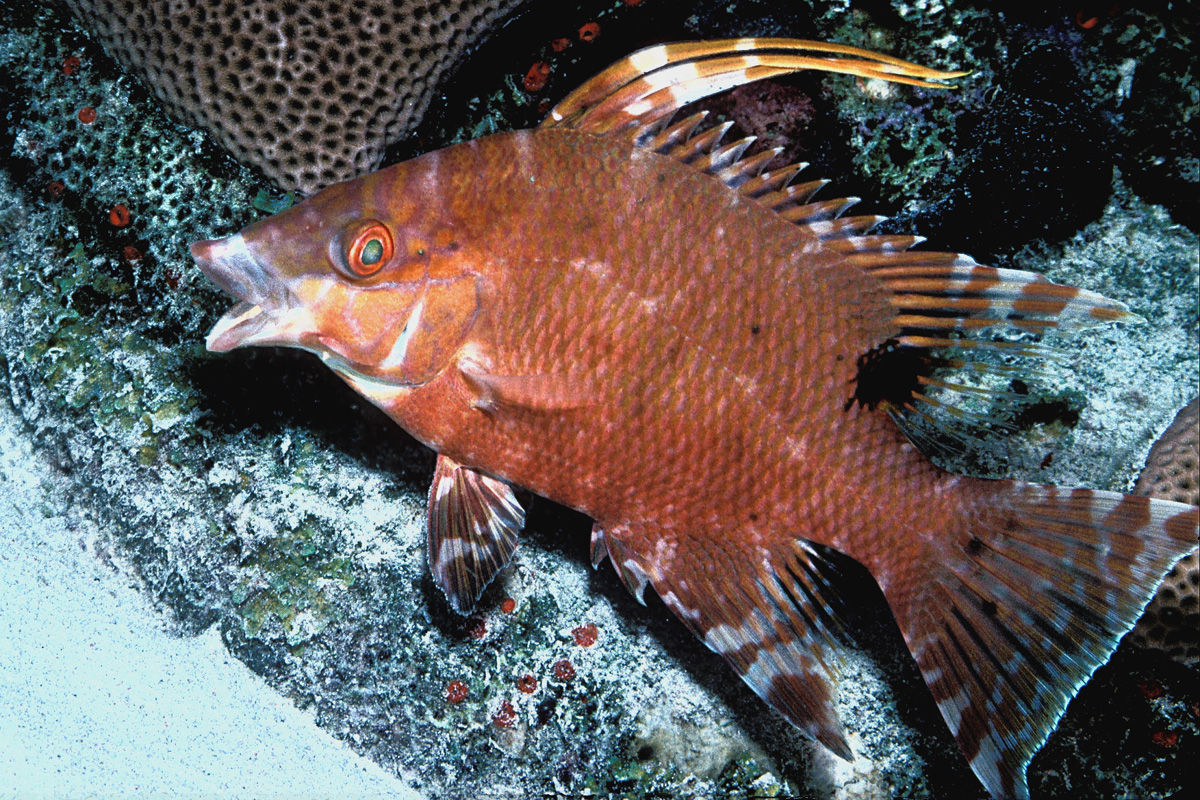
The hogfish is a species of wrasse distinguished by its very long, pig-like snout. This elongated mouth helps it root through sediment for buried prey. Adults can grow up to 90 cm in length and weigh about 11 kg. Males display a dark band from the snout to the first dorsal spine and a black spot behind the pectoral fins. Females and juveniles are paler, often grey or reddish-brown, without distinct patterns. The dorsal fin features several long spines followed by shorter ones. Uniquely, this fish can detect light through its skin using specialized cells, aiding in active camouflage against reef backgrounds.
Where it lives
This species inhabits the western Atlantic Ocean. Its range extends from Nova Scotia in Canada down to northern South America, including the Gulf of Mexico. Hogfish prefer reef environments, specifically seeking out areas rich in gorgonians. These soft corals provide the structural complexity the fish needs for shelter and foraging. They are not typically found in open ocean waters but stay close to these coastal reef structures throughout their lives.
How it lives
Hogfish are carnivores that feed on molluscs, crabs, and sea urchins. They use their snouts to dig into the seabed to find crustaceans hidden in the sand. Socially, they form harems where a single male defends and mates with a group of females within his territory. This structure supports their reproductive strategy. They are capable of changing colour to match their surroundings, using dermal photoreception to sense ambient light levels and adjust their appearance accordingly.
Breeding and life cycle
The hogfish is a sequential hermaphrodite, specifically protogynous. This means individuals start life as females and later change into males. The transition usually happens when the fish is about three years old and reaches a length of 36 cm. In South Florida, spawning takes place between November and June. The male protects his harem during this period. The maximum recorded lifespan for this species is 11 years.
Fish and people
Hogfish are valued as food and sport fish. In 2007, landings in Florida totalled over 139,000 kg. To prevent overfishing, management bodies like the South Atlantic Fishery Management Council and the Florida Fish and Wildlife Conservation Commission regulate the stock. Rules include limits on bag size, fish size, and the type of gear used. These measures aim to maintain healthy population levels for future fishing seasons.



Questions people ask about Hogfish
Why is it called a hogfish?
It gets its name from its elongated, pig-like snout. The fish uses this snout to root through sediment on the reef floor, searching for crustaceans and other food items buried in the sand.
Do hogfish change sex?
Yes, they are protogynous hermaphrodites. They begin life as females and change into males when they are about three years old and reach a length of approximately 36 cm.
Where do hogfish live?
They are native to the western Atlantic Ocean. Their range spans from Nova Scotia, Canada, to northern South America, including the Gulf of Mexico. They prefer reefs with plenty of gorgonians.
What do hogfish eat?
They are carnivores that feed on molluscs, crabs, and sea urchins. They use their long snouts to dig into the sediment to find these prey items hidden beneath the surface.
Good reading and sources
The facts on this page come from the Wikipedia article "Hogfish", written by its contributors and used under the CC BY-SA 4.0 licence, and from its Wikidata record (CC0). EveryFish rewrote the text in its own words, with AI assistance, and compares every page with the article to make sure no passage is copied. It may be reused under the same CC BY-SA 4.0 licence with a link back.
It may contain mistakes, and figures change over time. Nothing here is investment or buying advice. If something is wrong, tell us. Last refreshed 2026-11-15.
Like Hogfish
All reef fish WorldGreen humphead parrotfish
The largest parrotfish species, known for its massive head and role in reef bioerosion.Reef fish · Coasts and shelves
 WorldConvict tang
Striped marine surgeonfish found across the Indo-Pacific.Reef fish · Coasts and shelves · 1758
 🇦🇺 Australia and 4 moreLeopard coral grouper
A spotted reef predator prized for food across the Pacific.Perch-like · Coasts and shelves · 1802
 WorldBluespotted cornetfish
Long, slender reef fish with a tubular snout and blue spots.Reef fish · Coasts and shelves
More from Labridae
All of them WorldWrasse
A large family of colourful marine fish known for sex change and cleaning symbiosis.Reef fish · Coasts and shelves
 WorldBluehead wrasse
A small Atlantic reef fish known for changing sex and colour.Other · Coral reefs
 WorldQueen parrotfish
A colourful reef fish that turns coral into sandReef fish · Coasts and shelves
 WorldParrotfish
Reef-dwelling wrasses with beak-like teeth that grind coral into sand.Reef fish · Coasts and shelves