
Parrotfish
Reef-dwelling wrasses with beak-like teeth that grind coral into sand.
Parrotfish are a clade of roughly ninety-five species within the wrasse family. They inhabit coral reefs across the Indo-Pacific and other tropical waters, playing a vital role in reef health by grazing on algae and producing sand through bioerosion.
- Green humphead parrotfish can grow up to 1.3 metres long.
- They produce sand by grinding coral and excreting it.
- Most species change sex from female to male during life.
- Some species wrap themselves in mucus cocoons at night.
- They play a key role in preventing algal overgrowth on reefs.
What it is
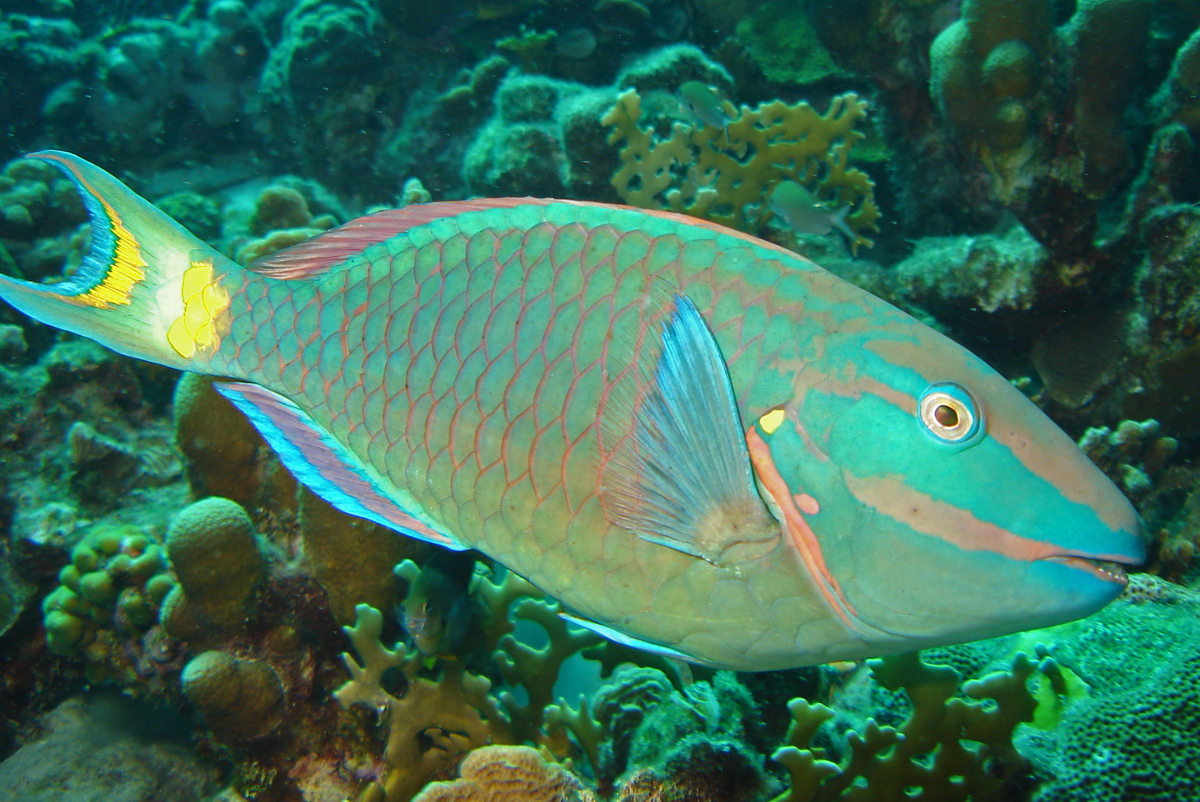
These fish belong to the subfamily Scarinae inside the wrasse family. Their name comes from mouthparts that look like bird beaks. These structures consist of fused teeth forming a hard plate for rasping surfaces. Most individuals measure between thirty and fifty centimetres long. The largest type, the green humphead, reaches one point three metres. The smallest species grows only thirteen centimetres. They display vivid colours in adulthood, often shifting from dull juvenile tones to bright blues or greens. Their bodies are covered in skin that produces protective mucus.
Where it lives
They live in warm tropical waters worldwide. The highest variety of species appears in the Indo-Pacific region. You can find them around coral reefs, rocky coastlines, and seagrass meadows. Some populations exist in the Caribbean and the Mediterranean Sea. They prefer shallow waters where sunlight supports the growth of algae and coral structures they rely on for food and shelter.
How it lives
They spend their days grazing on algae and dead coral rubble. This feeding action grinds rock and coral into fine sand particles. One large individual can produce ninety kilograms of sand annually. They also eat living coral polyps, sponges, and microscopic organisms attached to rocks. This grazing prevents algae from smothering the reef. They form schools while feeding and defend territories during mating seasons. Predators include larger fish and eels.
Breeding and life cycle
Most species change sex during their lives. They start as females and later become males. This shift involves changes in hormones and body colour. They release tiny floating eggs into open water. These eggs drift with currents until they hatch. Young fish settle onto the reef structure. Some species develop directly into males without passing through the female stage first.
Fish and people
Commercial fisheries target some larger species in the Indo-Pacific. They are not popular in home aquariums due to their destructive feeding habits. Local communities value them for maintaining reef balance. Protecting these fish helps stop seaweed from overgrowing coral. Their sand-producing activity contributes to beach formation. Overfishing poses a threat to slow-growing, large species.
Status and threats
Many species face pressure from fishing activities. Large, long-lived types are especially vulnerable to depletion. Habitat loss and pollution also impact their numbers. Conservation efforts focus on protecting reef ecosystems. Reducing fishing limits helps maintain healthy populations. Their role in preventing algal blooms makes them crucial for reef resilience against climate stress.


Questions people ask about Parrotfish
Why are they called parrotfish?
Their mouths contain fused teeth that form a hard, beak-like structure similar to a parrot's bill. This adaptation allows them to rasp algae and coral off hard surfaces efficiently.
Do parrotfish really make sand?
Yes. They bite into coral and rock to eat algae and microorganisms. Their digestive systems break down the calcium carbonate, and they excrete the remaining material as fine white sand, contributing significantly to tropical beaches.
Can parrotfish change their sex?
Most species are sequential hermaphrodites. They begin life as females and later transform into males. This process involves hormonal shifts and changes in physical appearance and behaviour.
Are they dangerous to humans?
No. Parrotfish are herbivores or corallivores. They do not attack humans. However, their strong beaks can cause minor injuries if handled roughly, so care is needed when catching them.
Good reading and sources
The facts on this page come from the Wikipedia article "Parrotfish", written by its contributors and used under the CC BY-SA 4.0 licence, and from its Wikidata record (CC0). EveryFish rewrote the text in its own words, with AI assistance, and compares every page with the article to make sure no passage is copied. It may be reused under the same CC BY-SA 4.0 licence with a link back.
It may contain mistakes, and figures change over time. Nothing here is investment or buying advice. If something is wrong, tell us. Last refreshed 2026-11-15.
Like Parrotfish
All reef fish WorldWrasse
A large family of colourful marine fish known for sex change and cleaning symbiosis.Reef fish · Coasts and shelves
 WorldDamselfish
Small marine fish known for aggressive territorial behaviour and reef farming.Reef fish · Coasts and shelves
 WorldBluespotted cornetfish
Long, slender reef fish with a tubular snout and blue spots.Reef fish · Coasts and shelves
 WorldWhitetail dascyllus
A small Indo-Pacific reef fish with bold black and white stripes.Reef fish · Coasts and shelves