
Striped snakehead
A large freshwater food fish native to South and Southeast Asia.
The striped snakehead is a bony fish native to South and Southeast Asia. It grows up to one metre long and serves as a vital food source across its range. This species survives dry seasons by burrowing into mud and guards its young fiercely.
- Grows up to one metre in length
- Survives dry seasons by burrowing in mud
- Both parents guard eggs and fry
- State fish of Andhra Pradesh and Telangana
- Used in traditional asthma treatments in India
What it is
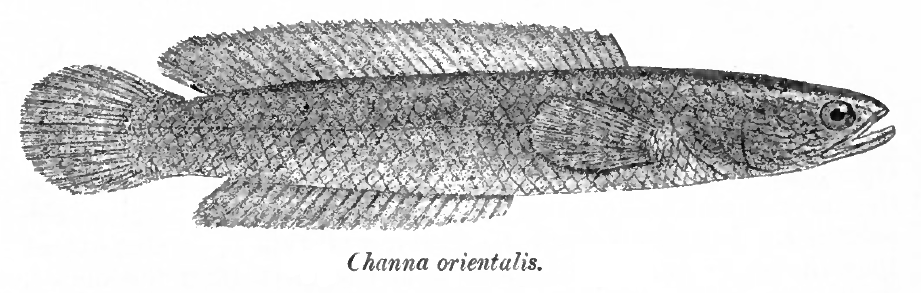
This bony fish features an endoskeleton ribcage and can reach lengths of one metre, though such sizes are rare in the wild due to fishing pressure. Adults display dark brown colouration with faint black bands running across the body. Young fry appear reddish orange before turning greenish brown as they grow. It belongs to the snakehead group and is widely recognised by various local names across Asia.
Where it lives
Native to South and Southeast Asia, its territory includes Pakistan, India, Nepal, Bangladesh, Sri Lanka, and southern China. It also inhabits most of Southeast Asia. Introductions have occurred in parts of Indonesia, the Philippines, and Mauritius. Reports of wild populations in Hawaii and Madagascar were misidentifications of a different species, although commercial farms in Hawaii do hold this fish.
How it lives
It thrives in freshwater plains, moving from rivers and lakes into flooded fields during wet periods. In the dry season, it returns to permanent water bodies and survives by burrowing into mud. The diet consists of frogs, water bugs, and smaller fish. During breeding, it becomes aggressive and attacks moving objects. Both male and female participate in nest building and guarding offspring.
Breeding and life cycle
Males and females work together to construct nests from water vegetation. After spawning, both parents guard the eggs diligently. The fry remain under parental protection until they reach approximately five to six centimetres in length and change colour from reddish orange to greenish brown. This shared parental care helps ensure higher survival rates for the young.
Fish and people
It is a major food fish with significant economic value. In Kerala, curry with tapioca is a delicacy, while Indonesians prefer it salted. Bengalis consume it widely with rice, and it is the state fish of Andhra Pradesh and Telangana. Thai cuisine uses it for grilled dishes, fermented sauces, and sausages. Traditional Chinese medicine values it for wound healing. In Hyderabad, live fish are swallowed for asthma treatment, a practice lacking clinical proof.
Status and threats
Genetic studies suggest this taxon may be a species complex. While not listed with a specific conservation status here, heavy fishing pressure prevents many individuals from reaching their maximum size. The species faces threats from pathogens causing epizootic ulcerative syndrome, which leads to stunted growth and mortality in farmed populations.


Questions people ask about Striped snakehead
How big does the striped snakehead get?
This fish can grow up to one metre in length. However, due to intense fishing pressure, individuals of this maximum size are rarely found in the wild today.
What does the striped snakehead eat?
It preys on frogs, water bugs, and smaller fish. During the breeding season, it becomes highly aggressive and will attack any moving object it encounters in its territory.
Is the striped snakehead good for eating?
Yes, it is an important food fish across its native range. It is prepared in curries, salted, grilled, or used in fermented sauces in countries like India, Thailand, and Indonesia.
How does it survive in dry conditions?
During the dry season, it returns to permanent water bodies and survives by burrowing into the mud. This adaptation allows it to wait out periods when shallow waters evaporate.
Good reading and sources
- Channa striata on WikipediaEncyclopedia
- More photos on Wikimedia CommonsPhotos
- Wikidata recordOpen data
The facts on this page come from the Wikipedia article "Channa striata", written by its contributors and used under the CC BY-SA 4.0 licence, and from its Wikidata record (CC0). EveryFish rewrote the text in its own words, with AI assistance, and compares every page with the article to make sure no passage is copied. It may be reused under the same CC BY-SA 4.0 licence with a link back.
It may contain mistakes, and figures change over time. Nothing here is investment or buying advice. If something is wrong, tell us. Last refreshed 2026-11-15.
Like Striped snakehead
All other fish 🇺🇬 Uganda and 2 moreSilver cyprinid
A small pelagic fish from Lake Victoria that supports regional food security.Other · Rivers and lakes
 🇧🇷 Brazil and 3 moreTambaqui
A large freshwater fish from South America known for its heavy body and seed-eating habits.Other · Rivers and lakes
 🇵🇭 Philippines and 4 moreMilkfish
The sole living species of the family Chanidae, found across the Indo-Pacific.Other · Coasts and shelves
 WorldSnakehead
Elongated freshwater predators with air-breathing organs found in Asia and Africa.Other · Rivers and lakes
More from Channidae
All of them Southeast AsiaGiant snakehead
A large freshwater predator from Southeast Asia known for air breathing and invasive potential.Other · Rivers and lakes
 🇦🇫 Afghanistan and 4 moreSpotted snakehead
Small carnivorous fish from South AsiaOther · Rivers and lakes
 🇮🇷 Iran and 4 moreDwarf snakehead
Small freshwater fish native to southern AsiaOther · Rivers and lakes
 🇮🇳 India and 1 moreBullseye snakehead
Large air-breathing fish native to South Asia.Other · Rivers and lakes