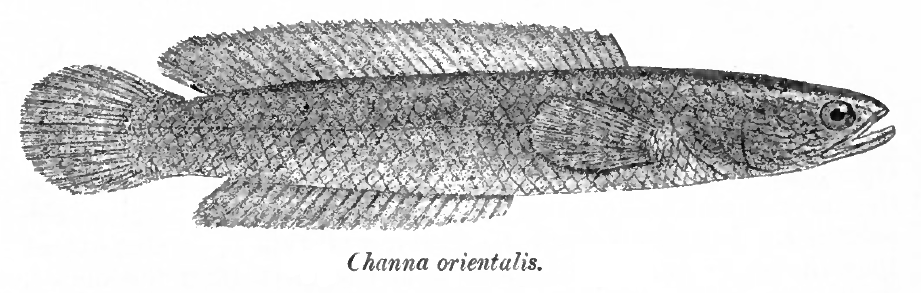
Snakehead
Elongated freshwater predators with air-breathing organs found in Asia and Africa.
Snakeheads are predatory freshwater fish native to parts of Africa and Asia. They are known for their ability to breathe air and survive on land, which has led to their use as food and their status as invasive species in new regions.
- Can breathe air and survive on land for up to four days
- Females release up to 15,000 eggs per spawning event
- Introduced to US waters since 2002 causing ecological concerns
- Valued food fish in Asia and Africa with tender flesh
- Two extant genera: Channa (Asia) and Parachanna (Africa)
What it is
Snakeheads belong to the family Channidae, a group of elongated freshwater fish native to Africa and Asia. They possess long dorsal fins, large mouths, and shiny teeth. Their bodies are adapted for thrust-feeding. Sizes vary significantly, with dwarf species staying under 25 cm while larger types exceed one metre. They are distinct among fish for their ability to extract oxygen from the air using suprabranchial organs, which develop as they mature. This trait allows them to leave water and travel across land to find new habitats.
Where it lives
The family originated in the south Himalayan region at least 50 million years ago. Fossil records show spread into Eurasia and Africa by millions of years later. Today they inhabit rivers and lakes across Asia and Africa. Humans have introduced them to many non-native areas including the United States, Hawaii, Madagascar, and parts of Europe. In the US, populations exist in states like Maryland, Virginia, Florida, and California. These introductions were often intentional for fisheries or accidental releases from aquariums.
How it lives
Young snakeheads eat plankton, aquatic insects, and mollusks. Adults primarily hunt other fish, frogs, and occasionally small rodents. They are apex predators in environments where they lack natural enemies. Their air-breathing capability supports survival out of water for up to four days if kept moist. They can wriggle over wet land distances up to 400 metres to reach other water bodies. This mobility aids their spread into new ecosystems and contributes to their reputation as aggressive invaders.
Breeding and life cycle
Snakeheads reach sexual maturity at two or three years of age. Females can release up to 15,000 eggs in a single spawning event. Reproduction can occur up to five times annually. This high reproductive rate allows populations to grow rapidly. A single female could theoretically produce 150,000 eggs over two years. This prolific breeding supports their success as invasive species in new territories where conditions are suitable.
Fish and people
Snakeheads are valued as food fish due to their tender flesh. They are farmed in aquaculture in Asia and Africa. Traditional dishes include Varal curry in Kerala, pucung gabus in Indonesia, and various preparations in Vietnam and the Philippines. In the US, chefs have promoted eating them to control invasive populations. They are also kept as pets but often become problematic when owners release large specimens into local waters. Legal restrictions on possession exist in several US states.
Status and threats
Snakeheads are considered destructive invasive species in many introduced regions. Their lack of natural predators and high reproduction rates cause ecological damage. Laws in US states like Virginia criminalize their introduction without authorization. Eradication is difficult due to extensive habitat availability and population size. Conservation efforts focus on preventing further spread rather than complete removal. Native ranges in Asia and Africa do not face these specific invasive threats.


Questions people ask about Snakehead
How do snakeheads move on land?
They use their bodies and fins to wriggle across wet ground. They can travel up to 400 metres to reach new water sources. This requires moisture to keep their skin and gills damp during transit.
Are snakeheads dangerous to humans?
They are not typically dangerous to humans but are aggressive predators of other aquatic life. They can bite if handled. Their main impact is ecological, disrupting local fish populations as invasive apex predators in new environments.
Why are they called Frankenfish?
Media outlets used this term after their appearance in North American waters. It reflects public concern about their unusual traits like air breathing and rapid spread. The name highlights their perceived unnatural status in non-native ecosystems.
Can you eat snakeheads?
Yes, they are prized food fish in Asia and Africa. The flesh is tender and used in various traditional dishes. In the US, some chefs promote eating them to help control invasive populations, though consumption is not widespread there.
Good reading and sources
- Snakehead (fish) on WikipediaEncyclopedia
- More photos on Wikimedia CommonsPhotos
- Wikidata recordOpen data
The facts on this page come from the Wikipedia article "Snakehead (fish)", written by its contributors and used under the CC BY-SA 4.0 licence, and from its Wikidata record (CC0). EveryFish rewrote the text in its own words, with AI assistance, and compares every page with the article to make sure no passage is copied. It may be reused under the same CC BY-SA 4.0 licence with a link back.
It may contain mistakes, and figures change over time. Nothing here is investment or buying advice. If something is wrong, tell us. Last refreshed 2026-11-15.
Like Snakehead
All other fish Southeast AsiaGiant snakehead
A large freshwater predator from Southeast Asia known for air breathing and invasive potential.Other · Rivers and lakes
 🇺🇬 Uganda and 2 moreSilver cyprinid
A small pelagic fish from Lake Victoria that supports regional food security.Other · Rivers and lakes
 WorldNile perch
Large freshwater predator native to Africa, now invasive in many lakes.Other · Rivers and lakes
 🇵🇭 Philippines and 4 moreMilkfish
The sole living species of the family Chanidae, found across the Indo-Pacific.Other · Coasts and shelves