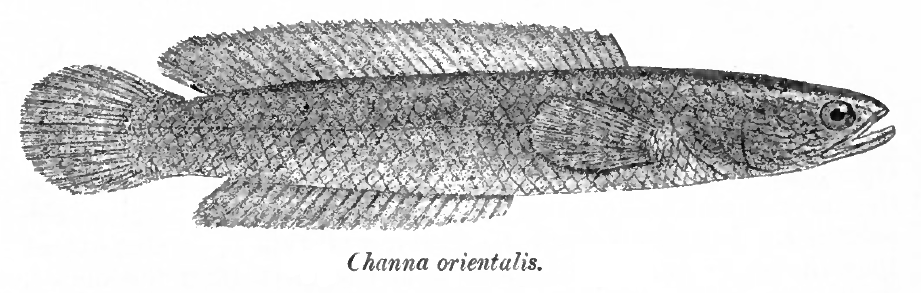
Dwarf snakehead
Small freshwater fish native to southern Asia
The dwarf snakehead is a small freshwater fish found across southern Asia. It belongs to a complex of closely related species that share similar physical traits but differ genetically. This adaptable fish lives in diverse wetlands and is valued for food and aquariums.
- Reaches up to 28 cm in total length
- Male broods eggs and juveniles in mouth
- Found in freshwater from Iran to Indonesia
- Part of a complex with hidden genetic splits
- Used for food and kept in aquaria
What it is
The dwarf snakehead is a small member of the Channidae family. Adults reach up to 28 cm in length, though most are smaller. Males display more intense colours and longer dorsal and anal fins than females. This fish is part of a species complex, meaning it likely includes several distinct taxa that look alike but are genetically different.
Where it lives
This species has a wide distribution across southern Asia. Records exist from Iran and Afghanistan in the west to Indonesia and Singapore in the east. It inhabits diverse freshwater environments, including large rivers, small brooks, and stagnant waters. The fish thrives in altered waterways like canals and agricultural rice paddies.
How it lives
The dwarf snakehead feeds on small fish, insects, and crustaceans. It is adaptable to various water conditions, surviving in both fast currents and still pools. Genetic studies show a split between western and eastern populations, which meet in Myanmar. Despite these genetic differences, their physical appearance remains very similar across the range.
Breeding and life cycle
This fish reproduces through mouthbrooding. The male carries the eggs and young juveniles in his mouth for protection. This parental care helps ensure the survival of the offspring in their early stages. The specific timing of spawning events is not detailed in the available records.
Fish and people
People catch this fish for food in many parts of Asia. It is also popular in the aquarium trade due to its attractive colouration and small size. Researchers have studied the species for potential use in aquaculture operations. Its ability to live in varied habitats makes it a resilient subject for such studies.
Status and threats
It notes that the group is a species complex with ongoing taxonomic revisions. Some populations, such as those in Sri Lanka and the eastern range, are often classified as separate species due to genetic distinctions.

Questions people ask about Dwarf snakehead
How big does the dwarf snakehead get?
This species can reach a total length of 28 cm. However, most individuals found in the wild are much smaller than this maximum size.
Where does the dwarf snakehead live?
It is native to freshwater habitats across southern Asia. Its range extends from Iran and Afghanistan in the west to Indonesia and Singapore in the east.
What does the dwarf snakehead eat?
This fish feeds on small fish, insects, and crustaceans. It is an opportunistic predator found in various wetland environments.
Why is it called a species complex?
Genetic studies show deep splits between populations. Western and eastern groups, along with the Sri Lankan population, may be separate species despite looking similar.
Good reading and sources
- Channa gachua on WikipediaEncyclopedia
- More photos on Wikimedia CommonsPhotos
- Wikidata recordOpen data
The facts on this page come from the Wikipedia article "Channa gachua", written by its contributors and used under the CC BY-SA 4.0 licence, and from its Wikidata record (CC0). EveryFish rewrote the text in its own words, with AI assistance, and compares every page with the article to make sure no passage is copied. It may be reused under the same CC BY-SA 4.0 licence with a link back.
It may contain mistakes, and figures change over time. Nothing here is investment or buying advice. If something is wrong, tell us. Last refreshed 2026-11-15.
Like Dwarf snakehead
All other fish Southeast AsiaGiant snakehead
A large freshwater predator from Southeast Asia known for air breathing and invasive potential.Other · Rivers and lakes
 🇧🇷 Brazil and 1 moreRed-bellied Pacu
A large South American freshwater fish related to piranhas, farmed for food and kept in aquariums.Other · Rivers and lakes
 🇧🇷 Brazil and 3 moreTambaqui
A large freshwater fish from South America known for its heavy body and seed-eating habits.Other · Rivers and lakes
 🇨🇳 China and 4 moreThree spot gourami
Hardy freshwater fish native to Southeast Asia with distinct side spots.Other · Rivers and lakes