
Red-bellied Pacu
A large South American freshwater fish related to piranhas, farmed for food and kept in aquariums.
The red-bellied pacu is a large freshwater fish native to the Amazon basin. It is widely farmed for its meat and occasionally kept as an aquarium pet, though it can become invasive outside its natural range.
- Reaches up to 88 cm and 25 kg.
- Native to the Amazon basin.
- Eats fruits, seeds, and nuts.
- Juveniles mimic piranhas for protection.
- Introduced and invasive in Florida.
What it is
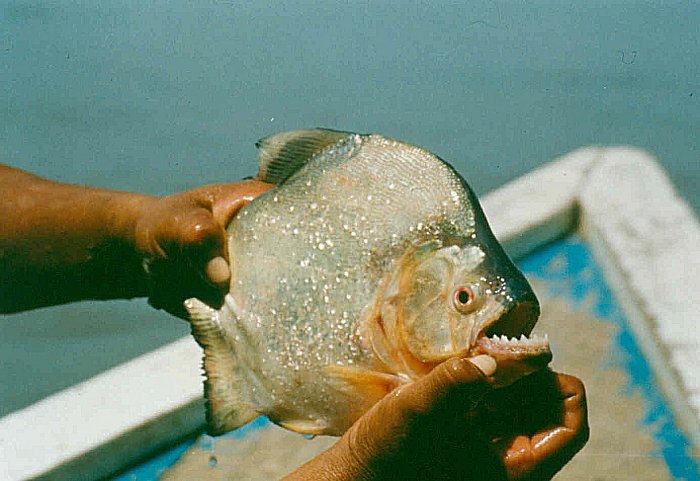
The red-bellied pacu is a large freshwater fish belonging to the serrasalmid family. Adults reach lengths of up to eighty-eight centimetres and weigh twenty-five kilograms. Juveniles display a bright red chest and stomach, which helps them avoid predators through mimicry. This colour fades as they mature. The species resembles the tambaqui but has a more rounded head profile and smaller adipose fin without rays. Its teeth are molar-like, suited for crushing hard items rather than tearing flesh.
Where it lives
This fish originates from the Amazon basin in tropical South America. Historically, populations in the Orinoco river were considered part of this group, but these are now classified as a separate species. The pacu has been introduced to other areas, including rivers and canals in South Florida, where it is considered an invasive species. In its native range, it inhabits flooded forests and floodplains across various river types, including nutrient-poor headwaters.
How it lives
The red-bellied pacu is migratory, though specific patterns remain unclear. It primarily feeds on fruits, seeds, and nuts, acting as an efficient seed disperser because many seeds pass through its digestive system undamaged. During the dry season, it becomes opportunistic, consuming zooplankton, insects, crustaceans, and small fish. Larvae are typically found in whitewater rivers, while adults prefer flooded forest habitats.
Breeding and life cycle
Spawning takes place at the beginning of the flood season, generally between November and February. Young larvae develop in whitewater rivers before moving to their adult habitats. The species can hybridize with the tambaqui in aquaculture settings. It also produces sterile offspring when crossing with P. orinoquensis, indicating reproductive barriers between these closely related groups.
Fish and people
This species supports significant fisheries in the Brazilian Amazon, ranking among the top catches by weight. It is widely farmed for food, often in hybrid forms with the tambaqui. The fish is also popular in the aquarium trade due to its size and distinctive juvenile appearance. However, its introduction to non-native waters like Florida raises concerns about ecological impact and invasive behaviour in local waterways.
Status and threats
The red-bellied pacu is not currently listed as threatened by major conservation bodies. Its population remains stable in its native Amazonian range. However, human activities such as farming and introduction to new regions have altered its distribution. In places like Florida, it is managed as an invasive species due to its potential to disrupt local ecosystems. Conservation efforts focus mainly on monitoring its spread outside South America.


Questions people ask about Red-bellied Pacu
Is the red-bellied pacu dangerous?
Adults are not dangerous to humans. Their teeth are molar-like, designed for crushing nuts and seeds. Juveniles resemble carnivorous piranhas, but this is a form of mimicry to avoid predation, not an indication of aggression toward people.
What does the red-bellied pacu eat?
It primarily consumes fruits, seeds, and nuts. It acts as an important seed disperser in its habitat. During dry seasons, it may also eat zooplankton, insects, crustaceans, and small fish when plant matter is less available.
Can you keep a red-bellied pacu in an aquarium?
Yes, they are kept in the aquarium trade. However, they grow very large, reaching nearly one metre long. They require spacious tanks and strong filtration. They are also known to hybridize with other pacu species in captivity.
Where is the red-bellied pacu found?
It is native to the Amazon basin in South America. It has been introduced to other regions, notably South Florida in the United States, where it is considered an invasive species in local rivers and canals.
Good reading and sources
- Piaractus brachypomus on WikipediaEncyclopedia
- More photos on Wikimedia CommonsPhotos
- Wikidata recordOpen data
The facts on this page come from the Wikipedia article "Piaractus brachypomus", written by its contributors and used under the CC BY-SA 4.0 licence, and from its Wikidata record (CC0). EveryFish rewrote the text in its own words, with AI assistance, and compares every page with the article to make sure no passage is copied. It may be reused under the same CC BY-SA 4.0 licence with a link back.
It may contain mistakes, and figures change over time. Nothing here is investment or buying advice. If something is wrong, tell us. Last refreshed 2026-11-15.
Like Red-bellied Pacu
All other fish Southeast AsiaGiant snakehead
A large freshwater predator from Southeast Asia known for air breathing and invasive potential.Other · Rivers and lakes
 🇧🇷 Brazil and 3 moreTambaqui
A large freshwater fish from South America known for its heavy body and seed-eating habits.Other · Rivers and lakes
 🇺🇬 Uganda and 2 moreSilver cyprinid
A small pelagic fish from Lake Victoria that supports regional food security.Other · Rivers and lakes
 🇧🇷 BrazilBanded leporinus
A striped freshwater fish from the Amazon kept in home tanks and occasionally caught by anglers.Other · Rivers and lakes
More from Serrasalmidae
All of them WorldSilver dollar
Round, silver tropical fish related to piranhas, popular in aquariums.Other · Rivers and lakes
 🇧🇷 Brazil and 4 moreRed-bellied piranha
A widespread South American freshwater fish known for its omnivorous diet and shoaling behavior.Other · Rivers and lakes
 🇸🇷 Suriname and 2 moreRedeye piranha
A large freshwater fish from South America with a rhombus-shaped body and red eyes.Other · Rivers and lakes · 1766