
Black tetra
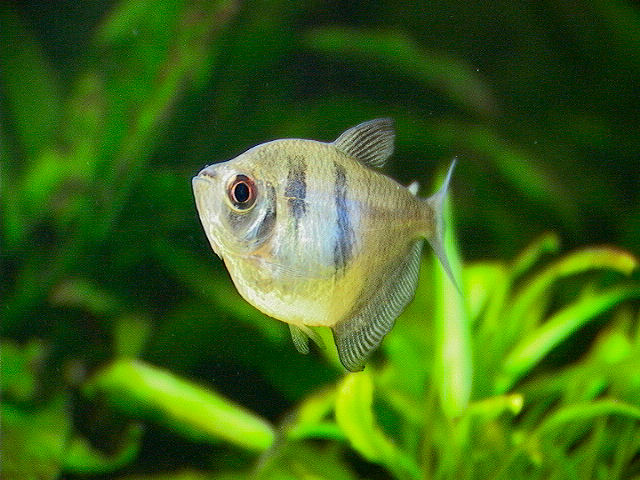
Small freshwater characin with dark vertical bars
The black tetra is a small freshwater fish native to South America. It belongs to the American characins and lives in river basins across Brazil, Paraguay and Argentina. Aquarists value it for its hardy nature and distinctive dark markings.
- Grows up to 7.5 cm in length
- Native to Paraguay River basin
- Base species for fluorescent GloFish
- Has two prominent vertical black bars
- Lives 3 to 5 years in captivity
What it is
This ray-finned fish has a roughly four-sided body shape. Its colour shifts from light near the head to nearly black at the tail. Two bold vertical stripes sit behind the gills. The rear half of the body carries a dense spread of dark pigment cells. This feature sets it apart from related species that lack such heavy shading. Adults reach about 7.5 centimetres in length.
Where it lives
Native waters include the Paraguay River basin in south-central Brazil, particularly the Pantanal region. Populations also exist in Paraguay and northeast Argentina. Groups in the upper Paraná and Paraíba do Sul Rivers likely arrived through human introduction. Earlier records from the Guapore River actually refer to a different species described in 2015.
How it lives
It lives in groups and feeds on tiny crustaceans, insects and worms. This shoaling behaviour helps it feel secure in open water. In home tanks, keepers often offer live foods like Daphnia or mosquito larvae. Frozen bloodworms are also accepted. The fish remains active and social when kept with compatible tank mates.
Breeding and life cycle
Sexual maturity arrives at around two years of age. Spawning involves releasing and fertilising eggs among aquatic plants. The adults frequently consume their own eggs after laying them. Hobbyists usually remove the parents post-spawning to protect the young. Captive individuals typically live three to five years, though some exceed six.
Fish and people
Aquarists widely keep this species due to its availability and hardiness. It serves as the genetic base for GloFish, which are fluorescent coloured variants sold in many hues. Keepers provide varied diets to maintain health. The fish is a staple in the freshwater aquarium trade and is easy to find in shops.


Questions people ask about Black tetra
How big does a black tetra get?
Adults reach a maximum length of 7.5 centimetres. This small size makes them suitable for community tanks with other peaceful fish.
What do black tetras eat?
They feed on small crustaceans, insects and worms. In aquariums, hobbyists often provide live Daphnia, mosquito larvae or frozen bloodworms.
Are black tetras the same as GloFish?
No, but they are related. The black tetra was used to create genetically modified GloFish. These modified versions display fluorescent colours not found in the wild type.
Good reading and sources
The facts on this page come from the Wikipedia article "Black tetra", written by its contributors and used under the CC BY-SA 4.0 licence, and from its Wikidata record (CC0). EveryFish rewrote the text in its own words, with AI assistance, and compares every page with the article to make sure no passage is copied. It may be reused under the same CC BY-SA 4.0 licence with a link back.
It may contain mistakes, and figures change over time. Nothing here is investment or buying advice. If something is wrong, tell us. Last refreshed 2026-11-15.
Like Black tetra
All other fish WorldSilver dollar
Round, silver tropical fish related to piranhas, popular in aquariums.Other · Rivers and lakes
 Southeast AsiaKissing gourami
A Southeast Asian freshwater fish known for its unique mouth-to-mouth sparring behaviour.Other · Rivers and lakes
 Southeast AsiaBumblebee goby
Small striped freshwater and brackish gobies from AsiaOther · Rivers and lakes
 🇨🇳 China and 4 moreCelestial Eye goldfish
Fancy goldfish with upward-facing telescope eyesOther · Rivers and lakes
More from Acestrorhamphidae
All of them Latin America and the CaribbeanPenguinfish
Small striped characin from South American riversOther · Rivers and lakes
 🇧🇷 BrazilLemon tetra
Small yellow freshwater fish from the Amazon basin.Other · Rivers and lakes
 🇺🇸 United States and 1 moreMexican tetra
A freshwater characin with surface and blind cave forms, studied for evolutionary biology.Other · Rivers and lakes
 🇨🇴 ColombiaEmperor tetra
A small freshwater fish from Colombia, prized in the aquarium trade for its striking colours and distinct sexual dimorphOther · Rivers and lakes