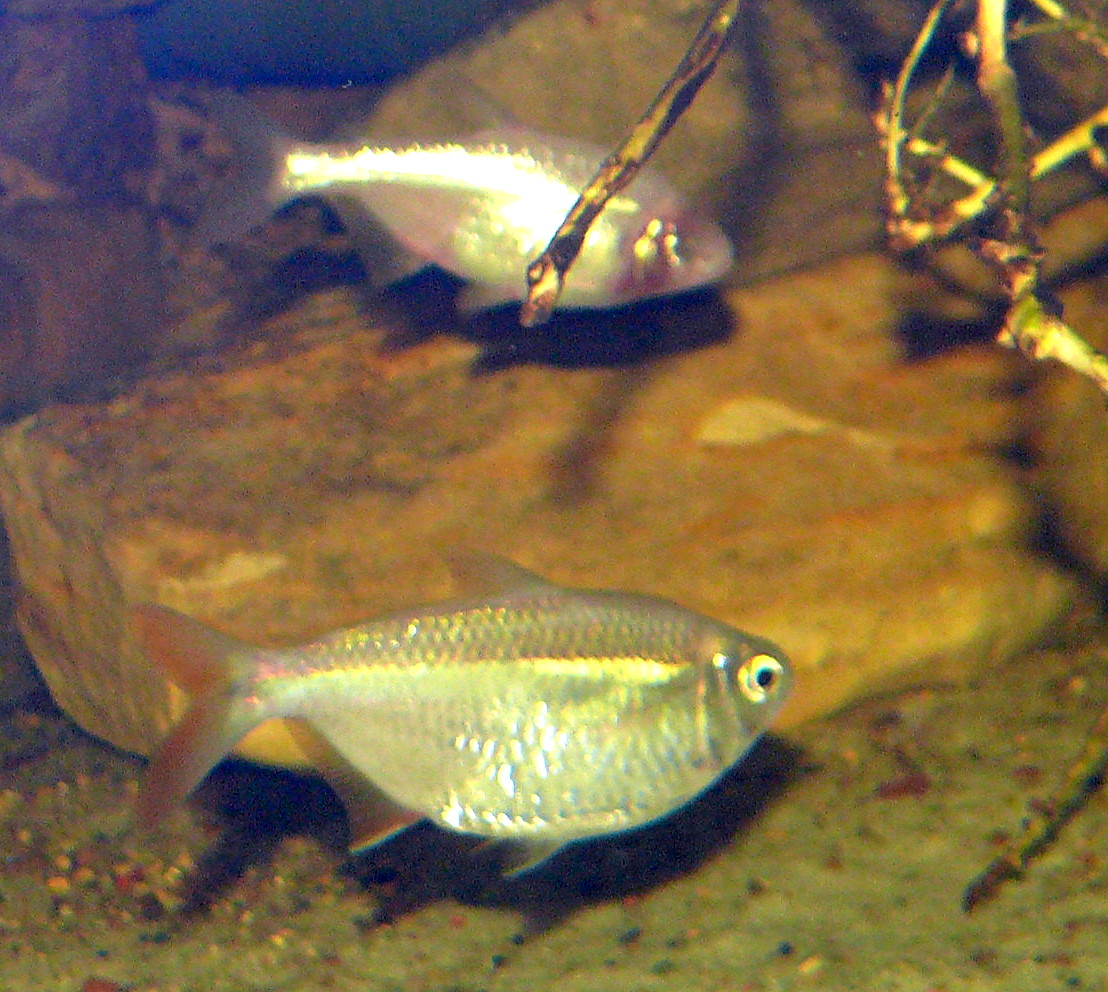
Mexican tetra
A freshwater characin with surface and blind cave forms, studied for evolutionary biology.
The Mexican tetra is a ray-finned fish found in Texas and Mexico. It exists as eyed surface dwellers and sightless cave populations, making it a key model for studying genetic adaptation and regressive evolution.
- Blind cave forms lack eyes and pigment, relying on lateral lines for navigation.
- Surface and cave populations interbreed successfully, producing fertile hybrids.
- Cave fish store four times more fat than surface counterparts for survival.
- Overexpression of the Shh gene correlates with increased taste buds and eye loss.
- Aquarium trade stock originates from 1936 collections in Cueva Chica Cave.
What it is
The Mexican tetra is a small freshwater ray-finned fish belonging to the American characins family. Surface-dwelling individuals reach about 12 cm and display typical silvery scales suited for their environment. In contrast, the blind cave form lacks pigment, appearing pinkish-white, and has lost functional eyes entirely. These cave fish possess empty sockets covered by skin instead of eyeballs, an adaptation to pitch-black underground habitats where visual signals are unnecessary.
Where it lives
Surface populations inhabit rivers including the lower Rio Grande, Nueces, and Pecos in Texas, extending into central and eastern Mexico. Approximately thirty distinct cave populations exist within karst regions of San Luis Potosí and southern Tamaulipas. A separate cave-adapted group occurs in Guerrero but belongs to a different species. Surface fish prefer midlevel waters over sandy or rocky substrates, while cave forms reside exclusively in dark subterranean streams.
How it lives
This species forms peaceful schools that swim in midwater columns. Natural diets consist of crustaceans, insect larvae, and plant matter. Cave variants exhibit heightened sensory capabilities, utilizing lateral lines to detect water pressure changes caused by objects or prey. They also possess enhanced olfactory senses with taste buds distributed across their heads. Blind fish store significantly more fat than surface relatives to survive irregular food availability in nutrient-poor caves.
Breeding and life cycle
Eyed surface fish and eyeless cave fish can interbreed to produce fertile offspring. This compatibility allows scientists to study genetic inheritance patterns directly. Larvae initially show shadow responses controlled by the pineal eye before eye degeneration occurs in cave lineages. The species reproduces readily in captivity, supporting both aquarium trade demands and laboratory research requirements without specialized breeding constraints.
Fish and people
The blind cave form is popular among aquarists due to its hardiness and unique appearance. Commercial facilities, particularly in Asia, breed large numbers from original stock collected in Cueva Chica Cave in 1936. Hobbyists keep them in subdued lighting with gravel substrates. The species serves as a primary model organism for evolutionary biologists investigating convergent evolution, regressive traits, and the genetic basis of blindness in isolated populations.
Status and threats
The species faces no major conservation threats according to available data. Cave populations originated recently, less than twenty thousand years ago, through independent invasions of underground habitats. Evolutionary studies focus on how natural selection favors energy conservation by eliminating eye maintenance costs. Genetic drift and pleiotropy also contribute to the fixation of blindness traits in dark environments without reducing overall population viability.


Questions people ask about Mexican tetra
Why do cave tetras lose their eyes?
Eye loss saves significant energy in dark caves where vision provides no benefit. Natural selection favors individuals that redirect resources toward growth and fat storage rather than maintaining useless organs, leading to rapid degeneration of ocular structures over generations.
Can blind cave tetras see any light?
Yes, they retain weak light sensitivity despite lacking functional eyes. Larvae exhibit shadow responses controlled by the pineal eye, and adults maintain endogenous circadian rhythms, allowing them to respond minimally to environmental light cues even in total darkness.
How do blind tetras find food?
They use highly sensitive lateral lines to detect water pressure fluctuations from moving objects. Enhanced olfactory senses with taste buds covering their heads also help locate nutrients. This combination compensates for the absence of visual hunting strategies used by surface relatives.
Are blind cave tetras safe for home aquariums?
They are hardy schooling fish suitable for aquariums when kept in subdued lighting with rocky substrates. They become semi-aggressive as they age but generally thrive on commercial foods like bloodworms and brine shrimp, requiring no special care beyond standard tank conditions.
Good reading and sources
- Mexican tetra on WikipediaEncyclopedia
- More photos on Wikimedia CommonsPhotos
- Wikidata recordOpen data
The facts on this page come from the Wikipedia article "Mexican tetra", written by its contributors and used under the CC BY-SA 4.0 licence, and from its Wikidata record (CC0). EveryFish rewrote the text in its own words, with AI assistance, and compares every page with the article to make sure no passage is copied. It may be reused under the same CC BY-SA 4.0 licence with a link back.
It may contain mistakes, and figures change over time. Nothing here is investment or buying advice. If something is wrong, tell us. Last refreshed 2026-11-15.
Like Mexican tetra
All other fish 🇧🇷 BrazilBanded leporinus
A striped freshwater fish from the Amazon kept in home tanks and occasionally caught by anglers.Other · Rivers and lakes
 Southeast AsiaGiant snakehead
A large freshwater predator from Southeast Asia known for air breathing and invasive potential.Other · Rivers and lakes
 🇧🇼 Botswana and 1 moreAfrican tigerfish
Predatory freshwater fish known for sharp teeth and leaping hunting behaviour.Other · Rivers and lakes · 1861
 🇧🇷 Brazil and 3 moreTambaqui
A large freshwater fish from South America known for its heavy body and seed-eating habits.Other · Rivers and lakes