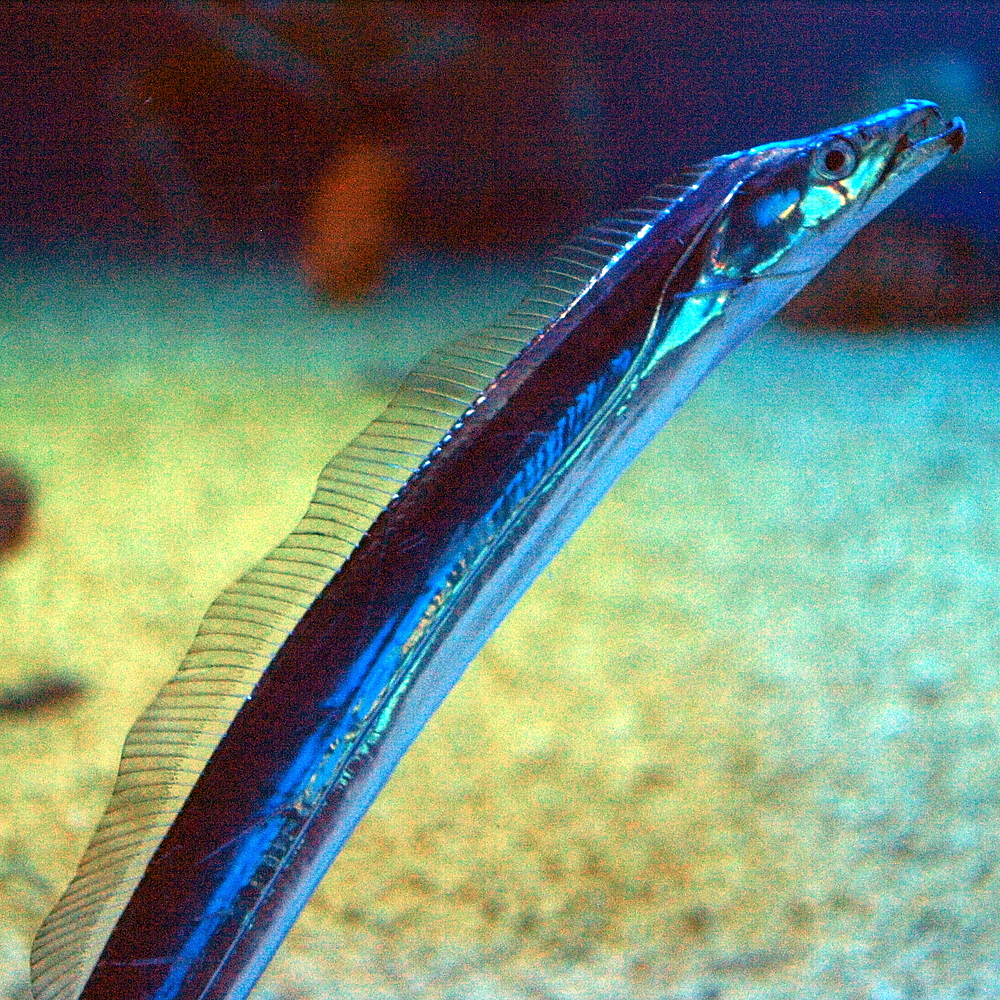
Black scabbardfish
A deep-water Atlantic fish known for its elongated body and coppery-black colour.
The black scabbardfish is a bathypelagic species found in the Atlantic Ocean. It reaches lengths of up to 110 cm and is commercially important for food in Portugal and Madeira.
- Maximum recorded length is 110 cm.
- Found at depths up to 1,700 metres.
- Spawns near Madeira and Canary Islands.
- Host to Anisakis parasites.
- Key species in Portuguese cuisine.
What it is
This fish has an extremely elongated shape with a large snout and strong fang-like teeth. Its body height is roughly one-eighth of its standard length, which can reach 110 cm. The skin displays a coppery-black hue with an iridescent tint, while the mouth interior remains black. Large eyes help it see in low light conditions. Dorsal fins contain numerous spines and soft rays, whereas adults lack pelvic fins entirely. Juveniles retain a single spine in this area before losing it as they mature.
Where it lives
It inhabits the Atlantic Ocean between latitudes 69°N and 27°N. Adults dwell at depths ranging from 180 to 1,700 metres. Younger individuals often occupy shallower mesopelagic zones between 100 and 500 metres. They perform a clockwise migration around the Northeast Atlantic. Populations are found near Iceland, France, Ireland, and the Iberian Peninsula. Spawning occurs near Madeira and the Canary Islands.
How it lives
Adults feed on crustaceans, cephalopods, and other fishes like grenadiers and blue whiting. They hunt at middle depths during the night after rising from deeper waters. Their streamlined form supports fast swimming. Predators include larger marine animals, though specific threats are not detailed. The fish exhibits slow growth rates due to energy investment in reproduction. Parasites like Anisakis are common hosts within their tissues.
Breeding and life cycle
Females spawn multiple times throughout their lives, releasing all eggs in a single event per season. Reproduction typically happens from September to December. Eggs and larvae drift pelagically with plankton. Males develop sperm year-round but peak in abundance during specific months. Females may skip spawning if non-reproductive males are present. Sexual maturity occurs around 80 cm in length.
Fish and people
The species holds high economic value for fisheries in Portugal and Madeira. It is prized for its flesh quality and fetches high prices. Traditional line gear catches dominate Portuguese waters, while trawlers operate off France and Ireland. Annual landings have increased significantly over recent decades. Consumption carries risks from toxic metals and parasites if not prepared correctly.
Status and threats
The Marine Conservation Society ranks this species poorly on sustainability charts. Overfishing poses a significant threat to population stability. Catches have reached high volumes, causing declines in some areas. Preservation efforts are recommended due to ecological importance. Deep-sea trawl fisheries contribute to mixed catches that impact vulnerable stocks.


Questions people ask about Black scabbardfish
What does the black scabbardfish eat?
It consumes crustaceans, cephalopods, and various fishes including grenadiers, codlings, and blue whiting. It hunts at middle depths during nighttime after migrating upwards from deeper waters.
Is it safe to eat raw black scabbardfish?
No. Raw or undercooked consumption can cause anisakiasis, a parasitic infection. Treatment requires surgical removal of nematodes via endoscopy. Toxic metals like mercury also pose health risks if organs are eaten.
Where does this fish live?
It inhabits the Atlantic Ocean between 69°N and 27°N latitude. Adults reside at depths between 180 and 1,700 metres. Juveniles often stay in shallower mesopelagic zones between 100 and 500 metres.
How long do they live?
Studies indicate maximum ages of about 14 years in Madeira and 12 years in mainland Portugal. Growth rates are notably slow compared to other commercial fish species.
Good reading and sources
- Black scabbardfish on WikipediaEncyclopedia
- More photos on Wikimedia CommonsPhotos
- Wikidata recordOpen data
The facts on this page come from the Wikipedia article "Black scabbardfish", written by its contributors and used under the CC BY-SA 4.0 licence, and from its Wikidata record (CC0). EveryFish rewrote the text in its own words, with AI assistance, and compares every page with the article to make sure no passage is copied. It may be reused under the same CC BY-SA 4.0 licence with a link back.
It may contain mistakes, and figures change over time. Nothing here is investment or buying advice. If something is wrong, tell us. Last refreshed 2026-11-15.
Like Black scabbardfish
All other fish WorldOarfish
Extremely long pelagic fish known for their ribbon-like bodies and association with sea serpent myths.Other · Open ocean · 1772
 WorldDeepsea lizardfish
A deep-ocean predator with a flattened head and large eyes found in tropical seas worldwide.Other · Deep sea · 1878
 WorldToothfish
A genus of large marine fish from the Southern Hemisphere, known commercially as Chilean sea bass.Other · Deep sea · 1898
WorldAntarctic toothfish
A large, antifreeze-equipped fish of the Southern Ocean, marketed as Chilean sea bass.Other · Deep sea · 1937