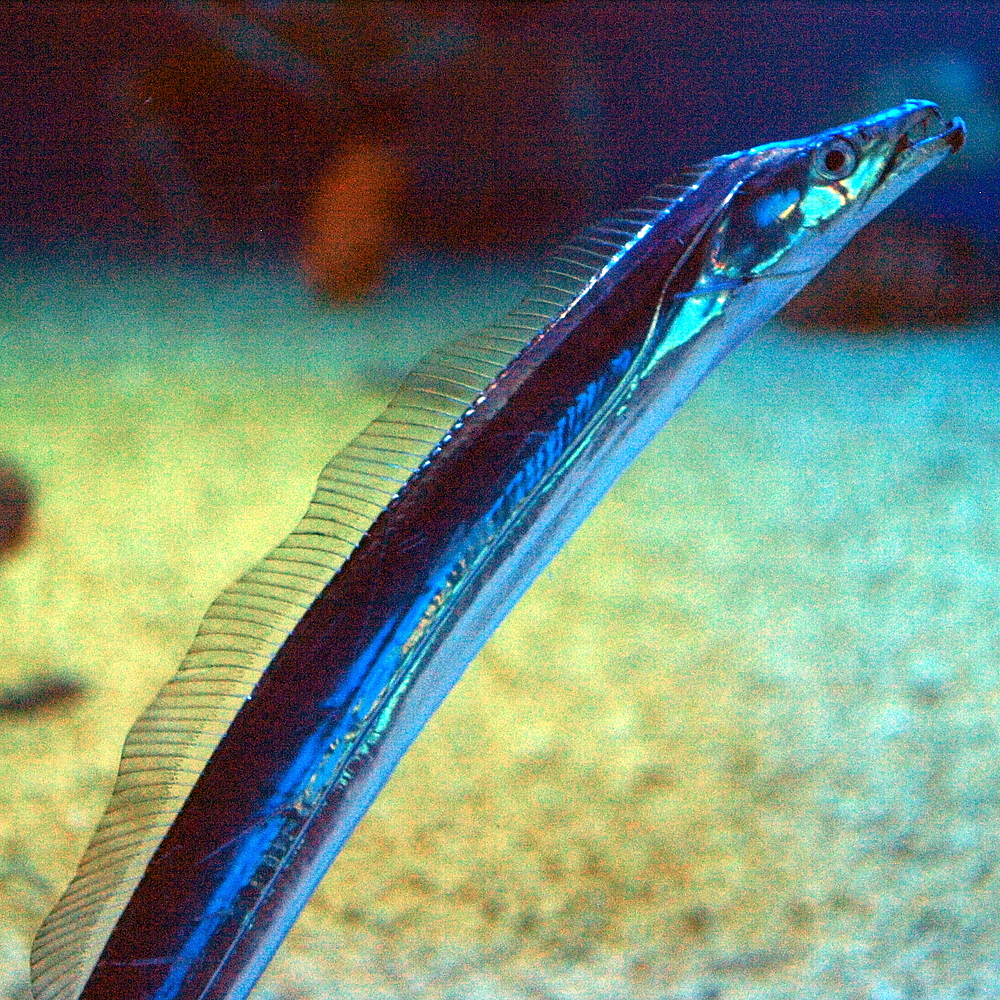
Largehead hairtail
A long, silver, ribbon-like fish found in warm oceans worldwide.
The largehead hairtail is a widespread marine fish with a distinctive elongated body. It supports major global fisheries, particularly in Asia, and is valued for its firm, easy-to-debone flesh.
- Grows up to 2.3 metres long
- Sixth most important captured fish species in 2009
- Lacks a caudal fin and ventral fins
- Prefers water temperatures above 14 °C
- Known as galchi in Korea and tachiuo in Japan
What it is
This fish has a long, flat, ribbon-like body that tapers to a point. It lacks a traditional tail fin and ventral fins. A single dorsal fin runs along its entire back. The skin is silvery steel blue, fading to grey after death. Its large mouth holds sharp, fang-like teeth. Adults can reach 2.3 metres in length, though most are smaller.
Where it lives
It lives in tropical and temperate oceans globally. In the Atlantic, it ranges from the UK to South Africa and Virginia to Argentina. In the Pacific, it is found from California to Peru and across the Indo-Pacific to Japan and Australia. It avoids cold water below 10 °C and prefers depths between 40 and 350 metres over muddy bottoms.
How it lives
Adults are aggressive carnivores that eat fish, squid, and shrimp. They often cannibalise younger members of their species. Juveniles feed on krill and small fish at night near the surface. Large adults form dense schools. Some populations migrate seasonally. They stay in warmer waters, typically above 14 °C.
Breeding and life cycle
Spawning timing depends on water temperature. In tropical zones, it occurs year-round. In cooler regions, it happens in spring and summer. Females release thousands of floating eggs. These hatch within three to six days. Larvae need water warmer than 21 °C to survive. Fish in the Sea of Japan mature at one or two years old.
Fish and people
It is a major commercial species, with over 1.3 million tonnes caught in 2009. China and Taiwan report the highest landings. The flesh is firm, tender, and low in oil. It is easy to remove bones. In Korea and Japan, it is grilled or eaten raw as sashimi. In Brazil and Portugal, it is fried or grilled.
Status and threats
The species is abundant and supports significant fisheries. Taxonomic debates exist regarding separate species in the Atlantic and Pacific. Genetic studies suggest divergence between populations. The IUCN recognises distinct East Atlantic groups. Overall, it remains a common catch in many nations.


Questions people ask about Largehead hairtail
What does the largehead hairtail look like?
It has a long, flat, silver body shaped like a ribbon. It tapers to a point and lacks a standard tail fin. A single dorsal fin runs along its back, and it has sharp, fang-like teeth.
Where is this fish commonly found?
It lives in tropical and temperate oceans worldwide. It is found in the Atlantic, Pacific, and Indian Oceans. It prefers coastal waters with muddy bottoms and avoids temperatures below 10 °C.
Is the largehead hairtail good to eat?
Yes, it is a major commercial food fish. The meat is firm, tender, and low in oil. It is popular in Asia for grilling and sashimi, and in South America for frying.
Good reading and sources
- Largehead hairtail on WikipediaEncyclopedia
- More photos on Wikimedia CommonsPhotos
- Wikidata recordOpen data
The facts on this page come from the Wikipedia article "Largehead hairtail", written by its contributors and used under the CC BY-SA 4.0 licence, and from its Wikidata record (CC0). EveryFish rewrote the text in its own words, with AI assistance, and compares every page with the article to make sure no passage is copied. It may be reused under the same CC BY-SA 4.0 licence with a link back.
It may contain mistakes, and figures change over time. Nothing here is investment or buying advice. If something is wrong, tell us. Last refreshed 2026-11-15.
Like Largehead hairtail
All other fish WorldPorcupinefish
Spiny marine fish that inflate into a defensive sphere to deter predators.Other · Coasts and shelves
 🇦🇺 Australia and 1 moreAustralian ghostshark
A cartilaginous fish native to southern Australia and New Zealand waters.Other · Coasts and shelves
 🇵🇭 Philippines and 4 moreMilkfish
The sole living species of the family Chanidae, found across the Indo-Pacific.Other · Coasts and shelves
 WorldGreat barracuda
Large predatory fish found in warm oceans worldwide.Other · Coasts and shelves