
Australian ghostshark
A cartilaginous fish native to southern Australia and New Zealand waters.
The Australian ghostshark is a chimaera found in coastal waters of southern Australia and New Zealand. It serves as a key model for genome research due to its small size and evolutionary position among jawed vertebrates.
- Has the smallest genome of any cartilaginous fish
- Shares a common ancestor with humans from 450 million years ago
- Uses a hoe-shaped snout to probe for food
- Sold as flake or whitefish in Australian markets
- Classified as Not Threatened in New Zealand
What it is
This creature is a cartilaginous fish belonging to the subclass Holocephali, known as chimaeras. It is not a true shark, though it shares the broader group Chondrichthyes with sharks and rays. The body is smooth, torpedo-shaped, and silvery with iridescent reflections and dark markings. Two triangular dorsal fins sit widely apart on its back. A distinctive hoe-shaped snout helps it probe the sea floor. Adults can reach lengths of up to 1.5 metres, with males maturing at half that size and females at roughly 70 centimetres.
Where it lives
The species inhabits waters off southern Australia, including Tasmania, and extends to New Zealand south of East Cape and Kaipara Harbour. It lives at depths ranging from the surface down to 200 metres. During spring and autumn, adults migrate inshore towards estuaries and bays. There is some scientific hypothesis that the populations in Australia and New Zealand might represent separate species, though they are currently classified as one.
How it lives
These fish use their specialized snouts to search for invertebrates and small fish on the ocean bottom. They possess three cone pigments, granting them colour vision similar to humans. A sharp spine on the dorsal fin has a reputation for being venomous, although no serious injuries have been recorded. The maximum lifespan is estimated at fifteen years. They are active in coastal zones and move into shallower waters seasonally.
Breeding and life cycle
Spawning occurs from spring through autumn when adults move into sheltered bays. Females deposit large yellowish egg capsules onto sandy or muddy seabeds. Seawater enters the case after a few months as it partially opens. Juveniles hatch after six to eight months, emerging at approximately 12 centimetres in length. This extended development period protects the young during their most vulnerable stage.
Fish and people
In New Zealand, the white flesh is popular in fish-and-chips shops. In Australia, it is sold as flake or whitefish, though often discarded by gillnet fisheries targeting gummy sharks due to lower market value. Recreational anglers catch them in Victoria and Tasmania. The species is vital for science; its small genome helps researchers understand vertebrate evolution, sharing a common ancestor with humans from 450 million years ago.
Status and threats
The New Zealand Department of Conservation classifies the species as Not Threatened, noting it is conservation dependent but increasing. Commercial exploitation occurs in New Zealand during spring and summer. In Australia, it is caught incidentally or by recreational fishers. No major global conservation alerts are currently raised for this population.
Questions people ask about Australian ghostshark
Is the Australian ghostshark a true shark?
No, it is a chimaera belonging to the subclass Holocephali. While it is a cartilaginous fish like sharks and rays, it forms a distinct group separate from the subclass Elasmobranchii which contains true sharks.
Why is this fish important for scientific research?
It has the smallest genome among cartilaginous fish. This makes it an ideal model for studying the evolution of vertebrate genomes, including humans, with whom it shares an ancient common ancestor from roughly 450 million years ago.
Is the dorsal fin spine dangerous to humans?
The dorsal fin has a sharp spine that is reputed to be venomous. However, there have been no reports of serious injuries to humans caused by this spine, suggesting the risk is low despite its reputation.
Where does the Australian ghostshark live?
It is native to southern Australia, including Tasmania, and New Zealand. It inhabits depths from zero to 200 metres and migrates inshore to estuaries and bays during spring and autumn for breeding.
Good reading and sources
- Client ChallengeNature, Article
- Transcriptional Activation of Elephant Shark Mineralocorticoid Receptor by Corticosteroids, Progesterone and SpironolactonearXiv, Article
- Australian ghostshark on WikipediaEncyclopedia
- More photos on Wikimedia CommonsPhotos
- Wikidata recordOpen data
The facts on this page come from the Wikipedia article "Australian ghostshark", written by its contributors and used under the CC BY-SA 4.0 licence, and from its Wikidata record (CC0). EveryFish rewrote the text in its own words, with AI assistance, and compares every page with the article to make sure no passage is copied. It may be reused under the same CC BY-SA 4.0 licence with a link back.
It may contain mistakes, and figures change over time. Nothing here is investment or buying advice. If something is wrong, tell us. Last refreshed 2026-11-15.
Like Australian ghostshark
All other fish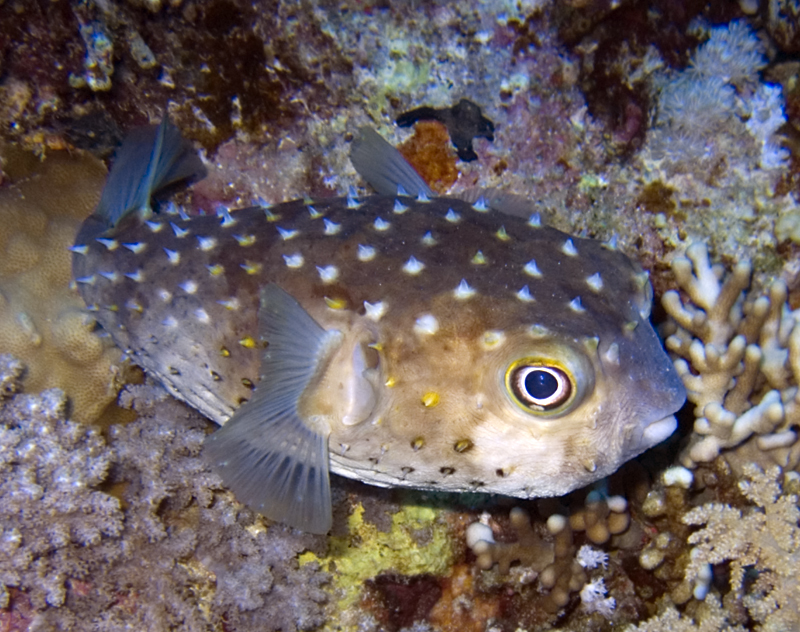 WorldPorcupinefish
Spiny marine fish that inflate into a defensive sphere to deter predators.Other · Coasts and shelves
 🇵🇭 Philippines and 4 moreMilkfish
The sole living species of the family Chanidae, found across the Indo-Pacific.Other · Coasts and shelves
 WorldBigeye trevally
A large marine fish found in tropical oceans, known for its nocturnal hunting and distinctive dark dorsal fin.Other · Coasts and shelves · 1825
 WorldBluehead wrasse
A small Atlantic reef fish known for changing sex and colour.Other · Coral reefs