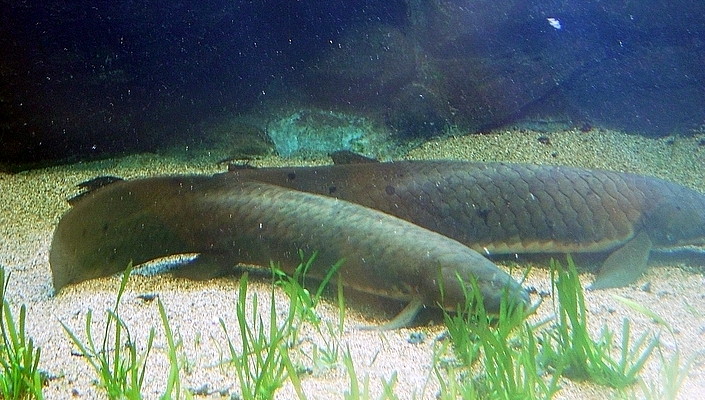
Australian lungfish
Ancient air-breathing fish endemic to Queensland rivers, known for its longevity and living fossil status.
The Australian lungfish (Neoceratodus forsteri) is the sole survivor of its family, native to specific river systems in southeast Queensland. It is a living fossil with a lineage dating back hundreds of millions of years, prized by scientists for its unique biology and extreme lifespan.
- Sole survivor of the Neoceratodontidae family
- Lineage dates back 380 million years
- One individual lived to approximately 109 years old
- Endemic to Mary and Burnett Rivers in Queensland
- Breathes air via a single dorsal lung
What it is
This ancient fish belongs to the only surviving family of its kind, Neoceratodontidae. It possesses a stout, elongated body covered in large bony scales that overlap extensively for protection. The colouration ranges from olive-green or dull brown on the back to pale yellow or orange underneath, with males showing brighter reddish hues during breeding. Adults reach up to 150 cm in length and weigh around 43 kg. They have flattened heads, small eyes with unique photoreceptors, and paddle-shaped tails. Unlike other lungfish, they have large, fleshy pectoral and pelvic fins.
Where it lives
Native exclusively to the Mary and Burnett River systems in south-eastern Queensland, Australia. Historical introductions occurred in the Brisbane, Albert, Stanley, Coomera, Pine, Caboolture, and Condamine Rivers, though survival in these new areas is uncertain. The species prefers slow-flowing rivers and still waters containing aquatic vegetation. It inhabits mud, sand, or gravel bottoms, typically residing in deep pools between three and ten metres. It tolerates cold but thrives in water temperatures ranging from 15 to 25 degrees Celsius.
How it lives
The lungfish is largely sedentary, staying within a single pool or two adjacent ones throughout its life. It does not follow migratory paths but moves toward spawning sites between July and December. It breathes air using a single dorsal lung when water oxygen levels drop due to heat or activity. This facultative air breathing allows it to survive out of water for days if kept moist, unlike African relatives that burrow in cocoons. It is generally inactive during the day but becomes more active in the late afternoon and evening, capable of rapid escape movements using its strong tail.
Breeding and life cycle
Maturity is reached late, around 17 years for males and 22 for females. Spawning occurs from August to November, triggered by day length, in flowing streams over one metre deep. Pairs deposit adhesive eggs among aquatic plants, avoiding algae-covered or stagnant areas. The female lays few eggs, roughly a few hundred in her lifetime, often spaced singly. Eggs hatch after three to four weeks into tadpole-like larvae without external gills. Young grow slowly, feeding once the yolk sac is absorbed, and can reach significant size under optimal conditions.
Fish and people
The settlement of Ceratodus in Queensland derives its name from this species. Named by Gerard Krefft in honour of politician William Forster, it holds scientific value as a living fossil. Its lineage dates back 380 million years, with fossils showing minimal change over 100 million years. One individual, Granddad, lived in the Shedd Aquarium in Chicago for over a century, dying in 2017 at an estimated age of 109. This record highlights its status as one of the longest-living subtropical freshwater fish known to science.
Status and threats
The species is classified as Least Concern globally, though local populations face threats. Habitat degradation, pollution, and dam construction can impact river flows essential for spawning. While historically widespread with seven species in Australia, only this one remains. Conservation efforts focus on protecting the Mary and Burnett River systems. Introductions to other rivers have had mixed success, raising concerns about genetic integrity and ecological balance. Research continues to monitor population health and breeding success in both wild and captive environments.


Questions people ask about Australian lungfish
How long can an Australian lungfish live?
Adults live at least 20 to 25 years. One famous individual named Granddad died in 2017 at an estimated age of 109 years, making it one of the longest-lived subtropical freshwater fish recorded.
Where do Australian lungfish live?
They are endemic to southeast Queensland, Australia. Their primary natural habitat includes the Mary and Burnett River systems, where they inhabit slow-flowing rivers and deep pools with vegetation.
Do Australian lungfish breathe air?
Yes, they are facultative air breathers. They use a single dorsal lung to supplement oxygen intake when water levels are low or temperatures are high, rising to the surface to swallow air.
Why is it called a living fossil?
Fossils identical to modern specimens have been found in northern New South Wales, indicating the genus has remained virtually unchanged for over 100 million years since the Devonian period.
Good reading and sources
- Australian lungfish on WikipediaEncyclopedia
- More photos on Wikimedia CommonsPhotos
- Wikidata recordOpen data
The facts on this page come from the Wikipedia article "Australian lungfish", written by its contributors and used under the CC BY-SA 4.0 licence, and from its Wikidata record (CC0). EveryFish rewrote the text in its own words, with AI assistance, and compares every page with the article to make sure no passage is copied. It may be reused under the same CC BY-SA 4.0 licence with a link back.
It may contain mistakes, and figures change over time. Nothing here is investment or buying advice. If something is wrong, tell us. Last refreshed 2026-11-15.
Like Australian lungfish
All ancient fish 🇳🇬 NigeriaGymnarchus
African electric fish with a long dorsal fin used for swimming and sensing prey.Ancient · Rivers and lakes · 1829
 🇺🇸 United States and 4 moreSea lamprey
A jawless, parasitic fish native to the Northern Hemisphere that attacks other fish.Ancient · Rivers and lakes · 1758
 🇲🇽 Mexico and 2 moreTropical gar
A small freshwater predator from Central America known for its armored scales and air-breathing ability.Ancient · Rivers and lakes
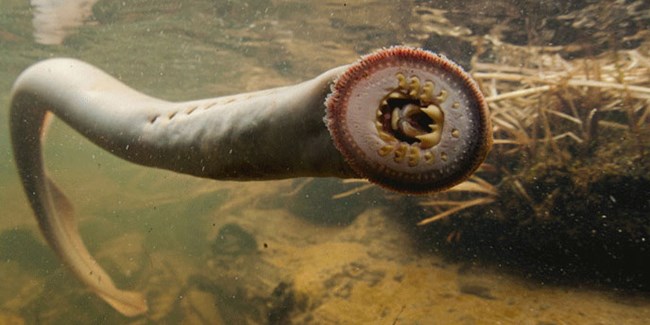 🇺🇸 United States and 1 morePacific lamprey
An anadromous parasitic jawless fish found along the Pacific Rim.Ancient · Rivers and lakes · 1872