
Gymnarchus
African electric fish with a long dorsal fin used for swimming and sensing prey.
Gymnarchus niloticus is a large freshwater fish native to West Africa. It generates weak electric fields to hunt in murky water and swims using an elongated dorsal fin rather than its tail.
- Swims using an elongated dorsal fin instead of a tail.
- Generates weak electric fields to locate prey in dark water.
- Reaches lengths of 1.6 metres and weights of 19 kilograms.
- Builds large nests in flooded swamps using plant material.
- Serves as a gift in Yoruba marriage ceremonies and celebrations.
What it is
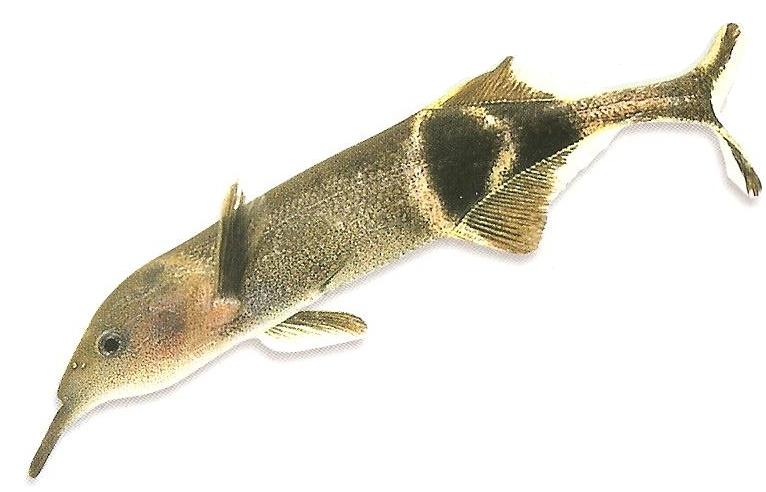
The aba, also called the frankfish, is a slender bony-tongue fish found in African waters. Adults reach 1.6 metres and weigh up to 19 kilograms. The body features brown or grey upper sides and a white belly. Small cycloid scales cover the skin. A single lung allows air breathing. The most distinct feature is the absence of pelvic and anal fins. An elongated dorsal fin runs along the back to the tail. This fin provides propulsion, enabling straight swimming and backward movement. The tail resembles a rat's tail.
Where it lives
This species inhabits tropical freshwaters across West Africa. Populations exist in the Nile, Turkana, Chad, Niger, Volta, Senegal, and Gambia river basins. They dwell at the bottom of rivers and lakes. The distribution is wide but scattered throughout these regions. Habitat conditions vary, but they remain strictly within freshwater environments.
How it lives
Hunting occurs primarily at night due to poor vision. The fish navigates using electroreception to detect prey conductivity. A weak electric field surrounds the body, distorted by nearby objects. Juveniles eat aquatic insects and crustaceans. Adults consume small fish, insects, copepods, shrimps, crabs, frogs, and snails. Large brains help interpret electrical signals. Fish adjust discharge frequencies to avoid interference from others.
Breeding and life cycle
Breeding happens in swamps during flood seasons when rivers overflow. Nests are elliptical structures built up to 1.5 metres across. Thick vegetation and antelope grass provide nesting material. Females lay between 620 and 1378 large eggs. Males outnumber females significantly. Both parents guard the young after hatching. This parental care is unique among related Mormyroid fishes.
Fish and people
The fish holds significant value as food in West Africa. It is eaten raw or smoked, with edible large eggs. High meat content makes it desirable. In Yoruba culture, it serves ceremonial purposes. Suitors present the fish to bride families during marriages. Leaders receive them at community celebrations. Overfishing and habitat destruction threaten local populations. Nigeria lists the species as endangered due to unsustainable practices.
Status and threats
Global conservation status remains least concern according to 2019 assessments. Population trends are currently unknown. Local declines occur in areas like Nigeria. Threats include pollution, dams, logging, and climate change. Unsustainable fishing captures juveniles alongside adults. Captured young often die, reducing future populations. Habitat degradation further stresses ecosystems.


Questions people ask about Gymnarchus
How does this fish navigate in dark water?
It produces a weak electric field around its body. Nearby objects distort this field. The fish senses these distortions through its skin to locate prey and navigate without relying on vision.
What makes its swimming unique?
Unlike most fish that use their tails for thrust, it uses an elongated dorsal fin. This allows it to swim forwards and backwards equally well while keeping its body straight.
Is it safe to eat?
Yes, it is highly valued as food in West Africa. It is commonly eaten raw or smoked. The large eggs are also considered edible by local populations.
Where does it breed?
Spawning occurs in swamps during high water seasons. Floodplains become accessible, allowing the fish to build nests in thickly-vegetated areas using specific plants.
Good reading and sources
The facts on this page come from the Wikipedia article "Gymnarchus", written by its contributors and used under the CC BY-SA 4.0 licence, and from its Wikidata record (CC0). EveryFish rewrote the text in its own words, with AI assistance, and compares every page with the article to make sure no passage is copied. It may be reused under the same CC BY-SA 4.0 licence with a link back.
It may contain mistakes, and figures change over time. Nothing here is investment or buying advice. If something is wrong, tell us. Last refreshed 2026-11-15.
Like Gymnarchus
All ancient fish 🇺🇸 United States and 4 moreSea lamprey
A jawless, parasitic fish native to the Northern Hemisphere that attacks other fish.Ancient · Rivers and lakes · 1758
 🇲🇽 Mexico and 2 moreTropical gar
A small freshwater predator from Central America known for its armored scales and air-breathing ability.Ancient · Rivers and lakes
 🇺🇸 United States and 1 moreShortnose sturgeon
A small, endangered North American sturgeon with a short snout.Ancient · Rivers and lakes · 1818
 🇧🇯 Benin and 4 moreSaddled bichir
A large African freshwater fish with primitive lungs and multiple dorsal finlets.Ancient · Rivers and lakes · 1845