
Thaumatichthys
A genus of deep-sea anglerfish with a unique internal lure and hinged jaws.
Thaumatichthys is a group of three deep-sea fish known for their strange appearance and hunting method. They live on the ocean floor in tropical waters worldwide, using a glowing bait inside their mouths to catch prey.
- Their glowing lure hangs inside their cavernous mouth.
- Females can be up to 36.5 cm long, while males are tiny.
- They live on the ocean floor between 1,000 and 3,600 meters deep.
- Their upper jaw snaps shut like a Venus flytrap to catch prey.
- Three species are recognized: T. axeli, T. binghami, and T. pagidostomus.
What it is
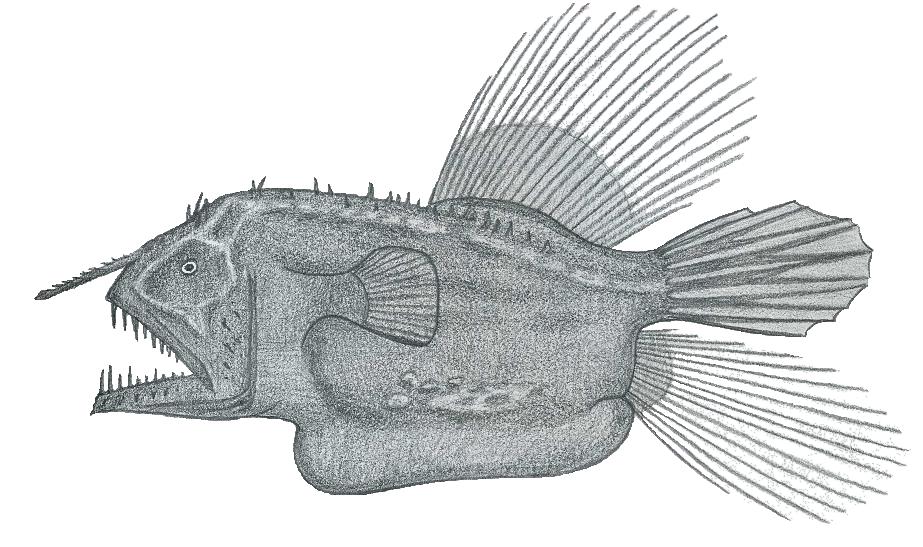
These creatures belong to the family Thaumatichthyidae and are commonly called wonderfish or trapjaw anglerfish. The name comes from Greek words meaning 'wonder' and 'fish'. They have a very distinct shape with a large, flattened head that is almost as long as the rest of their body. Their skin is dark brown or black and covered in tiny spines. Unlike other anglerfish, their glowing lure sits inside their huge mouth. This setup helps them ambush prey near the ocean floor in tropical waters around the world.
Where it lives
They are found in tropical oceans across the globe. One species lives in the eastern Pacific, another in the Caribbean Sea, and a third was found off Sulawesi. Larvae have also been spotted in the Gulf of Guinea and the Mozambique Channel. Adults stay on the bottom, between 1,000 and 3,600 meters deep. They are rarely caught in nets used for open water fishing because they live so close to the seabed.
How it lives
They are ambush predators that wait on the sea floor. Their most famous feature is a jaw mechanism that works like a mousetrap. They use a glowing light inside their mouth to attract animals. When prey gets close, the upper jaw snaps shut to trap it. This allows the lower jaw to keep moving for breathing. Stomach studies show they eat sea cucumbers and sometimes plants, making them omnivores. Males are much smaller than females and may not feed at all after growing up.
Breeding and life cycle
Males and females look completely different. Females are large with big heads and strong jaws. Males are tiny, slender, and have large sense organs but no lure. Male specimens measure only about 45 millimeters long. Larvae start life near the surface in shallow water. As they grow, they swim deeper until they reach the bottom to become adults. Scientists do not yet know if adult males attach to females like some other anglerfish.
Fish and people
They live too deep for recreational fishing and are not farmed. Because they are rare and hard to catch, they are mostly studied by scientists. No cultural or food uses are recorded for these deep-sea dwellers.
Status and threats
They are difficult to study because they live in extreme depths and are rarely captured. Most knowledge comes from a few specimens caught by bottom trawling. Without more data, it is unclear if they face threats from pollution or fishing.


Questions people ask about Thaumatichthys
What makes the Thaumatichthys different from other anglerfish?
Unlike most anglerfish, their bioluminescent lure is located inside their mouth rather than on a rod above it. They also have a unique jaw structure that hinges down to trap prey, similar to a mousetrap, allowing them to remain stationary while hunting.
How do male Thaumatichthys differ from females?
Males are significantly smaller, reaching only about 45 millimeters, and lack the glowing lure. They have enlarged sense organs and hooked teeth but appear unable to feed effectively after maturing, unlike the large, predatory females.
Where do these fish live in the ocean?
They are found in tropical oceans worldwide, including the Atlantic, Pacific, and Indian Oceans. Adults are benthic, living on the continental shelf or abyssal zone at depths ranging from 1,000 to 3,600 meters.
What do Thaumatichthys eat?
Studies of stomach contents reveal they eat sea cucumbers and have been found with plant matter. This suggests they are omnivores, though the plant material might have been swallowed accidentally along with their primary animal prey.
Good reading and sources
- Thaumatichthys on WikipediaEncyclopedia
- More photos on Wikimedia CommonsPhotos
- Wikidata recordOpen data
The facts on this page come from the Wikipedia article "Thaumatichthys", written by its contributors and used under the CC BY-SA 4.0 licence, and from its Wikidata record (CC0). EveryFish rewrote the text in its own words, with AI assistance, and compares every page with the article to make sure no passage is copied. It may be reused under the same CC BY-SA 4.0 licence with a link back.
It may contain mistakes, and figures change over time. Nothing here is investment or buying advice. If something is wrong, tell us. Last refreshed 2026-11-15.
Like Thaumatichthys
All sharks WorldStoplight loosejaw
Deep-sea dragonfish that hunts with invisible red light.Shark · Deep sea · 1848
 WorldChaunax
A genus of deep-sea anglerfishes known for their large mouths and luring habits.Shark · Deep sea · 1846
 🇿🇦 South Africa and 4 moreWhale shark
The largest living fish species, a gentle giant of tropical oceans.Shark · Open ocean · 1829
 WorldHairy angler
A deep-sea anglerfish with thread-like fins found in the Atlantic and Pacific Oceans.Shark · Deep sea · 1930