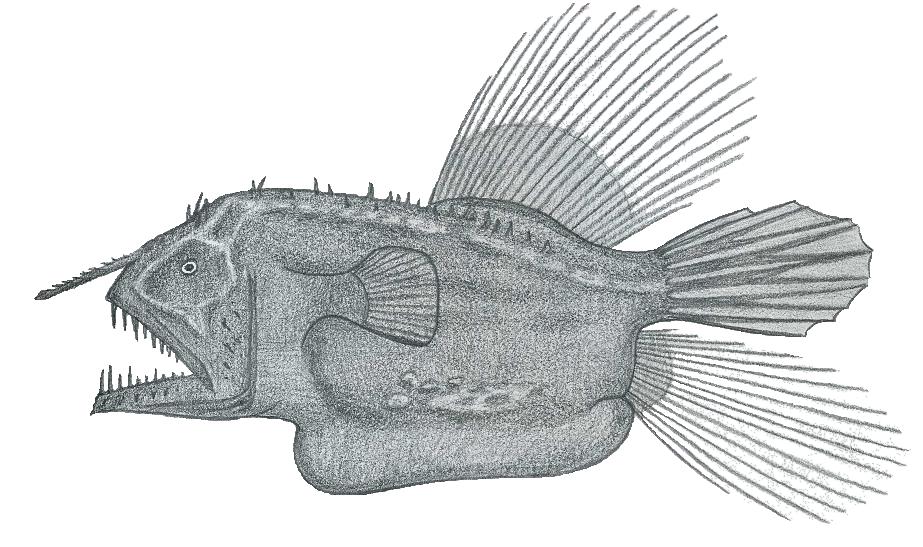
Hairy angler
A deep-sea anglerfish with thread-like fins found in the Atlantic and Pacific Oceans.
The hairy angler is a marine ray-finned fish known for extreme sexual dimorphism. Males act as parasites on females, merging with their bodies to reproduce in the dark ocean depths.
- Males merge with females to form a single reproductive unit.
- Dorsal fins have thread-like rays with sensory cells at the tips.
- Found at depths up to 2,100 metres in the Atlantic and Pacific.
- Maximum length reaches 21 centimetres.
- First described by Charles Tate Regan in 1930.
What it is
This species belongs to the fanfin family and lives in the dark ocean. Females have round bodies with large mouths and thin, backward-curving teeth. Their dorsal and anal fins feature long, thread-like rays that house sensory cells. The lure lacks a bulb but has filaments. Males are smaller with elongated bodies, large eyes, and no teeth. They use tooth-like structures on their jaws to grip females. The maximum recorded length is 21 cm.
Where it lives
It inhabits the Atlantic from Florida to Iceland and south to Cape Verde. Records also exist off Namibia and in the Eastern Pacific near California, Hawaii, and Baja California. These fish dwell in mesopelagic and bathypelagic zones. They live at depths ranging from 585 to 2,100 metres. This habitat places them well below the sunlit surface waters.
How it lives
Females are predators that use their esca to attract prey into striking range. Males possess sophisticated sensory organs to locate females. Upon finding a mate, the male attaches to the female. He eventually merges his circulatory and nervous systems with hers. This parasitic relationship ensures reproduction in the sparse deep-sea environment.
Breeding and life cycle
Reproduction relies on extreme sexual dimorphism. Males function as sexual parasites attached to females. They merge physically to share nutrients and signals. The specific name polynema refers to the many threads on the illicium. These filaments aid in the complex reproductive strategy unique to this group.
Fish and people
No commercial or recreational uses are documented for this species. Its deep-water habitat makes it inaccessible to most human activities. It holds no known place in local fisheries or aquarium trades. Research focuses on its biological adaptations rather than exploitation.
Status and threats
The provided text does not mention conservation assessments. No threats like overfishing or pollution are listed. Data deficiency may apply due to the difficulty of studying deep-sea environments. Current protection status remains unknown based on available information.
Questions people ask about Hairy angler
What is the hairy angler?
It is a deep-sea ray-finned fish in the fanfin family. Females have round bodies and thread-like fins. Males are much smaller and attach to females as parasites.
Where does it live?
It inhabits the Atlantic and Pacific Oceans. Ranges include Florida, Iceland, and Namibia. Depths vary from 585 to 2,100 metres in dark water zones.
How do they reproduce?
Males find females using sensory organs. They attach permanently and merge circulatory systems. This parasitic method ensures breeding in sparse populations.
What does it eat?
Females lure prey using a simple esca on their head. They wait in the dark for food to approach before striking. Males rely on the female for nutrition after attachment.
Good reading and sources
- Caulophryne polynema on WikipediaEncyclopedia
- More photos on Wikimedia CommonsPhotos
- Wikidata recordOpen data
The facts on this page come from the Wikipedia article "Caulophryne polynema", written by its contributors and used under the CC BY-SA 4.0 licence, and from its Wikidata record (CC0). EveryFish rewrote the text in its own words, with AI assistance, and compares every page with the article to make sure no passage is copied. It may be reused under the same CC BY-SA 4.0 licence with a link back.
It may contain mistakes, and figures change over time. Nothing here is investment or buying advice. If something is wrong, tell us. Last refreshed 2026-11-15.
Like Hairy angler
All sharks WorldThaumatichthys
A genus of deep-sea anglerfish with a unique internal lure and hinged jaws.Shark · Deep sea · 1908
 🇺🇸 United States and 3 moreStethacanthus
Extinct Devonian-Carboniferous shark with a distinctive anvil-shaped dorsal fin.Shark · Coasts and shelves · 1874
 WorldStoplight loosejaw
Deep-sea dragonfish that hunts with invisible red light.Shark · Deep sea · 1848
 WorldChaunax
A genus of deep-sea anglerfishes known for their large mouths and luring habits.Shark · Deep sea · 1846