
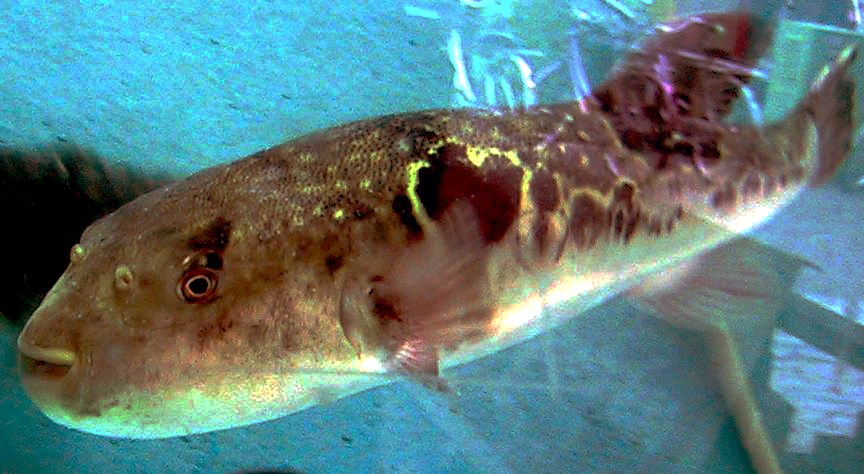
Japanese puffer
A small-genome pufferfish used in genomics and cuisine.
The Japanese puffer is a demersal fish found in East Asian seas. It serves as a key model for genomic research due to its compact DNA structure. Commercially valuable in Japan, it faces conservation challenges from overfishing despite aquaculture efforts.
- Genome is ~6% the size of the human genome.
- First vertebrate genome after human to be public.
- Tetrodotoxin is absent from skin and testes.
- Juveniles mature in estuaries for one year.
- Genetically modified variants grow 1.9 times faster.
What it is
The Japanese puffer, or torafugu, belongs to the genus Takifugu. Its name derives from Japanese for puffer and Latin for ruddy foot. This demersal species lives on the sea floor. It is distinct for having a very small genome, which scientists have fully sequenced. The fish is widely used as a reference in genetic studies because its DNA structure helps identify genes in humans and other vertebrates.
Where it lives
This species inhabits the Sea of Japan, East China Sea, and Yellow Sea. Its range extends north to southern Sakhalin. Adults live at depths between 10 and 135 metres. Spawning takes place in estuaries. Young fish tolerate varied salinity levels and stay in river mouths and lagoons. They mature there for one year before moving permanently to the open ocean.
How it lives
As a demersal fish, it lives near the seabed. Juveniles remain in brackish waters during their first year. After maturing, they migrate to marine environments. The species is known for its compact genetic makeup rather than specific behavioural traits like schooling or predation in the provided records. It serves primarily as a biological model for comparative genomic studies.
Breeding and life cycle
Spawning occurs in estuarine environments. The young can handle a wide range of salt concentrations. They reside in river mouths and lagoons for their first year of life. This period allows them to mature before they migrate to the open ocean for the rest of their lives. This migratory pattern connects freshwater and marine habitats.
Fish and people
Torafugu is highly valued in Japan as a food fish. Some organs contain tetrodotoxin, a potent poison concentrated in the liver and ovaries. The skin and testes are free of this toxin. Aquaculture is extensive. A genetically modified variant with removed appetite-control genes grows faster and is sold commercially. The genome was published in 2002, aiding human gene identification.
Status and threats
The IUCN classifies the Japanese puffer as Near Threatened. Catches have declined from a peak of 2,000 tonnes in 1987 to 101 tonnes in 2004. These levels appear unsustainable and hinder recovery from past over-exploitation. Experts recommend gear restrictions and seasonal adjustments to protect juveniles. Most fishing uses longlines. Aquaculture helps meet demand.
Questions people ask about Japanese puffer
Why is the Japanese puffer important for science?
It has a very small genome that is fully sequenced. Scientists use it as a reference to identify genes in human and other vertebrate genomes. It was the first vertebrate genome after the human one to be made publicly available.
Is the Japanese puffer safe to eat?
Some organs contain tetrodotoxin, which is highly toxic. The poison is concentrated in the liver and ovaries. However, the toxin is absent from the skin and testes. Proper preparation is essential to avoid poisoning.
Where do young Japanese puffers live?
Spawning occurs in estuaries. Young fish tolerate various salinities and remain in river mouths and lagoons. They mature there for one year before migrating permanently to the open ocean.
Good reading and sources
- Takifugu rubripes on WikipediaEncyclopedia
- More photos on Wikimedia CommonsPhotos
- Wikidata recordOpen data
The facts on this page come from the Wikipedia article "Takifugu rubripes", written by its contributors and used under the CC BY-SA 4.0 licence, and from its Wikidata record (CC0). EveryFish rewrote the text in its own words, with AI assistance, and compares every page with the article to make sure no passage is copied. It may be reused under the same CC BY-SA 4.0 licence with a link back.
It may contain mistakes, and figures change over time. Nothing here is investment or buying advice. If something is wrong, tell us. Last refreshed 2026-11-15.
Like Japanese puffer
All other fish 🇵🇭 Philippines and 4 moreMilkfish
The sole living species of the family Chanidae, found across the Indo-Pacific.Other · Coasts and shelves
 🇧🇷 Brazil and 3 moreTambaqui
A large freshwater fish from South America known for its heavy body and seed-eating habits.Other · Rivers and lakes
 🇦🇺 Australia and 1 moreAustralian ghostshark
A cartilaginous fish native to southern Australia and New Zealand waters.Other · Coasts and shelves
 🇦🇷 Argentina and 4 moreArgentinian silverside
A large, adaptable silverside native to South America.Other · Rivers and lakes
More from Tetraodontidae
All of them WorldStarry toado
A pufferfish found in subtropical oceans worldwide.Other · Coasts and shelves
 Sub-Saharan AfricaMbu pufferfish
Large carnivorous freshwater puffer from the Congo River.Other · Rivers and lakes
 🇰🇭 Cambodia and 1 moreFigure 8 puffer
A small brackish water pufferfish with distinctive eye-like markings.Other · Rivers and lakes
 🇮🇳 IndiaDwarf pufferfish
A tiny freshwater pufferfish from India prized for its bright colours and small size in home aquaria.Other · Rivers and lakes · 1941