
Swordfish
Large migratory fish with a long flat bill, sole member of its family.
The swordfish is a large predatory fish found in tropical and temperate oceans worldwide. It is the only species in the family Xiphiidae and is known for its distinctive elongated bill used to slash prey.
- Maximum recorded weight is 682 kg.
- Heater cells warm eyes and brains significantly.
- Females produce up to 29 million eggs per batch.
- Kashrut status varies between Orthodox and Conservative views.
- North Atlantic stock rebuilt to 5% above target levels.
What it is
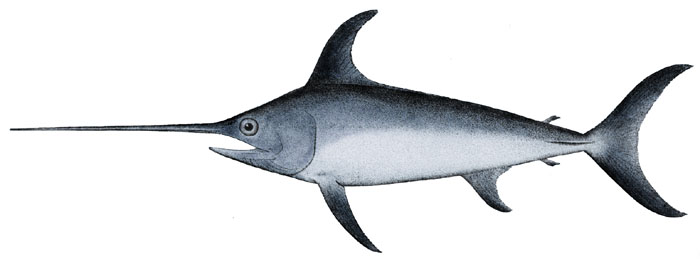
This species is a large, round-bodied fish characterized by a long, flat, sword-like bill. Adults lose their teeth and scales as they mature. They are the sole members of the family Xiphiidae. The name derives from Greek and Latin words for sword. Females grow larger than males, and Pacific populations reach greater sizes than those in the northwest Atlantic or Mediterranean.
Where it lives
They inhabit tropical and temperate regions across the Atlantic, Pacific, and Indian Oceans. They prefer water temperatures between 18 and 22 °C but tolerate ranges from 5 to 27 °C. These fish migrate toward colder areas to feed during summer months. They typically swim from near the surface down to 550 m, though records show dives to 2,878 m.
How it lives
Swordfish are solitary or form loose groups, rarely schooling. They use their bills to slash prey rather than spear it. Special heater cells around the eyes maintain brain temperature 10–15 °C above ambient water, enhancing vision. They feed mainly at night on squid, mackerel, herring, and crustaceans. Juveniles face predation from sharks and marine mammals, while adults have few natural enemies.
Breeding and life cycle
Spawning occurs in warm waters above 23–24 °C. In the North Pacific, this happens in spring and summer; in the Caribbean, it is year-round. Large females produce between one and twenty-nine million pelagic eggs. Larvae hatch at 4 mm with visible bills and develop rapidly. Eggs measure 1.6–1.8 mm in diameter, with embryonic development starting two and a half days after fertilization.
Fish and people
Swordfish are popular sport fish and food sources. They are often grilled as steaks due to firm flesh. Some flesh shows an orange tint from shrimp diets, sold as pumpkin swordfish. The FDA warns against consumption by pregnant women and children due to methylmercury. Traditional fishing includes harpoons and longlines. Recreational methods include deep-drop fishing with heavy weights and glow lures.
Status and threats
Conservation efforts began in 1998 with campaigns highlighting overfishing risks. A ban on sales and imports was proposed, leading to protected areas in the Atlantic. The North Atlantic stock has rebuilt to levels 5% above targets. No robust assessments exist for the northwestern Pacific or South Atlantic. Longlining bans along coasts have aided population recovery in some regions.


Questions people ask about Swordfish
Is swordfish safe to eat?
The FDA warns that swordfish contain high methylmercury levels. Pregnant women, nursing mothers, and young children are advised not to eat them. Other consumers should limit intake due to potential toxicity risks associated with mercury accumulation in large predatory fish.
How do swordfish see in deep water?
They possess special heater cells next to their eyes that raise brain and eye temperatures 10–15 °C above surrounding water. This thermal regulation improves visual acuity, allowing them to hunt effectively in darker, deeper environments where prey might be less visible.
Are swordfish kosher?
Opinions differ among Jewish authorities. Standard Orthodox Judaism considers them non-kosher due to scale loss. Conservative Judaism accepts them as kosher. Historical texts suggest they were born with scales, which shed later. Mediterranean Jewish communities traditionally consumed them despite modern debates.
What is the largest swordfish caught?
The maximum reported length is 4.55 meters with a weight of 682 kilograms. The International Game Fish Association record is a 536 kg specimen taken off Chile in 1953. Pacific individuals generally grow larger than those in the Atlantic or Mediterranean.
Good reading and sources
- Sharks Wash Up on Beaches, Stabbed by Swordfish (Published 2020)The New York Times, Article
- Client ChallengeNature, Article
The facts on this page come from the Wikipedia article "Swordfish", written by its contributors and used under the CC BY-SA 4.0 licence, and from its Wikidata record (CC0). EveryFish rewrote the text in its own words, with AI assistance, and compares every page with the article to make sure no passage is copied. It may be reused under the same CC BY-SA 4.0 licence with a link back.
It may contain mistakes, and figures change over time. Nothing here is investment or buying advice. If something is wrong, tell us. Last refreshed 2026-11-15.
Like Swordfish
All other fish WorldMackerel
A group of pelagic fish known for their speed, stripes, and role in global fisheries.Tuna · Open ocean
 WorldIndo-Pacific sailfish
Fast ocean predator with a large dorsal finOther · Coasts and shelves
 🇺🇸 United States and 2 moreLingcod
A large predatory fish of the North American Pacific coast.Other · Coasts and shelves
 WorldCobia
A large, solitary marine fish found in warm tropical and subtropical waters worldwide.Other · Coasts and shelves