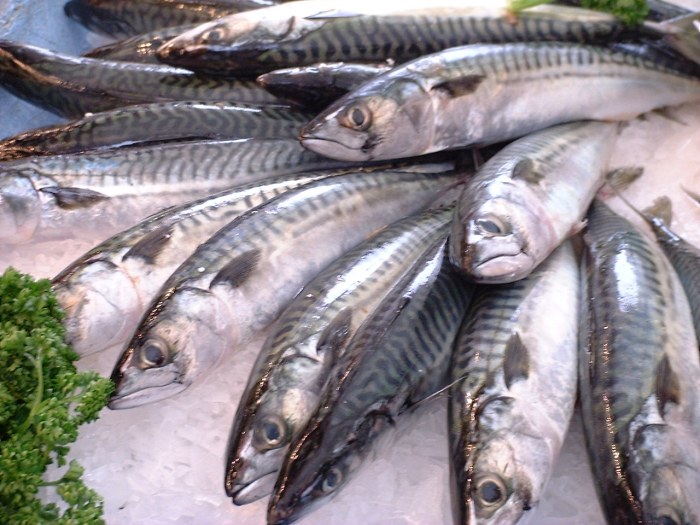
Mackerel
A group of pelagic fish known for their speed, stripes, and role in global fisheries.
Mackerel refers to numerous species within the family Scombridae, primarily inhabiting temperate and tropical oceans. These swift swimmers are vital to marine ecosystems as prey and to humans as a major food source, though some stocks face pressure from intense commercial harvesting.
- Atlantic mackerel swims at 0.98 m/sec sustained speed.
- Females lay between 300,000 and 1,500,000 floating eggs.
- Stripes help fish align and match speed while schooling.
- Chub mackerel accounts for half of scombroid catch.
- Flesh spoils quickly and can cause food poisoning if not fresh.
What it is
Mackerel describes a collection of fast-swimming fish, most belonging to the family Scombridae. They typically display iridescent green-blue backs with vertical dark stripes that help them coordinate movements while schooling. Their bodies are slender and cylindrical, lacking swim bladders, which allows them to retract fins into body grooves for streamlined swimming. While closely related to tuna, they are generally smaller and slimmer. Some species, like the king mackerel, grow larger, but many remain small enough to serve as forage for predators.
Where it lives
These fish inhabit temperate and tropical seas across the globe, avoiding the polar regions. Most species have restricted ranges, though some, like the wahoo, span multiple oceans. Populations often form distinct stocks based on geography. Certain types migrate vertically, moving deeper during daylight and rising to feed at night. Others undertake long horizontal migrations between feeding and spawning grounds, sometimes crossing entire ocean basins or moving along coastlines.
How it lives
Adult mackerel hunt small crustaceans, shrimp, squid, and smaller fish using sharp teeth. They are highly social, forming large schools where stripes act as visual cues for alignment and speed matching. This schooling behaviour attracts predators such as sharks, tuna, billfish, seabirds, and whales. The fish are powerful swimmers capable of rapid bursts. Younger individuals feed primarily on zooplankton before developing predatory habits as they mature into active hunters within the pelagic zone.
Breeding and life cycle
Mackerel are prolific spawners that release eggs near the water surface. Females produce hundreds of thousands of eggs that float freely in the open sea. Larvae and juveniles drift as plankton, consuming microscopic organisms before growing teeth and shifting to animal prey. Spawning often occurs in shallow coastal waters where adults gather in shoals. After breeding, groups may disperse to feeding areas, sometimes returning to previous locations in smaller numbers.
Fish and people
Humans harvest mackerel extensively for food, with chub mackerel and Atlantic mackerel dominating global catches. The flesh is rich in omega-3 oils but spoils quickly, requiring immediate consumption, refrigeration, salting, or smoking. Historically, preservation methods were limited, leading to issues with spoilage. In some cultures, the fish faced stigma due to folklore about its diet. Today, it remains a staple seafood item, while sport fishermen prize species like the king mackerel for their fighting strength.
Status and threats
Intensive fishing has impacted several mackerel stocks. The North Sea experienced ecological disruption due to overfishing, affecting industry jobs. In the Southeast US, king and Spanish mackerel faced depletion in the 1980s, prompting regulations on size, location, and bag limits that aided recovery by 2001. Chilean jack mackerel fisheries have also suffered from heavy exploitation, raising concerns about potential collapse. Management strategies continue to evolve to balance commercial needs with stock sustainability.


Questions people ask about Mackerel
What do mackerel eat?
Adult mackerel hunt small crustaceans like copepods, shrimp, squid, and other small fish using sharp teeth. Juveniles feed on zooplankton drifting in the open sea until they mature into predators.
Are all mackerel the same species?
No. Mackerel refers to over thirty species, mostly in the family Scombridae. It includes true mackerels, Spanish mackerels, and even some unrelated fish like jack mackerel that share similar physical traits or names.
Why do mackerel have stripes?
The vertical stripes act as visual cues that help fish in a school align themselves with neighbours and match swimming speeds. Reflective platelets in the stripes may also convey movement information to nearby fish.
How is mackerel preserved?
Because the flesh spoils rapidly, especially in warm climates, it must be eaten fresh, refrigerated, salted, smoked, or canned. Historical methods relied heavily on salting and smoking before modern refrigeration became available.
Good reading and sources
- In Mackerel's Plunder, Hints of Epic Fish Collapse (Published 2012)The New York Times, Article
- Why is Britain braced for a mackerel war?BBC, Article
The facts on this page come from the Wikipedia article "Mackerel", written by its contributors and used under the CC BY-SA 4.0 licence, and from its Wikidata record (CC0). EveryFish rewrote the text in its own words, with AI assistance, and compares every page with the article to make sure no passage is copied. It may be reused under the same CC BY-SA 4.0 licence with a link back.
It may contain mistakes, and figures change over time. Nothing here is investment or buying advice. If something is wrong, tell us. Last refreshed 2026-11-15.
Like Mackerel
All tunas and mackerels 🇳🇴 Norway and 2 moreAtlantic mackerel
Fast-swimming, oily fish of the North AtlanticTuna · Coasts and shelves · 1758
 WorldAtlantic bluefin tuna
Large, warm-blooded tuna of the Atlantic and Mediterranean.Tuna · Open ocean · 1758
 🇺🇸 United States and 2 moreLingcod
A large predatory fish of the North American Pacific coast.Other · Coasts and shelves
 🇺🇸 United States and 3 morePacific bonito
Striped marine fish of the Pacific coastTuna · Coasts and shelves
More from Scombridae
All of them WorldDogtooth tuna
A large Indo-Pacific bonito prized by sport anglers.Tuna · Coasts and shelves
 WorldBullet tuna
Small, slender tuna found in tropical oceans worldwide.Tuna · Open ocean
 WorldBlue mackerel
A small, fast pelagic fish found in tropical Indo-Pacific waters.Tuna · Coasts and shelves
WorldSlender tuna
A southern ocean tuna with oily flesh and a slender build.Tuna · Open ocean