
Spiny seahorse
A small, thorn-covered marine fish from the Indo-Pacific.
The spiny seahorse is a small marine fish native to the Indo-Pacific region. It lives in deep waters on seagrass beds and reefs. The species is listed as Vulnerable due to habitat loss and fishing bycatch.
- Covered in sharp thorns with dark tips
- Lives in deep waters up to 95 metres
- Male broods eggs in a ventral pouch
- Listed as Vulnerable by the IUCN
- Commonly caught as bycatch in shrimp trawls
What it is
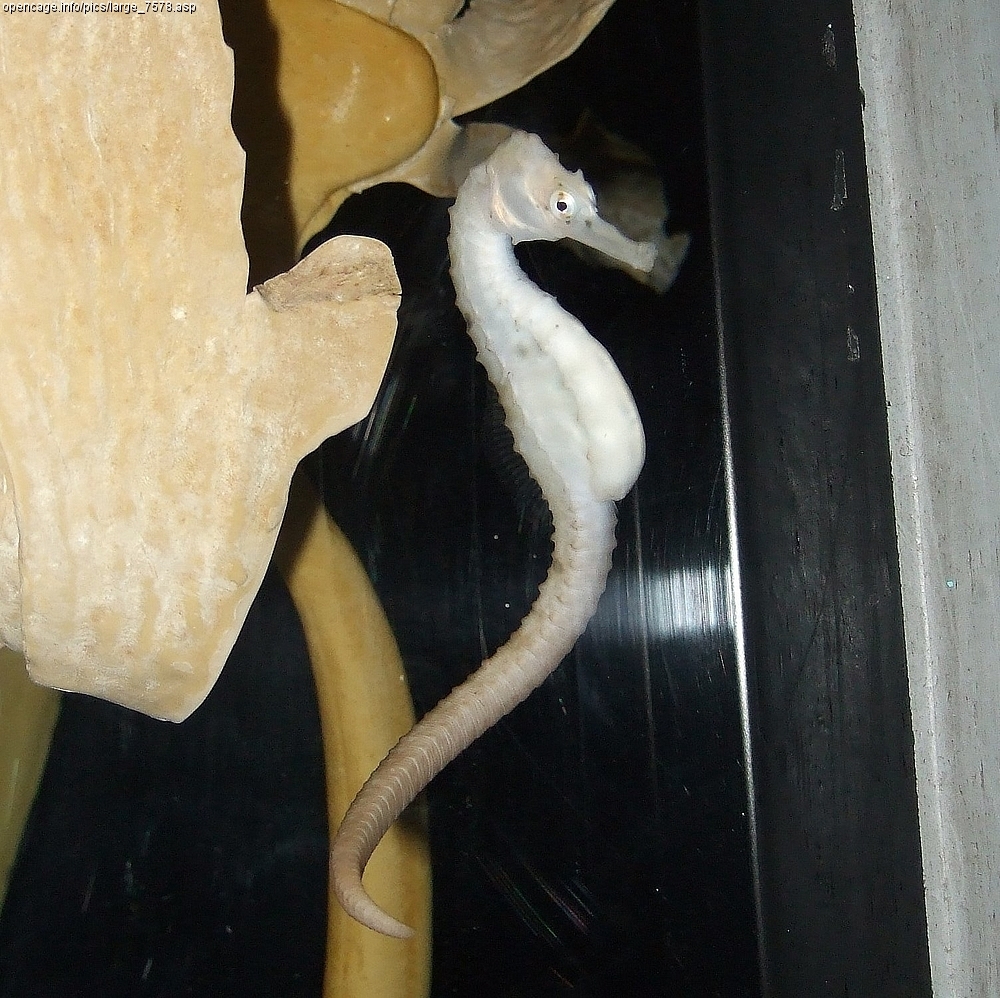
The spiny seahorse is a small marine fish belonging to the family Syngnathidae. Its body is slender and elongated, reaching a maximum length of 17 cm. The entire surface is covered with sharp thorns that have dark tips. These spines are uniform on the tail but longer on the trunk and head. The snout is long and tapered, often marked with thin white lines. Colouration varies widely to match the environment, ranging from grey and cream to bright yellow, green, red, or brown. Patterns may appear on the sides or back.
Where it lives
This species is widespread but relatively rare across the Indo-Pacific. Records exist from the Timor Sea and Great Barrier Reef in Australia, extending to Port Stephens in New South Wales. It is also found in Bali, Papua New Guinea, New Caledonia, and Japan. The fish favours deeper waters, typically between 10 and 95 metres, and is usually seen below 15 metres. It inhabits various substrates, including sponges, soft corals, and weedy rocky reefs, but shows a strong preference for seagrass beds.
How it lives
The spiny seahorse is carnivorous, feeding on small crustaceans and other planktonic organisms. It relies on its ability to blend into surroundings for protection. While specific schooling behaviour is not detailed, it shares general seahorse traits of limited mobility. Predation risks are high due to its small size and slow movement. The species faces significant threats from non-selective fishing gear, particularly shrimp trawls, which degrade its habitat and capture individuals as bycatch.
Breeding and life cycle
Reproduction is ovoviviparous, meaning eggs develop inside the body before hatching. The female uses an ovipositor to transfer eggs into a sealed pouch on the male’s abdomen. The male fertilises the eggs internally and broods them. His pouch contains villi rich in capillaries, acting like a placenta to supply oxygen and possibly nourishment. He also regulates salt balance for the developing embryos. Once fully grown, the young are expelled and live independently.
Fish and people
The spiny seahorse is one of the six most common seahorses in international trade. It is caught directly or as bycatch in shrimp fisheries. While less common in the aquarium trade due to its deep-water habitat, it is sold dried for traditional medicine or as decorations. Its spines make it less desirable for some medicinal uses. Trade has been reported since the mid-1990s, with fishers noting declining availability. It is listed under CITES Appendix II to control trade.
Status and threats
The IUCN lists the species as Vulnerable. Populations have declined by more than 30 per cent over the last 10 to 15 years. Major threats include habitat destruction, specifically the loss of seagrass beds due to coastal construction, dredging, and pollution. Bycatch in shrimp trawls is a primary cause of population loss. Conservation efforts are complicated because much of the trade comes from non-selective fishing rather than targeted collection, making export quotas less effective.


Questions people ask about Spiny seahorse
How big does the spiny seahorse get?
It is a small fish that reaches a maximum length of 15 to 17 centimetres. Its body is slender and elongated, covered entirely in sharp thorns.
Where does the spiny seahorse live?
It is found in the Indo-Pacific, including Australia, Indonesia, and Japan. It prefers relatively deep waters between 10 and 95 metres, mainly on seagrass beds.
Why is the spiny seahorse vulnerable?
Populations have dropped by over 30 per cent due to habitat loss and bycatch in shrimp trawls. It is also traded for traditional medicine and decorations.
How do spiny seahorses reproduce?
The female transfers eggs to the male’s abdominal pouch. The male fertilises and broods them, providing oxygen and protection until the young are born.
Good reading and sources
- Spiny seahorse on WikipediaEncyclopedia
- More photos on Wikimedia CommonsPhotos
- Wikidata recordOpen data
The facts on this page come from the Wikipedia article "Spiny seahorse", written by its contributors and used under the CC BY-SA 4.0 licence, and from its Wikidata record (CC0). EveryFish rewrote the text in its own words, with AI assistance, and compares every page with the article to make sure no passage is copied. It may be reused under the same CC BY-SA 4.0 licence with a link back.
It may contain mistakes, and figures change over time. Nothing here is investment or buying advice. If something is wrong, tell us. Last refreshed 2026-11-15.
Like Spiny seahorse
All other fish WorldCommon seahorse
A small, spotted seahorse found in Indo-Pacific coastal waters.Other · Estuaries and mangroves
 🇦🇺 AustraliaCommon seadragon
Camouflaged marine fish with leaf-like appendages found in southern Australia.Other · Coasts and shelves
 WorldSeahorse
Small marine fish with horse-like heads and curled tails in the genus Hippocampus.Other · Coasts and shelves
 🇺🇸 United States and 3 moreLined seahorse
A western Atlantic seahorse with white neck lines and male pregnancy.Other · Coasts and shelves · 1810
More from Syngnathidae
All of them Southeast AsiaPygmy seahorse
Tiny seahorses with unique brooding and camouflage traits found in Southeast Asian reefs.Other · Coasts and shelves
 🇦🇺 Australia and 1 moreBig-belly seahorse
The largest seahorse species, found in southern Australia and New Zealand.Other · Coasts and shelves
 🇦🇺 AustraliaLeafy seadragon
A marine fish from southern Australia known for its leaf-like skin appendages used for camouflage.Other · Coasts and shelves · 1865
 OceaniaBargibant's seahorse
Tiny seahorse camouflaged on sea-fansOther · Coral reefs · 1970