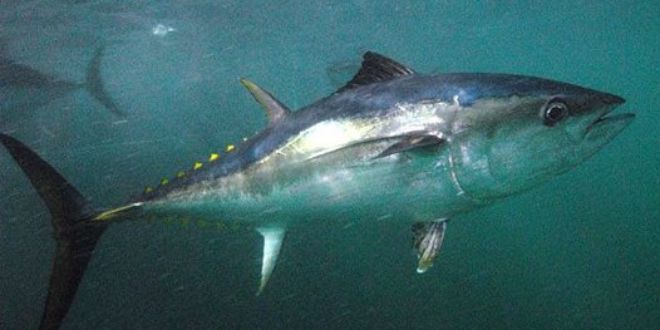
Southern bluefin tuna
Large migratory tuna of the southern oceans.
The southern bluefin tuna is a large pelagic fish found in open waters of the southern hemisphere. It maintains high body temperatures to support rapid swimming and long migrations between Australia and the Indian Ocean. Listed as endangered, it faces pressure from fishing and environmental changes.
- Can maintain body temperature 10 °C above ambient water
- Dives to depths of 2,500 metres
- Must swim continuously to breathe via ram ventilation
- Listed as Endangered by the IUCN
- Reaches weights of up to 260 kilograms
What it is
This species belongs to the mackerel family and ranks among the largest bony fishes. Adults reach lengths of 2.5 metres and weights of 260 kilograms. It possesses a streamlined body built for speed and endurance in open water. Unlike many fish, it can keep its core temperature significantly higher than the surrounding sea. This adaptation supports intense physical activity and allows it to inhabit a wide range of thermal environments.
Where it lives
These tunas inhabit the open oceans of the southern hemisphere, primarily between latitudes 30°S and 50°S. They travel as far south as 60°S. Their migrations cover vast distances, moving between tropical and cool temperate zones. Seasonal movements often take them from waters off Australia into the Indian Ocean. They dive to depths of 2,500 metres, enduring temperatures as low as 3 °C. During spawning, they seek warmer waters reaching 30 °C.
How it lives
As opportunistic predators, they feed on various fish, crustaceans, cephalopods, and salps. Their high metabolic rate demands constant movement and efficient oxygen uptake. They swim continuously to force water over their gills, a process known as ram ventilation. If they stop swimming, they cannot breathe. Their muscles generate heat, which is retained by a network of blood vessels. This thermoregulation allows them to hunt effectively in cold deep waters while maintaining muscle function.
Breeding and life cycle
Spawning occurs in warm surface waters where temperatures can reach 30 °C. The specific timing and locations are tied to these thermal preferences. The physiological stress of moving between cold feeding grounds and warm spawning areas is significant for their circulatory systems.
Fish and people
Humans value this fish as a food source. Its status as an endangered species highlights concerns over population levels. Conservation efforts aim to manage fishing pressures and protect habitats. The high demand for tuna meat drives commercial interest, but sustainable practices are critical given their slow growth and late maturity compared to smaller fish species.
Status and threats
The International Union for Conservation of Nature lists this species as Endangered. Threats include overfishing and the challenges of managing a highly migratory stock across international boundaries. Their complex physiology makes them sensitive to environmental changes. Protecting their breeding grounds and migration routes is essential for recovery. Current measures focus on limiting catch quotas and monitoring population trends.


Questions people ask about Southern bluefin tuna
Why must southern bluefin tuna keep swimming?
They are obligate ram ventilators, meaning they rely on forward motion to push water over their gills for oxygen. Unlike other fish, they lack the pump mechanism to move water while stationary. Stopping would cause them to suffocate due to lack of airflow.
How do they stay warm in cold water?
They use a countercurrent heat exchange system called rete mirabile. Blood vessels are arranged so that heat from working muscles warms the incoming cold blood. This keeps their core temperature up to 10 °C higher than the surrounding ocean.
What is their conservation status?
The species is listed as Endangered by the IUCN. This classification reflects significant population declines due to historical overfishing and ongoing management challenges. Conservation programmes now strictly regulate catches to allow stocks to recover.
Good reading and sources
- Southern bluefin tuna on WikipediaEncyclopedia
- More photos on Wikimedia CommonsPhotos
- Wikidata recordOpen data
The facts on this page come from the Wikipedia article "Southern bluefin tuna", written by its contributors and used under the CC BY-SA 4.0 licence, and from its Wikidata record (CC0). EveryFish rewrote the text in its own words, with AI assistance, and compares every page with the article to make sure no passage is copied. It may be reused under the same CC BY-SA 4.0 licence with a link back.
It may contain mistakes, and figures change over time. Nothing here is investment or buying advice. If something is wrong, tell us. Last refreshed 2026-11-15.
Like Southern bluefin tuna
All tunas and mackerels WorldBigeye tuna
Deep-bodied tuna of tropical and temperate oceans.Tuna · Open ocean
 🇺🇸 United States and 3 morePacific bonito
Striped marine fish of the Pacific coastTuna · Coasts and shelves
 WorldMackerel
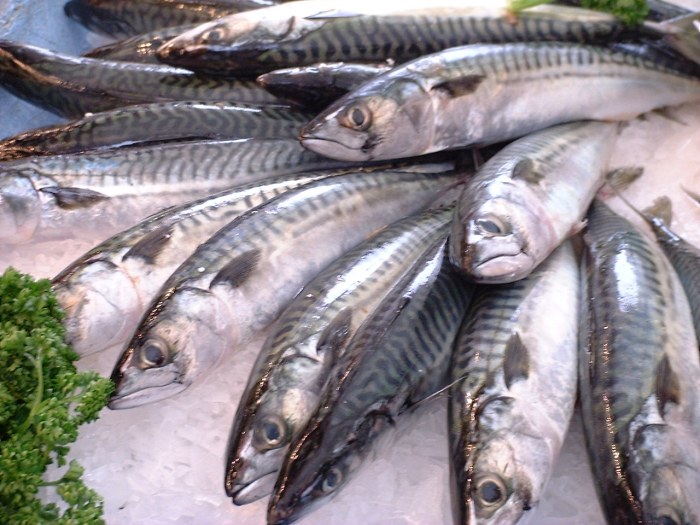
A group of pelagic fish known for their speed, stripes, and role in global fisheries.Tuna · Open ocean
 WorldPacific bluefin tuna
Large migratory tuna of the northern Pacific OceanTuna · Open ocean
More from Scombridae
All of them WorldDogtooth tuna
A large Indo-Pacific bonito prized by sport anglers.Tuna · Coasts and shelves
 WorldBullet tuna
Small, slender tuna found in tropical oceans worldwide.Tuna · Open ocean
 WorldBlue mackerel
A small, fast pelagic fish found in tropical Indo-Pacific waters.Tuna · Coasts and shelves
WorldSlender tuna
A southern ocean tuna with oily flesh and a slender build.Tuna · Open ocean