
Bigeye tuna
Deep-bodied tuna of tropical and temperate oceans.
The bigeye tuna is a large species of true tuna found in open waters worldwide, excluding the Mediterranean. It possesses unique physiology for deep-water foraging and faces significant pressure from industrial fisheries, leading to overfished status in several regions.
- Can grow up to 2.5 m in length and weigh over 180 kg
- Tolerates low oxygen levels down to 1.0 mL/L in deep water
- Overfished in western and central Pacific and eastern Pacific
- Added to Greenpeace seafood red list in 2010
- Undertakes daily vertical shifts to depths of 500 m
What it is
This species belongs to the genus Thunnus within the mackerel family Scombridae. It features a deep, streamlined body with a large head and prominent eyes. The pectoral fins are notably long, extending beyond the second dorsal fin in juveniles. Adults have thirteen or fourteen dorsal spines. These fish can reach lengths of 2.5 metres and weigh over 180 kilograms. Their physical structure supports life in open ocean environments across tropical and temperate zones.
Where it lives
Bigeye tuna inhabit open waters in all tropical and temperate oceans but are absent from the Mediterranean Sea. They perform daily vertical migrations, moving to depths of 300 to 500 metres during daylight hours. In the eastern Pacific, they spend most time between 200 and 350 metres. Around Hawaii, they prefer 300 to 400 metres, while in the Coral Sea, they dive to 300 to 500 metres. They track optimal temperatures of 10 to 15 degrees Celsius, which vary by region.
How it lives
These tuna feed on epipelagic and mesopelagic fish, crustaceans, and cephalopods. Their diet often includes species that migrate vertically, linking their movement to prey availability. They associate with seamounts, buoys, and fish aggregating devices for periods of ten to thirty days. During these associations, they remain in surface waters. Tagging studies show they can cross entire ocean basins yet maintain site fidelity to specific regions. Central Pacific populations migrate from subtropical to tropical waters seasonally.
Breeding and life cycle
Spawning occurs throughout most months in tropical Pacific regions. At higher latitudes, it becomes seasonal when sea surface temperatures exceed 24 degrees Celsius. In the northwestern Atlantic, spawning happens in June and July. The Gulf of Guinea serves as the only known Atlantic nursery, with spawning in January and February. Sexual maturity varies geographically, occurring at lengths of 102 to 135 centimetres. This corresponds to an age of two to four years. Maximum recorded age is sixteen years based on otolith growth increments.
Fish and people
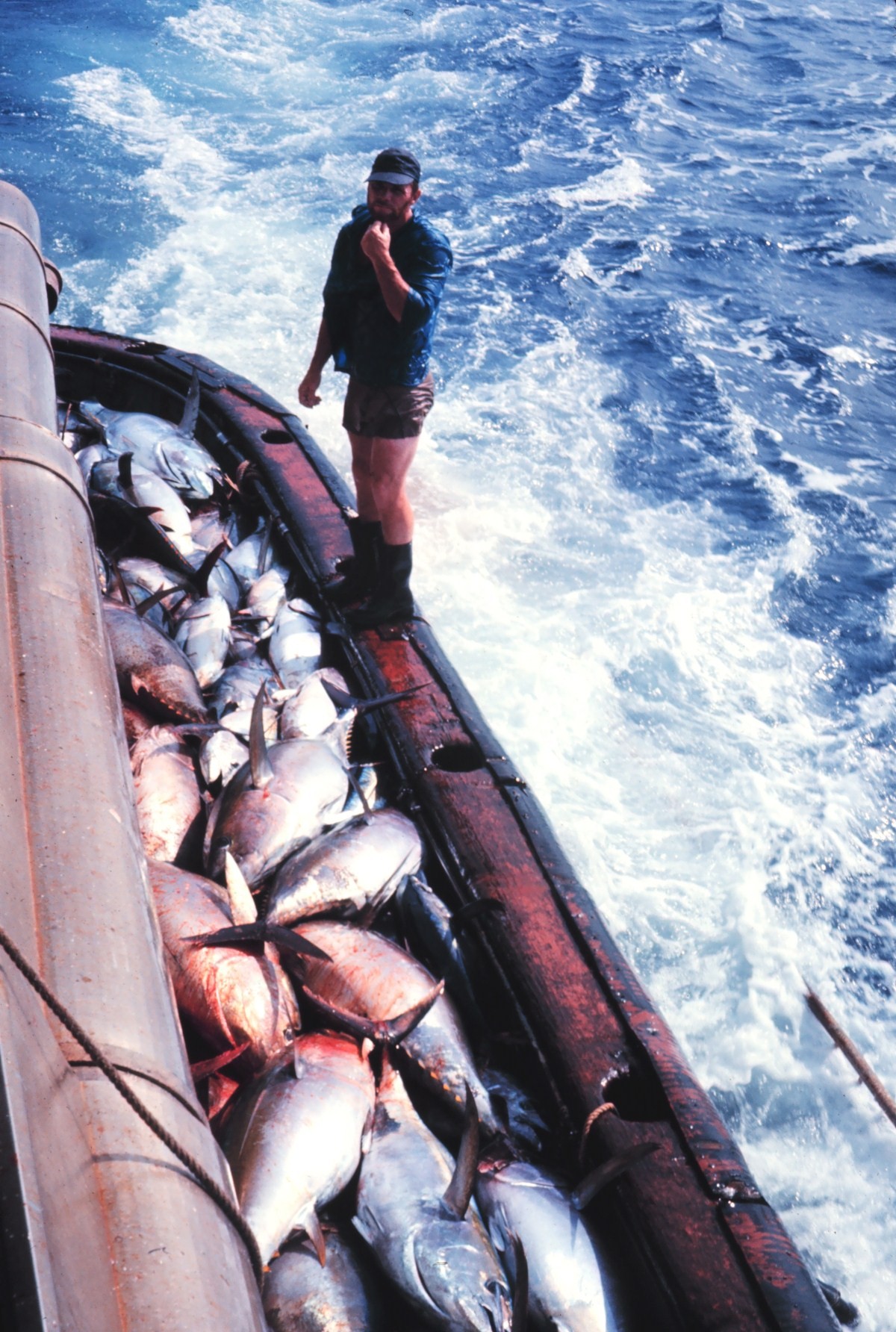
Commercial vessels caught approximately 450,500 metric tonnes in 2012. Purse seine fleets dominate catches in the Pacific, while longline fleets lead in the Indian and Atlantic Oceans. Fisheries use fish aggregating devices, accounting for 27 per cent of western and central Pacific catches. The angling record stands at 178 kilograms. Regional bodies manage stocks, including the WCPFC and IATTC in the Pacific. Greenpeace International placed this species on its seafood red list in 2010 due to sustainability risks.
Status and threats
Stock assessments indicate the species is overfished in the western and central Pacific Ocean and the eastern Pacific Ocean. It is close to or currently overfished in the Atlantic Ocean. The Indian Ocean stock is not considered overfished. Catch rates have declined sharply over the past fifty years due to increased industrial fishing. Ocean warming adds stress by reducing marine phytoplankton, particularly in the Indian Ocean. Conservation measures include spatial closures and catch limits.



Questions people ask about Bigeye tuna
How deep do bigeye tuna dive?
During the day, they typically descend to depths between 300 and 500 metres. These deeper waters are significantly cooler than surface layers. They return to shallower, warmer waters at dusk to re-warm their bodies.
What do bigeye tuna eat?
They primarily consume epipelagic and mesopelagic fish. Their diet also includes various crustaceans and cephalopods. Stomach contents often reveal diurnally migrating species, suggesting they follow prey movements.
Is bigeye tuna sustainable to eat?
Greenpeace International added it to its seafood red list in 2010. Stocks are overfished in the Pacific and near overfished in the Atlantic. Sustainability guides often recommend choosing other tuna types instead.
Where do bigeye tuna spawn?
Spawning occurs year-round in tropical Pacific regions. In the Atlantic, it happens in June and July in the northwest, and January and February in the Gulf of Guinea. Higher latitudes see seasonal spawning when water warms.
Good reading and sources
The facts on this page come from the Wikipedia article "Bigeye tuna", written by its contributors and used under the CC BY-SA 4.0 licence, and from its Wikidata record (CC0). EveryFish rewrote the text in its own words, with AI assistance, and compares every page with the article to make sure no passage is copied. It may be reused under the same CC BY-SA 4.0 licence with a link back.
It may contain mistakes, and figures change over time. Nothing here is investment or buying advice. If something is wrong, tell us. Last refreshed 2026-11-15.
Like Bigeye tuna
All tunas and mackerels 🇺🇸 United States and 3 morePacific bonito
Striped marine fish of the Pacific coastTuna · Coasts and shelves
 WorldMackerel
A group of pelagic fish known for their speed, stripes, and role in global fisheries.Tuna · Open ocean
 WorldSouthern bluefin tuna
Large migratory tuna of the southern oceans.Tuna · Open ocean
 WorldPacific bluefin tuna
Large migratory tuna of the northern Pacific OceanTuna · Open ocean
More from Scombridae
All of them WorldDogtooth tuna
A large Indo-Pacific bonito prized by sport anglers.Tuna · Coasts and shelves
 WorldBullet tuna
Small, slender tuna found in tropical oceans worldwide.Tuna · Open ocean
 WorldBlue mackerel
A small, fast pelagic fish found in tropical Indo-Pacific waters.Tuna · Coasts and shelves
WorldSlender tuna
A southern ocean tuna with oily flesh and a slender build.Tuna · Open ocean