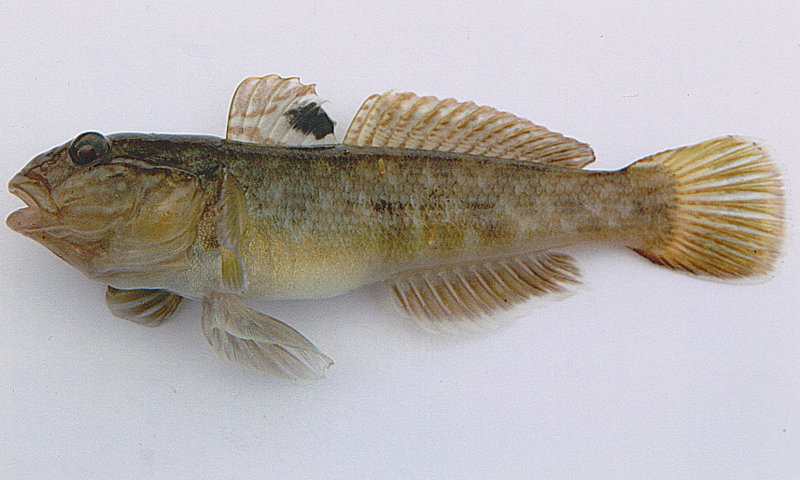
Round goby
Small bottom-dwelling fish native to Eurasia and invasive in North America
The round goby is a small, salt-tolerant fish from the Black and Caspian Seas. It has spread to the Baltic Sea and North American Great Lakes via ship ballast water. This aggressive invader outcompetes native species but also serves as prey for larger fish and helps control zebra mussel populations.
- Has a fused pelvic fin disc for sticking to rocks
- Introduced to Great Lakes via ship ballast water in 1990
- Eats invasive zebra and quagga mussels
- Males turn black and guard eggs during spawning
- Makes up 90% of Lake Erie watersnake diet
What it is
The round goby is a small, soft-bodied fish with large eyes that protrude slightly from the head. A distinctive black spot marks its first dorsal fin. Its pelvic fins fuse into a disc on the belly, acting like a suction cup. Adults range from ten to twenty-five centimetres in length. Males grow larger than females and turn inky black during spawning season. Juveniles appear grey, while mature fish show mottled patterns of grey, black, brown, and olive green.
Where it lives
Native to Central Eurasia, this species inhabits the Black Sea, Caspian Sea, and Sea of Azov. It thrives in both fresh and marine waters, tolerating high salinity. In recent decades, it has spread invasively to the Baltic Sea, North Sea basin, and major European rivers like the Danube and Rhine. Since 1990, it has established large populations in the North American Great Lakes, expanding into tributaries and even reaching the Hudson River.
How it lives
These bottom-dwellers feed day and night, detecting prey while stationary. Their diet consists mainly of mollusks, crustaceans, worms, and insect larvae. In invaded waters, they consume large numbers of zebra and quagga mussels. Native predators such as bass, walleye, lake trout, and burbot have adapted to eat them. The Lake Erie watersnake also relies heavily on round gobies, which now make up most of its diet.
Breeding and life cycle
Females reach maturity in one to two years, while males take three to four. Spawning occurs from April to September. Males migrate to shallow waters and release pheromones to attract females. They defend territories and change colour to signal readiness. Females lay eggs in rock crevices, where males guard and fan them to ensure oxygen supply. Hatch rates can reach ninety-five per cent due to this parental care.
Fish and people
Accidentally introduced via cargo ship ballast water, the round goby is a significant invasive species. It competes with native fish for shelter and food, reducing populations of sculpins and logperch. However, it also provides a food source for predatory fish and helps control invasive mussel populations. Researchers study its impact on food webs and toxin bioaccumulation, as it may transfer contaminants from mussels to larger predators.
Status and threats
The species is considered invasive in Europe and North America. It spreads rapidly through connected waterways and reservoirs. Genetic studies show multiple invasion pathways mixing lineages from different native regions. While it threatens native biodiversity by outcompeting local species, its role as prey has supported the recovery of some threatened predators like the Lake Erie watersnake.


Questions people ask about Round goby
How did the round goby reach North America?
The species was accidentally transported in the ballast water of cargo ships. The first recorded catch in North America occurred in the St. Clair River in 1990, marking the start of its spread through the Great Lakes system.
What does the round goby eat?
It primarily feeds on bottom-dwelling invertebrates such as mollusks, crustaceans, worms, and insect larvae. In invaded areas, it consumes large quantities of invasive zebra and quagga mussels.
Is the round goby dangerous to humans?
The fish itself is not directly dangerous to humans. However, it can carry parasites like trematodes that may infest humans. It also contributes to toxin bioaccumulation in the food chain by eating contaminated mussels.
Good reading and sources
The facts on this page come from the Wikipedia article "Round goby", written by its contributors and used under the CC BY-SA 4.0 licence, and from its Wikidata record (CC0). EveryFish rewrote the text in its own words, with AI assistance, and compares every page with the article to make sure no passage is copied. It may be reused under the same CC BY-SA 4.0 licence with a link back.
It may contain mistakes, and figures change over time. Nothing here is investment or buying advice. If something is wrong, tell us. Last refreshed 2026-11-15.
Like Round goby
All other fish South AsiaGreen spotted puffer
Small brackish water pufferfish with a tiny genomeOther · Rivers and lakes
 WorldThree-spined stickleback
Small northern fish known for rapid evolution and complex breeding.Other · Rivers and lakes
 WorldStickleback
A family of small ray-finned fishes with dorsal spines found across the Northern Hemisphere.Other · Rivers and lakes · 1758
 🇦🇴 Angola and 3 moreAtlantic mudskipper
Semi-aquatic goby that walks on mudflats in West Africa.Other · Rivers and lakes · 1766
