
Pacific hagfish
A jawless, slime-producing fish found in the deep Pacific Ocean.
The Pacific hagfish is a primitive, jawless marine animal inhabiting the deep waters of the Northeast Pacific. It is known for its unique ability to produce vast amounts of slime and its soft, eel-like body structure.
- Produces massive amounts of slime for defense, clogging predator gills.
- Jawless fish with a body plan resembling early Paleozoic ancestors.
- Can tie its body into complex knots to remove slime or tear meat.
- Hagfish skin is used commercially for leather goods in Asia.
- Conservation status is data deficient due to limited stock assessments.
What it is
This ancient creature belongs to a lineage that resembles early vertebrates. It possesses a long, slender body covered in loose, slimy skin that lacks true scales. The head features a sucker-like mouth surrounded by eight barbels, but it has no jaws. Visible eyes are absent, though transparent skin covers basic eye structures. A single dorsal fin-fold runs along the back, and ten to fourteen gill pores line the sides. Adults typically reach forty-two centimetres, with a maximum recorded size of sixty-three centimetres. Its colouration varies from dark brown to grayish red, often with blue or purple tints and lighter underbellies.
Where it lives
These animals inhabit the continental shelves and upper slopes of the Northeast Pacific Ocean. Their range extends from southeast Alaska down to Baja California in Mexico. A discovery off the coast of Costa Rica in twenty fifteen suggests their distribution may be much wider than previously understood. They dwell on fine silt and clay bottoms at depths ranging from sixteen to nine hundred and sixty-six metres. Populations appear abundant within these specific zones, though the Costa Rican record raises questions about recent expansion or prior sampling gaps.
How it lives
They exhibit an incredibly low metabolic rate, allowing survival in oxygen-poor environments like decaying carcasses or sediment burrows. This adaptation lets them function where other fish cannot. Their diet includes polychaete worms and invertebrates, but they also feed on the internal organs of large dead or dying fish. They enter bodies through natural openings to consume viscera. To escape predators, they can squeeze through openings smaller than half their body width using blood volume and loose skin. They also tie their bodies into knots to remove suffocating slime or tear meat, a behaviour facilitated by their flexible cartilaginous notochords.
Breeding and life cycle
Females lay approximately twenty-eight eggs, each five millimetres in diameter. Fertilization occurs externally, after which females guard the eggs in burrows. The species displays a one-to-one sex ratio and slight sexual dimorphism, with females being slightly smaller. Juveniles exhibit hermaphroditism before differentiating into separate sexes at maturity. Spawning occurs on irregular cycles lasting two to three years. This slow reproductive rate makes the population vulnerable to fishing pressures, as regeneration of resources takes considerable time.
Fish and people
A commercial fishery operates along the United States West Coast, primarily targeting this species for the Asian leather market. The skins are processed into accessories marketed as yuppie leather or eel-skin. The production of copious slime during capture creates significant challenges for fishermen, who must deal with equipment clogging. This trait has led to the colloquial nickname slime eel. While the demand for hagfish products exists, stock assessment data remains limited, complicating management decisions regarding sustainable harvest levels.
Status and threats
The conservation status is classified as data deficient due to a lack of comprehensive stock assessments. Increasing demand for hagfish leather raises concerns among scientists, particularly given the species' low reproductive rate. The extended intervals between spawning events suggest that active fisheries could negatively impact population health if not carefully managed. Further research into their reproductive ecology is necessary to establish informed protection measures and ensure the sustainability of the trade.


Questions people ask about Pacific hagfish
What makes the Pacific hagfish unique compared to other fish?
It is a jawless fish lacking true bones, possessing instead a flexible cartilaginous notochord. It produces enormous quantities of slime from glands in its skin when threatened, which can clog the gills of attacking predators. This defensive mechanism is energetically costly and takes weeks to regenerate fully.
Where does the Pacific hagfish live?
It inhabits the deep waters of the Northeast Pacific Ocean, ranging from southeast Alaska to Baja California, Mexico. Recent discoveries extend its known range to Costa Rica. It dwells on soft silt and clay bottoms at depths between sixteen and nine hundred and sixty-six metres.
How do Pacific hagfish reproduce?
Females lay about twenty-eight eggs, which are fertilized externally. Females guard these eggs in burrows. Spawning occurs irregularly, with cycles lasting two to three years. Juveniles start as hermaphrodites and differentiate into distinct sexes only upon reaching maturity.
Is the Pacific hagfish dangerous to humans?
No, it is not considered dangerous to humans. However, its slime is notorious for fouling fishing gear and nets, making handling difficult for fishermen. The primary human interaction involves commercial harvesting for its skin, which is sold as leather.
What is the current conservation status of this species?
The International Union for Conservation of Nature lists the Pacific hagfish as data deficient. There is insufficient information on population numbers and reproductive ecology to assess threats accurately, despite increasing commercial demand for its skin.
Good reading and sources
- Pacific hagfish on WikipediaEncyclopedia
- More photos on Wikimedia CommonsPhotos
- Wikidata recordOpen data
The facts on this page come from the Wikipedia article "Pacific hagfish", written by its contributors and used under the CC BY-SA 4.0 licence, and from its Wikidata record (CC0). EveryFish rewrote the text in its own words, with AI assistance, and compares every page with the article to make sure no passage is copied. It may be reused under the same CC BY-SA 4.0 licence with a link back.
It may contain mistakes, and figures change over time. Nothing here is investment or buying advice. If something is wrong, tell us. Last refreshed 2026-11-15.
Like Pacific hagfish
All ancient fish WorldLamprey
Jawless fish with a sucking mouth found in temperate waters worldwide.Ancient · Rivers and lakes
 🇧🇷 Brazil and 1 moreArapaima
Large freshwater fish from the Amazon basin known for its size and air-breathing ability.Ancient · Rivers and lakes
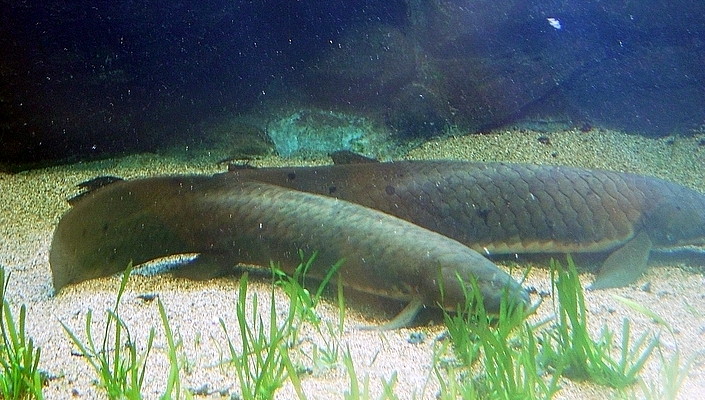 🇦🇺 AustraliaLungfish
Ancient freshwater fish that breathe air and have lobed fins.Ancient · Rivers and lakes
 🇺🇸 United States and 1 moreAtlantic sturgeon
A large anadromous fish native to the western Atlantic Ocean and its river systems.Ancient · Rivers and lakes