Lungfish
Ancient freshwater fish that breathe air and have lobed fins.
Lungfish are a group of six living species found in Africa, South America, and Australia. They are known for their ability to breathe atmospheric air and their evolutionary link to land-dwelling vertebrates.
- Six living species exist across Africa, South America, and Australia.
- They breathe air using lungs homologous to those of tetrapods.
- The marbled lungfish has the largest known vertebrate genome.
- Some species can estivate in mud during dry seasons for months.
- Queensland lungfish fossils date back 380 million years.
What it is
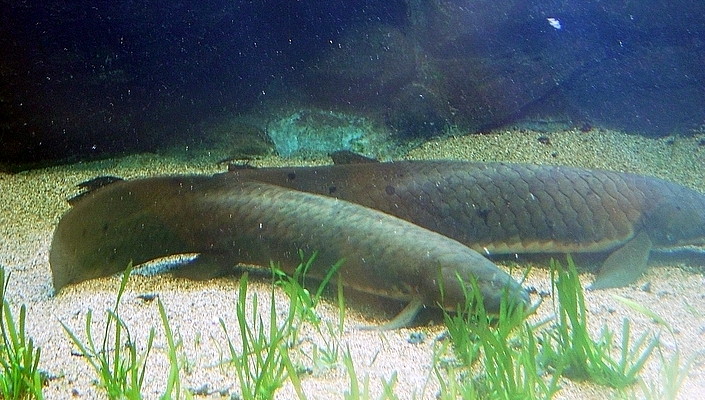
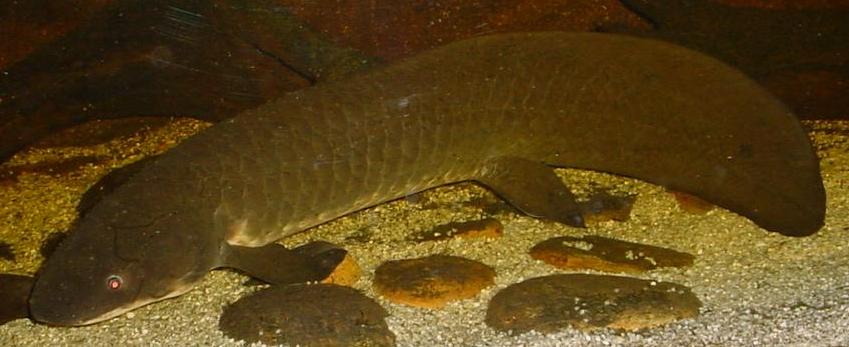
Lungfish are ancient freshwater vertebrates belonging to the class Dipnoi. They possess fleshy, lobed fins supported by an internal skeleton, a trait shared with early land animals. Their bodies are elongated and eel-like, featuring thin, threadlike pectoral and pelvic fins. A single caudal fin replaces the separate dorsal and anal fins seen in most other fish. They have tooth plates used for crushing hard-shelled prey. The name lungfish refers to their specialized lungs, which allow them to survive in oxygen-poor waters or during dry seasons when they bury themselves in mud.
Where it lives
These fish inhabit freshwater environments across three continents. In Africa, four species live in various river basins and swamps. One species is found in South America within the Amazon and Paraguay River systems. The Queensland lungfish is endemic to Australia, specifically in New South Wales. Fossil records indicate they were once more widespread, including marine ancestors from the Devonian period. Today, all living species are restricted to freshwater habitats, having lost their marine origins millions of years ago.
How it lives
Lungfish are omnivores, eating insects, crustaceans, worms, mollusks, and plant matter. They lack a true stomach and instead have an intestinal spiral valve for digestion. A key survival strategy is aestivation, where African and South American species burrow into mud during droughts. They slow their metabolism drastically and convert toxic ammonia waste into less harmful urea. They can remain dormant for months until rains return. They are also extremely long-lived, with some individuals surviving over a century in captivity.
Breeding and life cycle
Breeding involves complex respiratory adaptations. During the breeding season, the South American lungfish develops feathery appendages from its pelvic fins to improve gas exchange around eggs in nests. Lungfish have lungs connected directly to the throat without a trachea. These lungs are subdivided into many small sacs to maximize surface area for air absorption. While most species use both gills and lungs, adults often rely heavily on air breathing as their gills become reduced and less functional for underwater respiration.
Fish and people
Lungfish have been consumed by local populations as a food source. Their unique biology makes them subjects of scientific research, particularly regarding genome size and evolutionary history. The marbled lungfish holds the record for the largest vertebrate genome. They are also kept in aquariums, where some individuals have lived for decades. Conservation efforts are needed due to habitat loss and overfishing, though specific status varies by region. Their role as living fossils provides critical insights into the transition of vertebrates from water to land.
Status and threats
Conservation status varies among the six species. Some face threats from habitat degradation, pollution, and fishing pressure. The Australian lungfish is protected in certain areas due to its endangered status in parts of its range. African species may be impacted by dam construction and water extraction. South American populations are less studied but likely face similar pressures. Overall, data deficiency exists for several species, making precise global assessments difficult. Continued monitoring is essential to protect these ancient lineages.


Questions people ask about Lungfish
How do lungfish breathe?
Lungfish have specialized lungs connected directly to their throat, allowing them to gulp air. This adaptation helps them survive in low-oxygen water or during droughts when they bury themselves in mud and enter a state of dormancy called aestivation.
Are lungfish dangerous to humans?
No, lungfish are not venomous or aggressive toward humans. They are generally docile bottom-dwellers that feed on small aquatic organisms. However, they can deliver a painful bite if handled roughly due to their strong tooth plates designed for crushing shells.
Why are lungfish important scientifically?
Lungfish are crucial for understanding evolution because they are the closest living relatives to tetrapods. Their large genomes and unique physiological traits, such as air breathing and aestivation, provide insights into how vertebrates adapted to life on land.
What is the largest lungfish species?
The marbled lungfish (Protopterus aethiopicus) is the largest, reaching up to 200 centimeters in length. It is found in Africa and is distinguished by its smooth skin, elongated body, and massive genome size.
Good reading and sources
The facts on this page come from the Wikipedia article "Lungfish", written by its contributors and used under the CC BY-SA 4.0 licence, and from its Wikidata record (CC0). EveryFish rewrote the text in its own words, with AI assistance, and compares every page with the article to make sure no passage is copied. It may be reused under the same CC BY-SA 4.0 licence with a link back.
It may contain mistakes, and figures change over time. Nothing here is investment or buying advice. If something is wrong, tell us. Last refreshed 2026-11-15.
Like Lungfish
All ancient fish 🇧🇷 Brazil and 1 moreArapaima
Large freshwater fish from the Amazon basin known for its size and air-breathing ability.Ancient · Rivers and lakes
 WorldLamprey
Jawless fish with a sucking mouth found in temperate waters worldwide.Ancient · Rivers and lakes
 🇺🇸 United States and 1 moreLake sturgeon
A large, long-lived freshwater fish native to North America.Ancient · Rivers and lakes
 🇺🇸 United States and 1 moreAtlantic sturgeon
A large anadromous fish native to the western Atlantic Ocean and its river systems.Ancient · Rivers and lakes