
Lake Tanganyika sardine
A freshwater clupeid fish native to Lake Tanganyika, now farmed and fished across Africa.
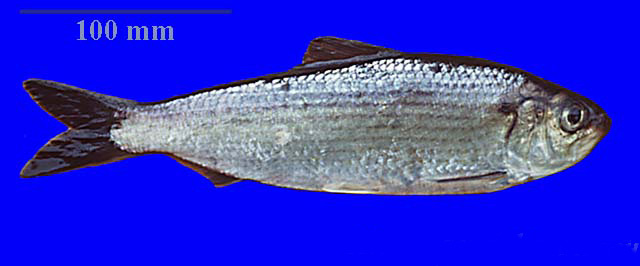
The Lake Tanganyika sardine is a small silver ray-finned fish endemic to Lake Tanganyika. It has been introduced to other African lakes as a food source, supporting significant fisheries in places like Lake Kariba.
- Maximum length reaches 17 centimetres.
- Introduced to Lake Kariba in 1967 and 1968.
- Annual catch in Lake Kariba exceeds 20,000 tonnes.
- Known collectively as kapenta with the Lake Tanganyika sprat.
- Survived transit through hydro-electric turbines to reach Cahora Bassa.
What it is
This species is a small silver ray-finned fish belonging to the family Dorosomatidae. It possesses a broad snout with tapering sides and a distinct bright stripe along its lateral line. A large swim bladder enables it to move rapidly through different water depths. Adults typically reach ten centimetres, though they can grow up to seventeen centimetres. Sexual maturity occurs at roughly six point eight centimetres. The fish is one of two species in the genus Limnothrissa, alongside the Lake Mweru endemic species.
Where it lives
Originally found only in Lake Tanganyika and the lower Malagarasi River, the fish has spread widely. Introductions began in Lake Kivu in Rwanda in nineteen fifty-nine. It was later placed in Lake Kariba on the Zambezi River between Zambia and Zimbabwe. Populations also exist in the Itezhi-Tezhi Dam in Zambia and have colonised Cahora Bassa lake in Mozambique after surviving transit through hydro-electric turbines.
How it lives
The fish performs daily vertical migrations, forming tight shoals in deep water during daylight hours. It rises to the surface at dawn and dusk, often tracking zooplankton movements. In Lake Kariba, however, these migrations do not follow plankton patterns. Adults prefer deeper waters while juveniles stay in shallow areas near rocky or sandy bottoms. They are omnivorous, feeding primarily on zooplankton and phytoplankton. Larger individuals may consume insects and occasionally other fish species.
Breeding and life cycle
Adults migrate to shallow waters to spawn, typically during rainy seasons. Peak breeding periods occur in May, June, December, and January. Fecundity increases with size; larger fish produce significantly more eggs. In Lake Tanganyika, a fourteen centimetre specimen produced fifty-five thousand eggs. Breeding in Lake Kariba runs from September to February. Population numbers generally rise from February to August before declining due to mortality.
Fish and people
The fish is known collectively as kapenta alongside the Lake Tanganyika sprat. It serves as an important food source in several African nations. The Zambian government introduced three hundred sixty thousand specimens into Lake Kariba in nineteen sixty-seven and nineteen sixty-eight. The annual catch in Lake Kariba ranges between twenty thousand and thirty thousand tonnes. Fish enter the local fishery at approximately four centimetres in length, around three to four months of age.
Status and threats
The species is classified as least concern globally. Its introduction to new lakes has created substantial fisheries, particularly in Lake Kariba. However, this expansion has altered local ecosystems. Predators such as Hydrocynus vittatus have adapted to feed heavily on the sardines. The fish's presence has also impacted zooplankton populations, potentially reducing the abundance of certain larger species in invaded waters.

Questions people ask about Lake Tanganyika sardine
What is the Lake Tanganyika sardine?
It is a small silver freshwater ray-finned fish native to Lake Tanganyika. It belongs to the family Dorosomatidae and is one of two species in the genus Limnothrissa. The fish is widely recognised for its role in African fisheries and is commonly referred to as kapenta.
Where does the fish live?
It is endemic to Lake Tanganyika and the lower Malagarasi River. It has been introduced to Lake Kivu in Rwanda, Lake Kariba in Zambia and Zimbabwe, the Itezhi-Tezhi Dam in Zambia, and Cahora Bassa lake in Mozambique.
How big does it get?
Most specimens measure about ten centimetres long. The maximum recorded length is seventeen centimetres. Sexual maturity is reached at approximately six point eight centimetres. Weight data is not provided in the sources.
What does it eat?
The fish is omnivorous, feeding mainly on zooplankton and phytoplankton. It also consumes insects such as chironomids and occasionally other fish. In Lake Kariba, it opportunistically targets the most abundant prey available at any given time.
Good reading and sources
- Lake Tanganyika sardine on WikipediaEncyclopedia
- More photos on Wikimedia CommonsPhotos
- Wikidata recordOpen data
The facts on this page come from the Wikipedia article "Lake Tanganyika sardine", written by its contributors and used under the CC BY-SA 4.0 licence, and from its Wikidata record (CC0). EveryFish rewrote the text in its own words, with AI assistance, and compares every page with the article to make sure no passage is copied. It may be reused under the same CC BY-SA 4.0 licence with a link back.
It may contain mistakes, and figures change over time. Nothing here is investment or buying advice. If something is wrong, tell us. Last refreshed 2026-11-15.
Like Lake Tanganyika sardine
All herrings and sardines 🇺🇸 United StatesAtlantic menhaden
A silvery herring species found along the North American Atlantic coast.Herring · Coasts and shelves
 🇺🇸 United States and 1 moreAlewife
A small North American herring that migrates between sea and rivers.Herring · Coasts and shelves
 🇹🇷 Turkey and 4 moreAnchovy
Small, oily forage fish found in oceans and some rivers worldwide.Herring · Coasts and shelves
 🇹🇷 Turkey and 4 moreEuropean anchovy
Small coastal forage fish of Europe and AfricaHerring · Coasts and shelves · 1758