
Grenadiers
Deep-sea gadiform fish with slender bodies and long tails, found globally in ocean depths.
Grenadiers are large marine fish belonging to the family Macrouridae. They inhabit deep waters from polar regions to the equator and represent a significant portion of the deep-sea biomass.
- Found at depths up to 7,000 meters globally.
- Can grow up to 2.1 meters in length.
- May comprise 15% of deep-sea fish biomass.
- Some species die immediately after spawning.
- Commercial fisheries have been largely unsuccessful.
What it is
Grenadiers, also known as rattails, are marine fish characterized by large heads, wide mouths, and slender bodies that taper into thin tails. This distinctive tail shape gives them their common name. They possess small scales, a tall pointed first dorsal fin, and a second dorsal fin extending along the back. Their eyes are large, adapted for low-light environments. Sizes vary significantly, ranging from small species around ten centimeters to the giant grenadier, which can reach two meters in length. These fish belong to the order Gadiformes and form the largest family within the suborder Macrouroidei.
Where it lives
These fish are found worldwide in deep ocean waters, spanning from the Arctic to the Antarctic. They typically inhabit benthic zones between two hundred and seven thousand meters deep. While most species live on the sea floor, they are attracted to structural features like hydrothermal vents, cold seeps, and shipwrecks. Two genera prefer midwater habitats rather than the bottom. As a group, they may constitute up to fifteen percent of the total deep-sea fish population, making them among the most abundant deep-living vertebrates.
How it lives
Grenadiers act as generalist predators and scavengers in the deep sea. Their diet includes smaller fish, shrimp, amphipods, cumaceans, and occasionally cephalopods. They use well-developed lateral lines and chemoreceptors on their heads and barbels to locate food. Some species form large schools, while others remain solitary. Benthic species have swim bladders with muscles that allow them to produce sounds, possibly for communication. Light-producing organs called photophores are present in some species near the abdomen.
Breeding and life cycle
Reproduction involves releasing vast numbers of tiny eggs, often exceeding one hundred thousand per female. Lipid droplets make these eggs buoyant, allowing them to float toward the thermocline where development occurs. Juveniles start in shallower waters and migrate deeper as they age. Spawning timing varies by species, with some being seasonal and others not. Certain species, like Coryphaenoides armatus, are semelparous, meaning adults die after reproducing. Nonsemelparous species can live for over fifty-six years.
Fish and people
Attempts to establish commercial fisheries for larger species, such as the giant grenadier, have largely failed because the meat is considered unpalatable. Despite this, commercially exploited species face risks of overfishing due to low resilience. The family contains twenty-eight recognized genera, with diversity concentrated in Coelorinchus, Coryphaenoides, and Nezumia. There is no significant aquarium trade or cultural usage mentioned for this group.
Status and threats
The macrourins generally exhibit low resilience to environmental changes and fishing pressure. Species targeted by commercial interests may be overfished, potentially leading to rapid fishery collapse. Conservation data is limited, but their abundance suggests ecological importance.

Questions people ask about Grenadiers
What do grenadiers eat?
They are generalists that feed on small fish, pelagic crustaceans like shrimp and amphipods, and occasionally cephalopods. Many also act as scavengers in the deep sea.
Why are they called rattails?
Their bodies taper into very thin caudal peduncles or tails, resembling a rat's tail. The scientific name derives from Greek words for big and tail.
Are grenadiers good to eat?
No, attempts to fish them commercially have failed because the meat is considered unpalatable. Most larger species are not used for food.
How long do they live?
Nonsemelparous species can live to 56 years or more. Some species, however, are semelparous and die shortly after spawning.
Good reading and sources
- Grenadiers (fish) on WikipediaEncyclopedia
- More photos on Wikimedia CommonsPhotos
- Wikidata recordOpen data
The facts on this page come from the Wikipedia article "Grenadiers (fish)", written by its contributors and used under the CC BY-SA 4.0 licence, and from its Wikidata record (CC0). EveryFish rewrote the text in its own words, with AI assistance, and compares every page with the article to make sure no passage is copied. It may be reused under the same CC BY-SA 4.0 licence with a link back.
It may contain mistakes, and figures change over time. Nothing here is investment or buying advice. If something is wrong, tell us. Last refreshed 2026-11-15.
Like Grenadiers
All other fish WorldOarfish
Extremely long pelagic fish known for their ribbon-like bodies and association with sea serpent myths.Other · Open ocean · 1772
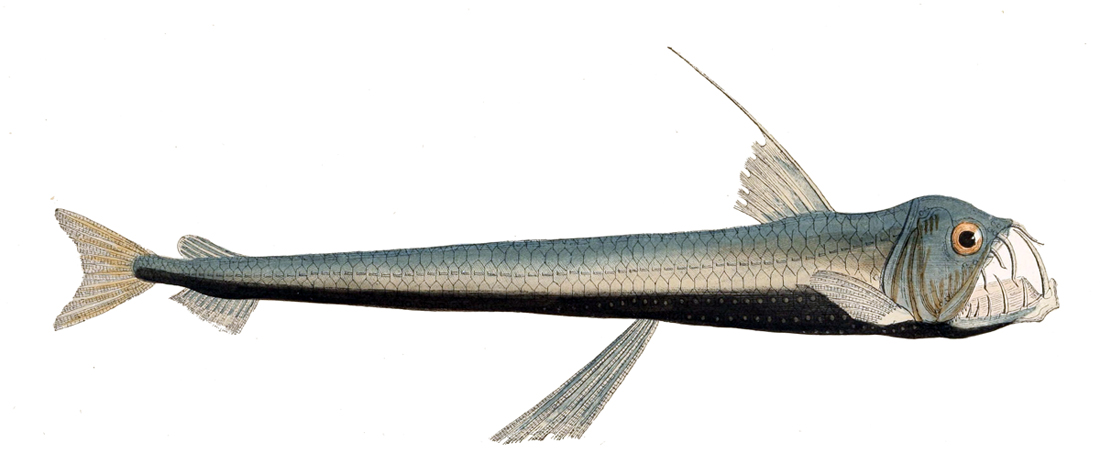 WorldSloane's viperfish
Deep-sea dragonfish with huge teeth and light organsOther · Open ocean · 1801
 WorldViperfish
Deep-sea fish with fang-like teeth and bioluminescent lures in the genus Chauliodus.Other · Open ocean · 1801
 WorldAnglerfish
Ray-finned fish using a modified dorsal fin ray as a lure to catch prey.Other · Coasts and shelves · 1829

