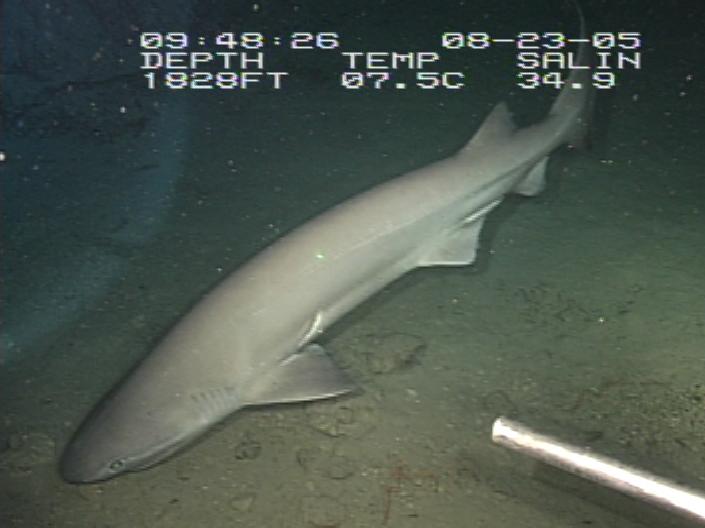
Bluntnose sixgill shark
A large, primitive shark with six gill slits found in deep tropical and temperate waters worldwide.
The bluntnose sixgill shark (Hexanchus griseus) is the largest hexanchoid shark, reaching lengths of up to 5.5 metres. First described by Pierre Joseph Bonnaterre in 1788, it inhabits deep continental shelves across global oceans. Its ancient lineage and broad diet make it a significant subject for marine research.
- Possesses six gill slits instead of the typical five found in most sharks.
- Grows to a maximum length of 5.5 metres and weighs up to 1,000 kg.
- Engages in nightly vertical migration to hunt in shallower waters.
- Produces large litters of 22 to 108 pups after a long gestation period.
- First scientifically described by Pierre Joseph Bonnaterre in 1788.
What it is
This species belongs to the family Hexanchidae and represents the largest member of its group. It possesses a robust body, a long tail, and a wide, blunt snout. The skin varies from tan to black, marked by light lateral lines and spots that increase with age. A key feature is the presence of six gill slits on each side, unlike most modern sharks which have five. Adults typically measure between three and four metres, though specimens can exceed five metres. The eyes are small with fluorescent blue-green irises and black pupils.
Where it lives
Found globally in tropical and temperate zones, this shark spans latitudes from 65°N to 48°S. Sightings occur off the Americas, Europe, Africa, Asia, and Australia. It inhabits the outer continental shelf and deeper slopes, usually between 180 and 1,100 metres below the surface. Juveniles may venture into shallower coastal waters near shorelines, while adults prefer depths exceeding one hundred metres. Fossil evidence suggests historical presence in regions like South Korea.
How it lives
These sharks act as generalists, consuming a wide variety of prey including fish, squid, marine mammals, and carrion. They exhibit diel vertical migration, rising to shallower depths at night to feed before returning to colder, deeper waters during the day. This movement helps conserve energy due to their positive buoyancy. Their sluggish nature belies bursts of speed used to chase prey. They utilize sawing and tearing motions with their jaws and lower pectoral fins to strike effectively.
Breeding and life cycle
Reproduction is ovoviviparous, meaning embryos develop inside eggs that remain within the mother until hatching. Litters are large, containing twenty-two to one-hundred-and-eight pups measuring sixty to seventy-five centimetres at birth. Females mature later than males, reaching sexual size at four-and-a-half metres around eighteen to thirty-five years of age. Males mature earlier at roughly three metres. Courtship involves males nipping female gill slits, leaving seasonal scars.
Fish and people
Although generally harmless to humans unless provoked, this species faces pressure from fishing activities. It is caught both as bycatch and targeted for food and sport. Its slow growth and late maturity make populations vulnerable to overexploitation. Conservation bodies list it as Near Threatened due to these biological traits. Regional assessments vary, with some areas classifying stocks as data poor but secure overseas. Historical encounters may have inspired local folklore regarding dangerous sea creatures.
Status and threats
The International Union for Conservation of Nature lists this species as Near Threatened. Its extensive range does not fully protect it from exploitation due to its longevity and appeal to sport fishermen. Population data remains scarce in many regions, but certain local stocks show severe depletion. The New Zealand Department of Conservation categorizes it as Not Threatened with qualifiers indicating data limitations. Conservation efforts focus on monitoring these vulnerable populations amidst increasing human activity.


Questions people ask about Bluntnose sixgill shark
How many gill slits does a bluntnose sixgill shark have?
Unlike most modern sharks which possess five gill slits on each side, the bluntnose sixgill shark has six. This distinctive feature gives the species its common name and places it within the primitive Hexanchidae family.
What is the maximum size of this shark?
Adults typically measure between 3.1 and 4.2 metres. However, the species can grow significantly larger, with recorded specimens reaching up to 5.5 metres in length and weighing approximately 1,000 kilograms.
Where do bluntnose sixgill sharks live?
They inhabit tropical and temperate waters across the Atlantic, Indian, and Pacific oceans. They prefer deep environments, typically swimming between 180 and 1,100 metres depth, though they can dive much deeper or visit shallower coastal areas.
Are they dangerous to humans?
No, they are generally harmless to humans unless directly provoked. Despite their large size and predatory nature, they do not pose a significant threat to people in normal circumstances.
Good reading and sources
- Bluntnose sixgill shark on WikipediaEncyclopedia
- More photos on Wikimedia CommonsPhotos
- Wikidata recordOpen data
The facts on this page come from the Wikipedia article "Bluntnose sixgill shark", written by its contributors and used under the CC BY-SA 4.0 licence, and from its Wikidata record (CC0). EveryFish rewrote the text in its own words, with AI assistance, and compares every page with the article to make sure no passage is copied. It may be reused under the same CC BY-SA 4.0 licence with a link back.
It may contain mistakes, and figures change over time. Nothing here is investment or buying advice. If something is wrong, tell us. Last refreshed 2026-11-15.
Like Bluntnose sixgill shark
All sharks WorldOpah
A deep-bodied, warm-blooded pelagic fish known for its red color and unique heat-retaining anatomy.Shark · Open ocean · 1839
 WorldBlue shark
A slender, deep-blue oceanic shark found in temperate and tropical seas worldwide.Shark · Open ocean
 WorldBramble shark
A deep-sea shark with thorn-like skin scales.Shark · Open ocean · 1788
 WorldCommon thresher
The largest thresher shark, known for its whip-like tail used to stun prey in cool coastal and open waters.Shark · Coasts and shelves · 1788
