
Zebrafish
Small striped fish from South Asia kept in aquariums and labs
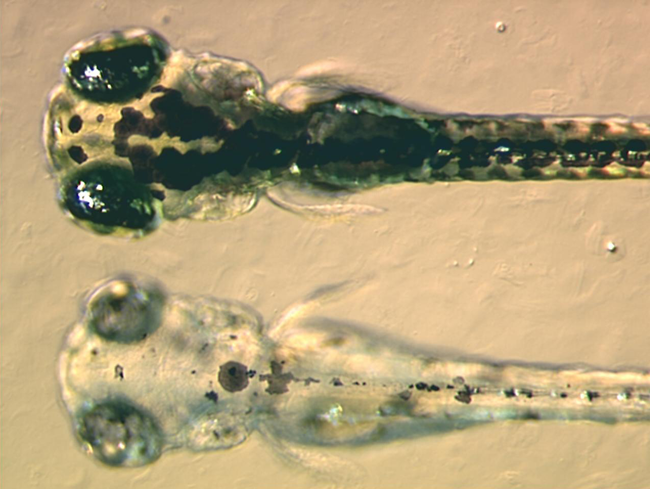
The zebrafish is a small striped fish native to freshwater habitats in South Asia. It is kept in home aquariums for its hardiness and quick breeding while serving as a model organism in developmental biology and genetics because its embryos are transparent and grow fast outside the mother.
- Grows to a maximum of 5 cm long
- Transparent embryos develop outside the mother
- Can regenerate heart and fin tissue
- First species sold as fluorescent GloFish
- Used to study vertebrate development and gene function
What it is
The zebrafish belongs to the carp family and has a slim body flattened from the sides. Five blue stripes run along each side from head to tail fin. Males show gold between the stripes and a pointed shape while females have a rounder body with silver stripes and a pale belly. They reach up to 5 cm long. These fish live in shallow fresh waters with some plants along the banks.
Where it lives
This species occurs in freshwater across South Asia, mainly in the Ganges and Brahmaputra river systems. Records exist from India, Pakistan, Bangladesh, Nepal and Bhutan, with the northern limit near the Himalayas. They occupy streams, canals, ditches, ponds and rice fields that have clear water and some vegetation. Water temperatures in these places mostly range from 16.5 to 34 degrees Celsius.
How it lives
Zebrafish swim in groups of six or more and get along with other fish in tanks. They can regrow parts of the heart and fins after injury. In laboratories they have been used to examine many processes including how cells repair tissue and how genes work during growth.
Breeding and life cycle
These fish spawn often when conditions are right, with females producing hundreds of eggs every two or three days. A male must be present for spawning. The eggs are clear and begin developing right away, with major organs forming within 36 hours. Young reach adult size in a few months. Plants in the tank encourage the process.
Fish and people
Zebrafish are sold as beginner aquarium fish because they are tough and breed readily. They were the first species turned into fluorescent GloFish for the pet trade. In laboratories they are a standard model for studies of development, gene function, toxicology and tissue repair. Their clear young make it simple to watch growth and test substances in the water.


Questions people ask about Zebrafish
Where does the zebrafish live?
It is native to freshwater habitats in India, Pakistan, Bangladesh, Nepal and Bhutan, mainly in the Ganges and Brahmaputra river basins.
Why is it used in research?
Its embryos are transparent, develop quickly and can be produced in large numbers, making it easy to study development and test drugs.
How long does it live?
In captivity zebrafish live around two to three years, though some reach over five years in good conditions.
How does it reproduce?
Females lay hundreds of eggs every few days when a male is present, and the clear eggs start developing right away.
Good reading and sources
- Research Offers Clue Into How Hearts Can Regenerate in Some Species (Published 2010)The New York Times, Article
- A Point Of View: Fly, Fish, Mouse and WormBBC, Article
The facts on this page come from the Wikipedia article "Zebrafish", written by its contributors and used under the CC BY-SA 4.0 licence, and from its Wikidata record (CC0). EveryFish rewrote the text in its own words, with AI assistance, and compares every page with the article to make sure no passage is copied. It may be reused under the same CC BY-SA 4.0 licence with a link back.
It may contain mistakes, and figures change over time. Nothing here is investment or buying advice. If something is wrong, tell us. Last refreshed 2026-11-15.
Like Zebrafish
All carps and minnows 🇹🇭 Thailand and 2 moreSiamese mud carp
Freshwater cyprinid native to Mekong and Chao Phraya riversCarp · Rivers and lakes
 WorldRasbora
A diverse genus of small freshwater fish native to South and Southeast Asia.Carp · Rivers and lakes · 1822
 🇨🇳 China and 4 moreChinese hooksnout carp
A small freshwater minnow native to East and Southeast Asia.Carp · Rivers and lakes
 🇷🇺 RussiaCaspian roach
A brackish water fish from the Caspian Sea region, widely consumed as a dried snack.Carp · Estuaries and mangroves