Yellowhead jawfish
Small Caribbean reef fish that builds burrows and broods eggs in its mouth.
The yellowhead jawfish is a small reef dweller found in the Caribbean Sea. Males carry eggs in their mouths until hatching. They build burrows in sand and rubble, often living in groups near coral structures.
- Males carry eggs in their mouths until hatching.
- Builds burrows using sand, shells, and small rocks.
- Common in Caribbean reefs and Florida waters.
- Docile in aquariums; keeps to small territories.
What it is
This small fish belongs to the jawfish family. It grows to about ten centimetres in length. The head and upper body display a bright yellow colour. This shade fades gradually into a pearlescent blue on the lower body. It lives on coral reefs where sand and rubble provide material for shelter. The fish spends much of its time with only its head visible above the substrate.
Where it lives
These fish inhabit the Caribbean Sea. They are particularly common in waters around Florida. You can find them at depths ranging from three to forty metres. They prefer shallow areas where loose materials like sand, shells, and small rocks are available. These materials are essential for constructing their burrows in rubble or sandy bottoms.
How it lives
They live in groups of up to seventy individuals. Each fish maintains a small territory near its burrow. They use their mouths to move sand and rocks, arranging these items to build or repair their homes. When threatened, they show two distinct behaviours. They may flee into their burrow and block the entrance with a large rock. Alternatively, they might spit sand or rocks at the intruder to defend their space.
Breeding and life cycle
This species practices mouthbrooding. The male takes responsibility for the eggs. He carries them in his mouth until they hatch. This method protects the developing young from predators. The male does not eat during this period to ensure the safety of the clutch. Once the eggs hatch, the young are released into the water column.
Fish and people
Aquarists keep this species due to its docile nature. It is one of the most peaceful jawfish towards its own kind. In captivity, it accepts brine shrimp, mysis shrimp, and prepared frozen foods. Keepers should provide one individual per ten gallons of water. They warn off tank mates by opening their jaws wide but rarely attack. Their burrowing behaviour makes them an interesting addition to reef tanks.
Questions people ask about Yellowhead jawfish
What does the yellowhead jawfish eat?
In the wild and captivity, they feed on planktonic matter. In aquariums, they commonly accept brine shrimp, mysis shrimp, and prepared frozen or pelleted fish foods.
How do yellowhead jawfish protect themselves?
They have two responses to intruders. They may flee into their burrow and cover the opening with a rock, or they may spit sand and rocks at the threat.
Are yellowhead jawfish aggressive in tanks?
No, they are considered one of the most docile jawfish. They warn others by opening their jaws wide but rarely attack. They can be kept in small groups.
Good reading and sources
- Yellowhead jawfish on WikipediaEncyclopedia
- More photos on Wikimedia CommonsPhotos
- Wikidata recordOpen data
The facts on this page come from the Wikipedia article "Yellowhead jawfish", written by its contributors and used under the CC BY-SA 4.0 licence, and from its Wikidata record (CC0). EveryFish rewrote the text in its own words, with AI assistance, and compares every page with the article to make sure no passage is copied. It may be reused under the same CC BY-SA 4.0 licence with a link back.
It may contain mistakes, and figures change over time. Nothing here is investment or buying advice. If something is wrong, tell us. Last refreshed 2026-11-15.
Like Yellowhead jawfish
All reef fish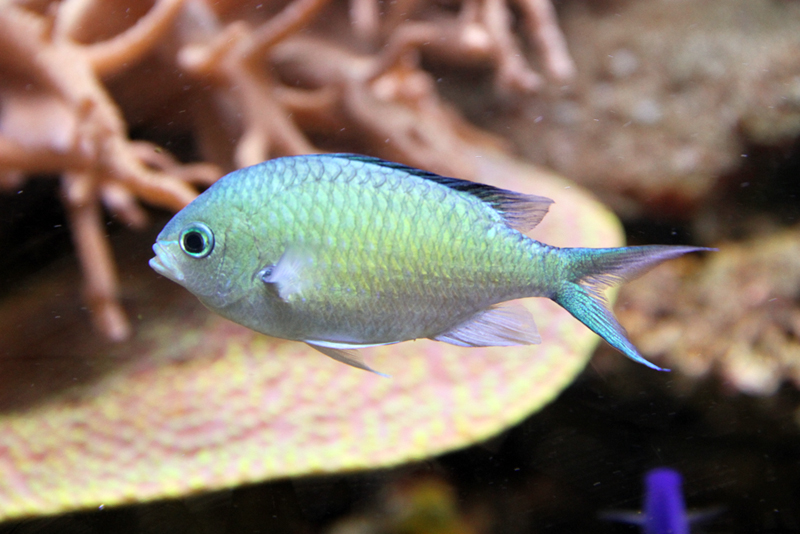 WorldGreen chromis
Small iridescent reef damselfish found across the Indo-Pacific.Reef fish · Coral reefs
 WorldSea goldie
A colourful reef fish that changes sex.Perch-like · Coasts and shelves
 WorldBluespotted cornetfish
Long, slender reef fish with a tubular snout and blue spots.Reef fish · Coasts and shelves
 WorldThreadfin butterflyfish
A tropical marine fish with a trailing dorsal filament.Reef fish · Coasts and shelves