
Spotted ratfish
Cartilaginous fish with a rat-like tail and venomous spine
The spotted ratfish is a cartilaginous chimaera found in the north-eastern Pacific Ocean. It features a pointed tail, large pectoral fins, and a venomous dorsal spine. This deep-water species lays leathery egg cases on sandy or muddy seabeds and is not commercially fished.
- Females grow up to 97 cm, larger than males
- Venomous dorsal spine deters predators like seals
- Leathery egg cases take up to a year to hatch
- Males have unique club-like head claspers for mating
- Rare pure albino specimen found in Puget Sound
What it is
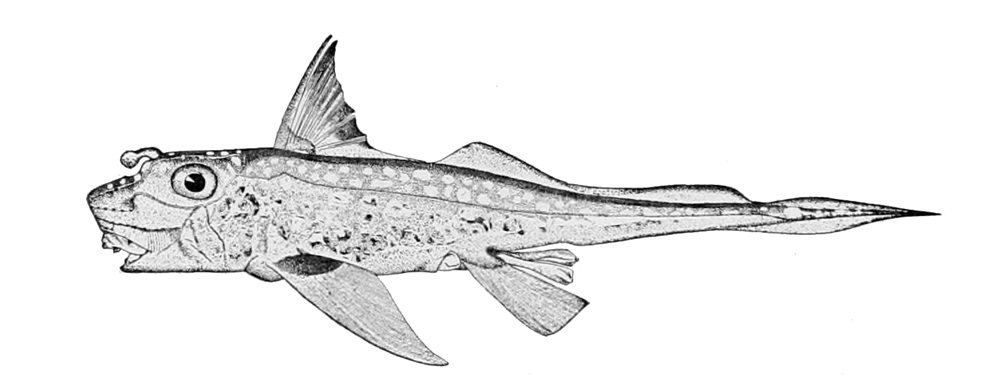
The spotted ratfish is a chimaera with a distinct appearance. It has smooth, scaleless skin that shines with silvery-bronze, gold, blue, and green hues. White spots speckle its back, and dark edges outline its fins. Large triangular pectoral fins extend like wings from its body. A long, pointed tail resembles that of a rat. The head features a duckbill snout, rabbit-like face, and large emerald green eyes that reflect light. Its body is supported by cartilage, not bone.
Where it lives
This species inhabits the north-eastern Pacific Ocean, ranging from Alaska to Baja California, with an isolated group in the Gulf of California. It is most abundant off the Pacific Northwest. Depths vary from surface waters to 913 metres, though it prefers 50 to 400 metres. In northern areas, it stays closer to shore. Seasonal movements bring it to shallow water in spring and autumn, retreating deeper in summer and winter. It favours temperatures between 7.2 and 8.9 degrees Celsius.
How it lives
Spotted ratfish swim slowly above the seafloor, using smell to locate food at night. They perform barrel rolls and corkscrew turns, resembling aquatic flight. Their diet includes crunchy prey like crabs and clams, as well as shrimp, worms, small fish, and sea stars. Predators include soupfin sharks, dogfish sharks, Pacific halibut, pinnipeds, and pigeon guillemots. They segregate by sex and age, with juveniles in deeper waters. A venomous spine on the dorsal fin defends against threats.
Breeding and life cycle
Females are oviparous, laying eggs from spring to autumn. Every 10 to 14 days, she releases up to two fertilized eggs into sand or mud. The leathery egg case is 12.7 cm long and attaches to the floor via a filament. Laying takes several days. Development lasts up to a year. Hatchlings are 14 cm long and grow to 30 cm in their first year. Males have unique cephalic claspers on their heads to hold females during mating.
Fish and people
Humans do not typically eat spotted ratfish, and they are not caught commercially. Divers often encounter them at night in the Pacific Northwest. Their leathery egg cases are frequently mistaken for inanimate objects. The species has been kept and bred in public aquaria, requiring low light and cool temperatures. A rare pure albino specimen was found near Whidbey Island, Washington. The venomous spine can cause painful wounds but is rarely dangerous to humans.
Status and threats
The spotted ratfish is common throughout much of its range. It is listed as Least Concern. No major commercial fishing targets this species, which helps maintain stable populations. Threats from habitat degradation or pollution are not highlighted as critical issues in current assessments. Its ability to adapt to aquarium conditions suggests some resilience, though wild populations rely on healthy deep-water ecosystems.

Questions people ask about Spotted ratfish
Is the spotted ratfish dangerous to humans?
It is not aggressive but has a venomous spine on its dorsal fin. If threatened, it can inflict a painful wound. The venom is mildly toxic and not usually serious for humans, though it has killed harbor seals that swallowed the fish.
What does the spotted ratfish eat?
It feeds on crunchy prey such as crabs and clams. Its diet also includes shrimp, worms, small fish, small crustaceans, and sea stars. It hunts at night, using smell to locate food near the seafloor.
Why is it called a ratfish?
The name comes from its long, pointed tail that closely resembles a rat's tail. The tail makes up almost half of the fish's total length. Its scientific name honors Alexander Collie, a naturalist who dissected the first specimen.
Can spotted ratfish be kept in aquariums?
Yes, unlike many deep-water relatives, they have been held and bred in public aquaria. They require specific conditions, including low light and cool temperatures between 8 and 12 degrees Celsius, to thrive in captivity.
Good reading and sources
- Spotted ratfish on WikipediaEncyclopedia
- More photos on Wikimedia CommonsPhotos
- Wikidata recordOpen data
The facts on this page come from the Wikipedia article "Spotted ratfish", written by its contributors and used under the CC BY-SA 4.0 licence, and from its Wikidata record (CC0). EveryFish rewrote the text in its own words, with AI assistance, and compares every page with the article to make sure no passage is copied. It may be reused under the same CC BY-SA 4.0 licence with a link back.
It may contain mistakes, and figures change over time. Nothing here is investment or buying advice. If something is wrong, tell us. Last refreshed 2026-11-15.
Like Spotted ratfish
All other fish WorldBluehead wrasse
A small Atlantic reef fish known for changing sex and colour.Other · Coral reefs
 WorldAnglerfish
Ray-finned fish using a modified dorsal fin ray as a lure to catch prey.Other · Coasts and shelves · 1829
 🇦🇺 Australia and 1 moreAustralian ghostshark
A cartilaginous fish native to southern Australia and New Zealand waters.Other · Coasts and shelves
 WorldBlue-spotted grouper
A widely distributed Indo-Pacific grouper known for its blue spots and invasive impact in Hawaii.Other · Coasts and shelves
