
Spotted handfish
Rare Australian fish that walks on the sea floor using hand-like fins.
The spotted handfish is a critically endangered marine species endemic to Tasmania. It uses modified pectoral fins to walk along the seabed rather than swim. Found only in the Derwent River estuary, it faces severe threats from invasive seastars that destroy its breeding habitat and eat its eggs.
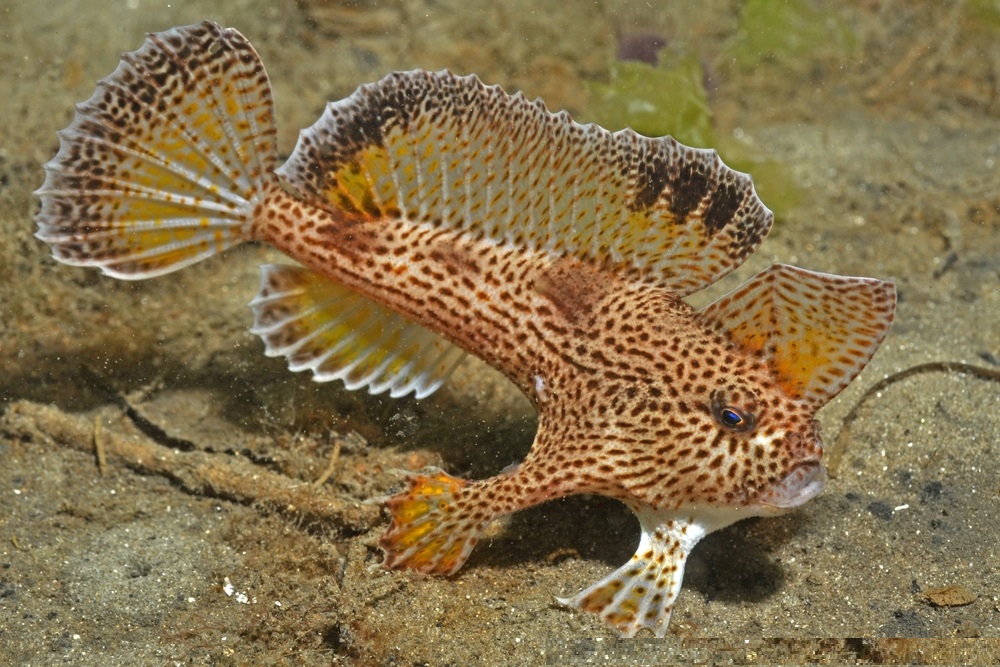
- Uses hand-like fins to walk on the sea floor
- Found only in the River Derwent estuary, Tasmania
- First marine fish listed as critically endangered by IUCN
- Threatened by invasive Northern Pacific seastars
- Females lay up to 250 large eggs on vertical objects
What it is
This rare anglerfish belongs to the handfish family, which is unique to Australia. It grows to about 12 centimetres long and moves slowly across the ocean bottom. Its most striking feature is its pectoral fins, which resemble hands with finger-like extensions. These limbs allow the fish to walk along the substrate instead of swimming through the water column. The skin is partially covered in small spines, giving it a hairy texture that inspired its scientific name.
Where it lives
The species has an extremely limited distribution. It lives only in the estuary of the River Derwent in Tasmania and adjacent coastal areas. It prefers shallow benthic zones, typically found between two and ten metres deep. The fish selects complex microhabitats for shelter, favouring areas with depressions, ripple formations, and shell debris. These features help it avoid predators in its restricted home range.
How it lives
Little is known about its daily behaviour, but it is a slow-moving predator. In the wild, it feeds on small shellfish, shrimp, and marine worms. Captive individuals accept mysid shrimp and amphipods. Because the fish has a low movement range, it rarely encounters others of its kind. This isolation reduces mating opportunities and increases the effort required to find a partner, posing risks to genetic diversity within the small population.
Breeding and life cycle
Spawning occurs during spring, specifically in September and October. Females attach between 80 and 250 large eggs to vertical structures such as sea grasses, sponges, algae, and worm tubes. The eggs measure three to four millimetres in diameter. After seven to eight weeks, they hatch into fully formed juveniles rather than free-swimming larvae. This direct development limits dispersal, keeping young fish close to their birthplace.
Fish and people
The spotted handfish holds historical significance as the first marine fish listed as critically endangered on the IUCN Red List in 1996. It is protected under Australian and Tasmanian laws, which prohibit collection without a permit. While not used for food or sport, it is studied by researchers monitoring its decline. Conservation efforts focus on managing the invasive Northern Pacific seastar, which threatens the species by eating eggs and destroying spawning habitats.
Status and threats
The International Union for Conservation of Nature classifies this fish as critically endangered. The primary threat is the invasive Northern Pacific seastar, established in the Derwent River since the 1980s. These seastars prey on handfish eggs and consume the sea squirts that provide essential spawning surfaces. Habitat loss and low reproductive rates due to isolated populations further endanger its survival. Legal protections are in place, but controlling the invasive predator remains urgent.


Questions people ask about Spotted handfish
How does the spotted handfish move?
Unlike most fish, it uses its modified pectoral fins to walk along the seabed. These fins look like hands with finger-like tips, allowing it to navigate complex bottom habitats without swimming.
Where can you find the spotted handfish?
It has a very restricted range, living only in the estuary of the River Derwent in Tasmania and nearby coastal areas. It prefers shallow depths between two and ten metres.
Why is the spotted handfish endangered?
The main threat is the invasive Northern Pacific seastar, which eats the fish's eggs and destroys the sea squirts used for spawning. Low population numbers and limited movement also hinder reproduction.
What does the spotted handfish eat?
In the wild, it preys on small shellfish, shrimp, and polychaete worms. In captivity, it accepts mysid shrimp, amphipods, and small live fish as part of its diet.
Good reading and sources
- Spotted handfish on WikipediaEncyclopedia
- More photos on Wikimedia CommonsPhotos
- Wikidata recordOpen data
The facts on this page come from the Wikipedia article "Spotted handfish", written by its contributors and used under the CC BY-SA 4.0 licence, and from its Wikidata record (CC0). EveryFish rewrote the text in its own words, with AI assistance, and compares every page with the article to make sure no passage is copied. It may be reused under the same CC BY-SA 4.0 licence with a link back.
It may contain mistakes, and figures change over time. Nothing here is investment or buying advice. If something is wrong, tell us. Last refreshed 2026-11-15.
Like Spotted handfish
All other fish 🇦🇺 AustraliaRed handfish
A rare Australian fish that crawls on the sea floor using hand-like fins.Other · Coasts and shelves · 1844
 WorldNorthern whiting
A widespread marine fish found in the Indo-Pacific, known for its silvery body and ability to bury itself in sand.Other · Coasts and shelves · 1775
 🇦🇴 Angola and 3 moreAtlantic mudskipper
Semi-aquatic goby that walks on mudflats in West Africa.Other · Rivers and lakes · 1766
 🇮🇩 Indonesia and 4 moreTorpedo scad
A fast, torpedo-shaped marine fish found across the Indo-Pacific.Other · Coasts and shelves · 1758