
Smooth butterfly ray
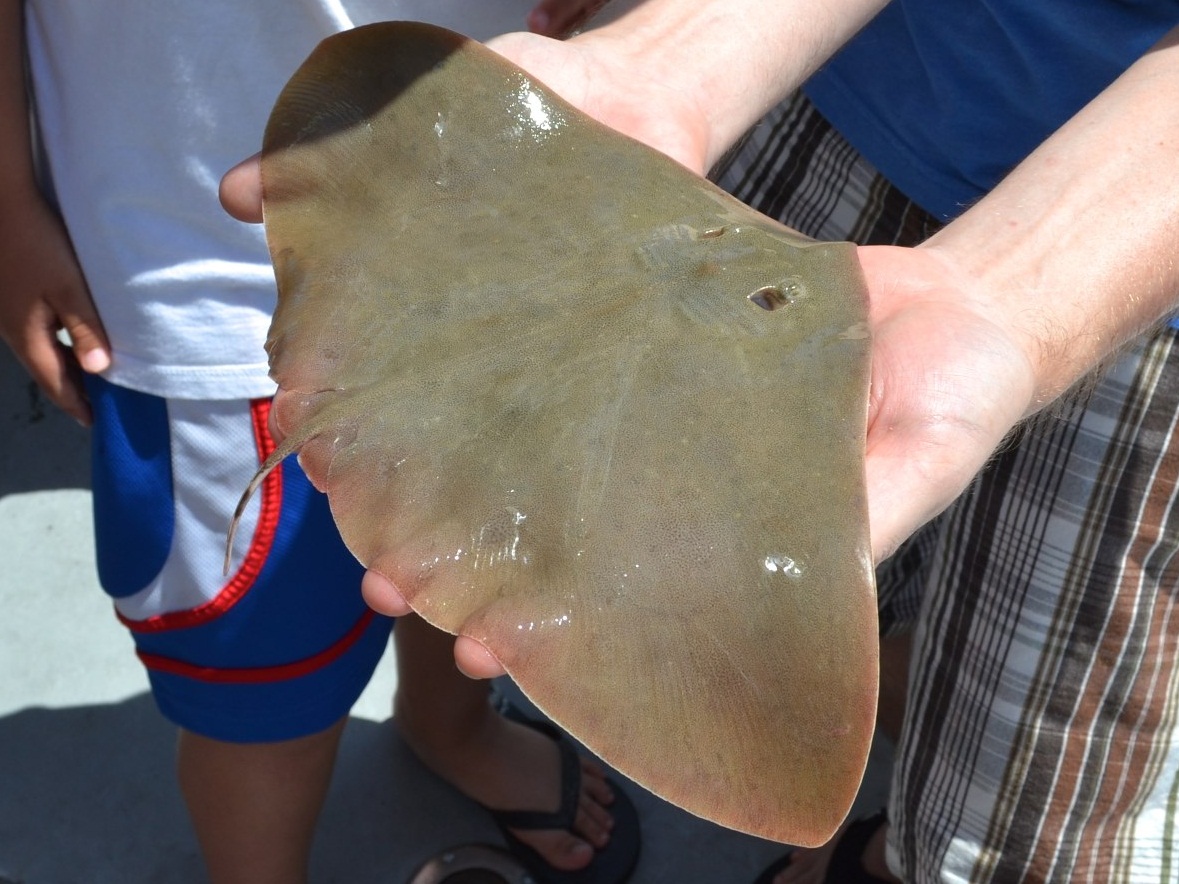
A diamond-shaped ray with a short tail and no sting.
The smooth butterfly ray is a cartilaginous fish found in warm Atlantic waters. It has a broad, flat body and lacks a stinging spine. This species lives near the sea floor and feeds on crustaceans and small fish.
- Maximum disc width reaches 120 centimetres
- Lacks a dorsal spine and cannot sting
- Found in Atlantic Ocean and Gulf of Mexico
- Classified as Near Threatened by IUCN
- Preyed upon by great hammerhead sharks
What it is
This cartilaginous fish belongs to the family Gymnuridae. Its name comes from its compressed, diamond-shaped body and wide pectoral fins. The tail is short with low fin folds and lacks a caudal fin. Adults reach a maximum width of 120 cm. The dorsal side varies in colour from grey to brown, while the ventral side is usually white. This countershading helps it blend into the sea floor. Unlike many relatives, it has no dorsal spine and cannot sting humans.
Where it lives
These rays inhabit the western and eastern Atlantic Ocean, ranging from Maryland to Brazil. They are also present in the Gulf of Mexico. They prefer neritic waters but enter brackish estuaries and hypersaline lagoons. Their habitat extends from the continental shelf down to depths of 40 metres. They favour tropical and warm waters with sandy or muddy bottoms where they can bury themselves.
How it lives
Smooth butterfly rays switch between undulating and oscillating swimming patterns. They undulate near the bottom and use powerful downstrokes when swimming freely. A lateral line canal on their head detects water movement. They feed on teleosts, crustaceans, mussels, and polychaetes. They may swallow large prey whole and then digest it over a long period. Sharks, particularly the great hammerhead, hunt them as primary predators.
Breeding and life cycle
Reproduction involves internal fertilization using claspers. Females carry embryos for two to four months via aplacental uterine viviparity. The young develop as histotrophs inside the mother. This species gives birth annually but produces few offspring. Females are larger than males, allowing them to carry more and larger embryos. This strategy invests significant energy into each reproductive cycle.
Fish and people
Fishers catch this species commercially and recreationally in parts of Australia, Europe, and Asia. It is often taken as bycatch but is usually released alive. The lack of a stinging spine makes it less dangerous to handle than other rays. There are no specific cultural traditions mentioned, but it is part of the general marine harvest in certain regions.
Status and threats
The International Union for Conservation of Nature classifies this species as Near Threatened. Frequent capture as bycatch poses a risk to populations. However, high survival rates after release help mitigate some threats. Continued monitoring is necessary to ensure sustainable numbers in its Atlantic and Gulf habitats.
Questions people ask about Smooth butterfly ray
Can the smooth butterfly ray sting humans?
No, this species does not have a dorsal spine on its tail. Therefore, it cannot sting or harm humans in the way that many other rays can. This makes it safer to handle if caught accidentally.
What does the smooth butterfly ray eat?
It primarily feeds on teleost fish and crustaceans. It also consumes bivalve mussels and polychaetes. The ray may swallow larger prey items whole and then undergo a long digestion period with little further feeding.
Where does this ray live?
It is found in the western and eastern Atlantic Ocean, from Maryland to Brazil, and in the Gulf of Mexico. It prefers shallow, warm waters with sandy or muddy bottoms, often entering estuaries.
How big do smooth butterfly rays get?
They have a maximum disc width of 120 cm. Mature females are typically about 50 cm wide, while males are around 42 cm. Newborns are between 16 and 22 cm wide at birth.
Good reading and sources
- Smooth butterfly ray on WikipediaEncyclopedia
- More photos on Wikimedia CommonsPhotos
- Wikidata recordOpen data
The facts on this page come from the Wikipedia article "Smooth butterfly ray", written by its contributors and used under the CC BY-SA 4.0 licence, and from its Wikidata record (CC0). EveryFish rewrote the text in its own words, with AI assistance, and compares every page with the article to make sure no passage is copied. It may be reused under the same CC BY-SA 4.0 licence with a link back.
It may contain mistakes, and figures change over time. Nothing here is investment or buying advice. If something is wrong, tell us. Last refreshed 2026-11-15.
Like Smooth butterfly ray
All rays and skates 🇺🇸 United States and 4 moreSpiny butterfly ray
A large Atlantic ray with a tail spine, valued for food and now critically endangered in many areas.Ray · Estuaries and mangroves
 🇿🇦 South Africa and 4 moreReticulate whipray
A large spotted stingray from the western Indian Ocean and eastern Mediterranean.Ray · Coasts and shelves · 1789
 WorldSkate
Cartilaginous fish with flat bodies and egg cases, found on sea floors worldwide.Shark · Coasts and shelves
 WorldGuitarfish
A family of rays with a shark-like tail and flattened head found in warm waters worldwide.Ray · Coasts and shelves