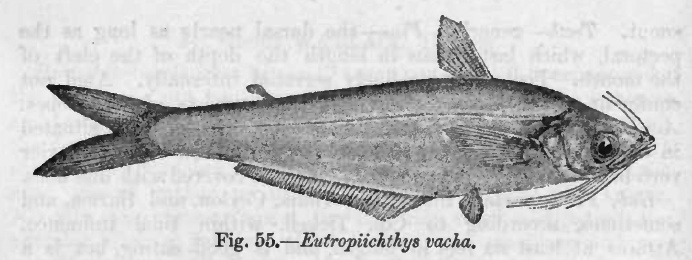
Silond catfish
Large schilbid catfish native to South Asian rivers.
The Silond catfish is a large species of schilbid catfish found in the rivers of Pakistan, India, Bangladesh and Nepal. It grows up to 183 centimetres and forms shoals, migrating into large rivers during monsoons to spawn.
- Grows up to 183 cm in length
- Native to Pakistan, India, Bangladesh and Nepal
- Migrates into large rivers during monsoons
- Forms shoals in river habitats
What it is
The Silond catfish is a member of the schilbid family, known for its substantial size and riverine habitat. It can reach a total length of 183 centimetres, making it one of the larger catfish in its range. The body shape is typical of schilbids, adapted for life in flowing waters. This species is native to South Asia, specifically found in the river systems of Pakistan, India, Bangladesh and Nepal. It is often observed in groups, indicating a social or schooling behaviour in its natural environment.
Where it lives
This fish inhabits the freshwater rivers of Pakistan, India, Bangladesh and Nepal. Its range extends into estuarine areas where fresh and salt water mix. The species is tied to the seasonal cycles of these river systems, particularly the monsoon rains that drive its movement patterns. It is not found in isolated lakes but rather in connected river networks that allow for its migratory habits.
How it lives
Silond catfish are social animals that occur in shoals. They move between different parts of the river system depending on the season. Adults live in estuaries or lower river reaches for much of the year. Their diet and specific predators are not detailed in the available records, but their grouping behaviour suggests protection against predation. They are active swimmers capable of navigating strong currents during their seasonal migrations.
Breeding and life cycle
Breeding is linked to the monsoon season. Adult fish ascend from estuaries into large rivers to spawn when water levels rise. This migration ensures that eggs and larvae have suitable conditions for development. After the monsoon rains stop and water levels recede, many adults become stranded in small, isolated pools. This post-spawning stranding is a notable feature of their life cycle in these fluctuating river environments.
Questions people ask about Silond catfish
How big does the Silond catfish get?
The Silond catfish can grow to a total length of 183 centimetres. This makes it a significantly large species within its family, suitable for large river environments.
Where is the Silond catfish found?
It is native to South Asia, specifically in the rivers of Pakistan, India, Bangladesh and Nepal. It inhabits both freshwater rivers and estuarine zones.
When does the Silond catfish breed?
Breeding occurs during the monsoon season. Adults migrate from estuaries into large rivers to spawn when water levels are high, returning or getting stranded as waters recede.
Good reading and sources
- Silonia silondia on WikipediaEncyclopedia
- More photos on Wikimedia CommonsPhotos
- Wikidata recordOpen data
The facts on this page come from the Wikipedia article "Silonia silondia", written by its contributors and used under the CC BY-SA 4.0 licence, and from its Wikidata record (CC0). EveryFish rewrote the text in its own words, with AI assistance, and compares every page with the article to make sure no passage is copied. It may be reused under the same CC BY-SA 4.0 licence with a link back.
It may contain mistakes, and figures change over time. Nothing here is investment or buying advice. If something is wrong, tell us. Last refreshed 2026-11-15.
Like Silond catfish
All catfishes 🇧🇷 Brazil and 4 moreTiger shovelnose catfish
Large striped South American river catfishCatfish · Rivers and lakes · 1862
 🇧🇷 Brazil and 4 moreAmazon sailfin catfish
A large freshwater armored catfish from South America, often kept in aquariums and known as an invasive pest elsewhere.Catfish · Rivers and lakes
 🇿🇦 South Africa and 4 moreAfrican sharptooth catfish
Large airbreathing catfish farmed across Africa and AsiaCatfish · Rivers and lakes
 🇨🇦 Canada and 1 moreBigmouth buffalo
A long-lived North American freshwater fish known for its terminal mouth and exceptional lifespan.Catfish · Rivers and lakes