
African sharptooth catfish
Large airbreathing catfish farmed across Africa and Asia
The African sharptooth catfish is a large freshwater species native to Africa and the Middle East. It thrives in diverse water conditions and has been widely introduced for aquaculture since the 1980s due to its rapid growth and hardiness.
- Reaches 1.7 m in length and 60 kg in weight
- Breathes air using modified gill arches
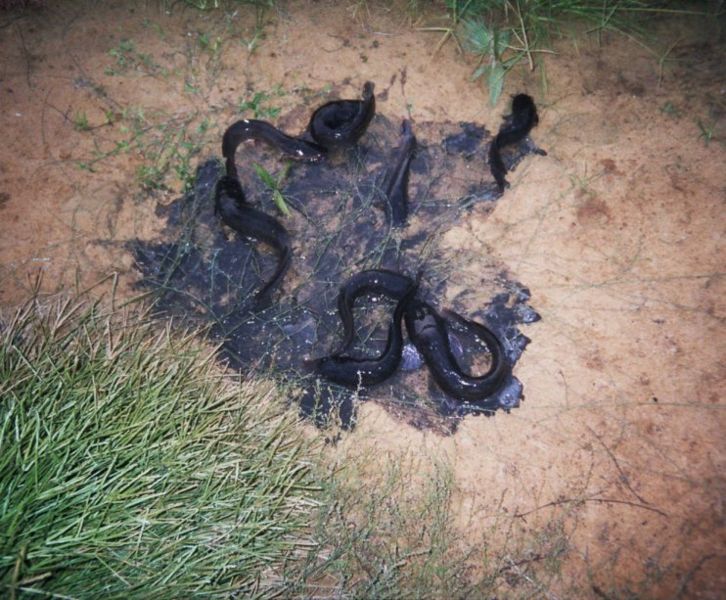
- Can crawl on land to escape drying water
- Widely farmed for high yield and hardiness
- Produces loud croaking sounds at night
What it is
This large catfish has an eel-like body with dark grey or black backs that fade to white bellies. Its head is flat and bony, featuring a broad mouth and four pairs of barbels. Unlike many fish, it possesses modified gill arches that act as accessory breathing organs, allowing it to survive in low-oxygen water. Only the pectoral fins carry spines. Adults typically measure between one and one and a half metres, though they can reach up to 1.7 metres and weigh 60 kilograms.
Where it lives
Native populations inhabit freshwater lakes, rivers, and swamps throughout Africa and the Middle East. The species adapts well to human-made environments, including oxidation ponds and urban sewage systems. In the early 1980s, farmers introduced it worldwide for aquaculture. It now resides in Cuba, Hispaniola, Brazil, Vietnam, Indonesia, Taiwan, and India. In regions with native Clarias species, such as Indonesia, this introduced variety is often distinguished by local names.
How it lives
Active at night, this omnivore consumes living and dead animal matter alongside plant material. Its diet includes insects, plankton, snails, crustaceans, small mammals, other fish, eggs, fruit, and seeds. The wide mouth allows it to swallow large prey whole, including waterbirds like the common moorhen. It can crawl over dry land to escape drying pools and survives in mud during dry seasons. Occasionally, it produces loud croaking sounds similar to a crow.
Breeding and life cycle
Spawning occurs at night in shallow, flooded areas of rivers and lakes. Males engage in aggressive encounters before courtship. During mating, the male curves around the female’s head while she releases eggs and milt, using her tail to spread them. There is no parental care beyond site selection. Eggs and larvae develop quickly, with young fish capable of swimming within two to three days after fertilisation.
Fish and people
Farmers in Central and Western Africa began rearing this species in the 1970s due to its fast growth and tolerance for poor water quality. It yields high densities and fetches higher market prices than tilapia in some regions because it can be sold live. Breeders sometimes cross it with Heterobranchus longifillis to create hybrids with white meat, though these crosses are stress-sensitive. In Indonesia, imported strains are known as lele dumbo.


Questions people ask about African sharptooth catfish
Can this catfish breathe out of water?
Yes, it has large accessory breathing organs made of modified gill arches. This allows it to survive in shallow mud for long periods and even crawl on dry ground to move between water sources when pools dry up.
What does the African sharptooth catfish eat?
It is an omnivore that feeds on insects, plankton, snails, crabs, other fish, birds, reptiles, and plant matter like fruit and seeds. Its wide mouth enables it to swallow relatively large prey whole.
Why is it popular in aquaculture?
It grows fast, tolerates adverse water quality, and can be raised in high densities. It also matures easily in captivity and often sells for a higher price than tilapia because it can be kept alive at markets.
Good reading and sources
- Clarias gariepinus on WikipediaEncyclopedia
- More photos on Wikimedia CommonsPhotos
- Wikidata recordOpen data
The facts on this page come from the Wikipedia article "Clarias gariepinus", written by its contributors and used under the CC BY-SA 4.0 licence, and from its Wikidata record (CC0). EveryFish rewrote the text in its own words, with AI assistance, and compares every page with the article to make sure no passage is copied. It may be reused under the same CC BY-SA 4.0 licence with a link back.
It may contain mistakes, and figures change over time. Nothing here is investment or buying advice. If something is wrong, tell us. Last refreshed 2026-11-15.
Like African sharptooth catfish
All catfishes Sub-Saharan AfricaSynodontis
A large African genus of spotted catfish known for squeaking sounds and belly-up swimming.Catfish · Rivers and lakes
 🇨🇦 Canada and 1 moreBigmouth buffalo
A long-lived North American freshwater fish known for its terminal mouth and exceptional lifespan.Catfish · Rivers and lakes