
Royal gramma
Small violet and yellow reef fish from the western Atlantic.
The royal gramma is a small marine fish native to tropical reefs in the western Atlantic Ocean. It features a striking two-tone colour pattern and is popular in home aquariums due to its hardiness and manageable size.
- Body fades from violet head to yellow tail
- Native to western Atlantic reef environments
- Acts as a cleaner fish for other species
- Males build algae nests for breeding
- Maximum recorded length is 8 cm
What it is
The royal gramma is a small reef fish with a distinctive appearance. Its body transitions from light purple or deep violet at the head to golden yellow at the tail. A black line runs through its eye, and a small black spot marks the front of its dorsal fin. This species averages just over 8 cm in length. It is often confused with the false gramma, but the latter has clear fins and a sharp colour division rather than a fade.
Where it lives
This species inhabits the tropical western Atlantic Ocean. Its range includes the waters around the Bahamas, Bermuda, and the Antilles. It is also found near Venezuela, Central America, and the northern coast of South America. Royal grammas prefer reef environments and typically swim at depths between 1 and 20 metres. They tend to stay closer to the bottom within this depth range.
How it lives
Royal grammas are planktivores that feed mainly on zooplankton and crustaceans. They also act as cleaner fish by removing ectoparasites from other species. In the wild, they pick food from the middle of the water column. These fish are territorial and stake out hiding places among rocks and crevices. They may chase away other small fish to protect their space. When threatened, they dart into holes and open their mouths wide as a warning.
Breeding and life cycle
Breeding involves a male building a nest from algae pieces among rocks. He leads a female to this site, where she deposits between 20 and 100 eggs. The eggs have tiny threads that anchor them to the algae. The male guards the nest, removes debris, and maintains the site for a month or more. Eggs hatch in five to seven days, usually in the evening. Fry initially feed on rotifers before moving to brine shrimp.
Fish and people
Aquarists value the royal gramma for its peaceful nature and vibrant colours. It is considered suitable for reef tanks with coral and invertebrates. A minimum tank size of 30 gallons is recommended, with moderate lighting. They accept frozen foods like brine shrimp and mysis shrimp, as well as flakes and pellets. While generally hardy, they can be aggressive in small nano tanks. They are best kept singly or in male-female pairs.


Questions people ask about Royal gramma
What does a royal gramma eat?
In the wild, they eat zooplankton and crustaceans. They also remove ectoparasites from other fish. In captivity, they accept frozen meaty foods like brine shrimp, mysis shrimp, flakes, and pellets.
How big do royal grammas get?
They are relatively small fish. The average size is slightly over 8 cm. The largest scientifically measured specimen was exactly 8 cm or 3.1 inches in length.
Are royal grammas aggressive?
They are generally peaceful but protect their territory. They may chase other small fish in smaller tanks. They guard their hiding spots vigorously and can be aggressive in nano reef setups.
Where do royal grammas live in the wild?
They are native to the tropical western Atlantic Ocean. Their range includes the Bahamas, Bermuda, Venezuela, the Antilles, and waters around Central America and northern South America.
Good reading and sources
The facts on this page come from the Wikipedia article "Royal gramma", written by its contributors and used under the CC BY-SA 4.0 licence, and from its Wikidata record (CC0). EveryFish rewrote the text in its own words, with AI assistance, and compares every page with the article to make sure no passage is copied. It may be reused under the same CC BY-SA 4.0 licence with a link back.
It may contain mistakes, and figures change over time. Nothing here is investment or buying advice. If something is wrong, tell us. Last refreshed 2026-11-15.
Like Royal gramma
All reef fish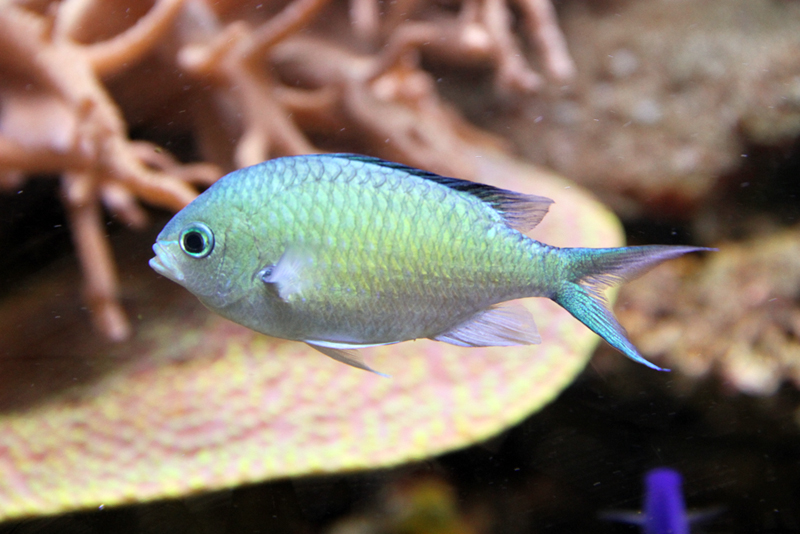 WorldGreen chromis
Small iridescent reef damselfish found across the Indo-Pacific.Reef fish · Coral reefs
 WorldRegal blue tang
Bright blue reef fish with a yellow tail and black markings.Reef fish · Coral reefs
 East AsiaTomato clownfish
A bright orange-red marine fish from the Western Pacific.Reef fish · Coasts and shelves
 WorldBluespotted cornetfish
Long, slender reef fish with a tubular snout and blue spots.Reef fish · Coasts and shelves