
Devil firefish
Venomous Indo-Pacific reef fish with feathery fins
The devil firefish is a venomous ray-finned species native to the western Indo-Pacific. It has spread invasively to the Mediterranean and Atlantic, posing risks to local ecosystems and human safety through its toxic spines.
- Grows up to 35 cm in length
- Venomous spines cause severe pain
- Invasive in Mediterranean and Caribbean
- Moray eels prey on it in Red Sea
- First described in 1828 by Bennett
What it is
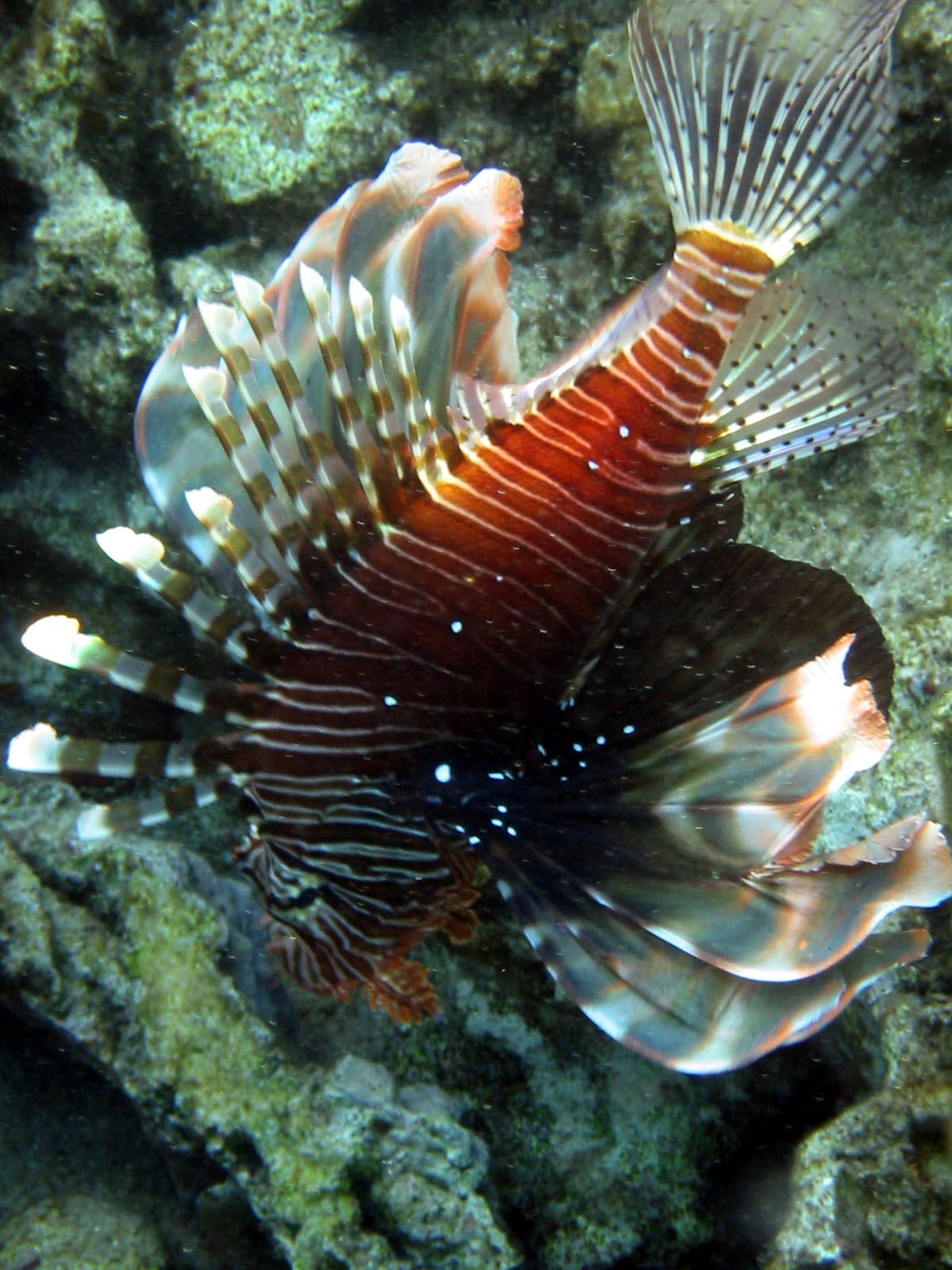
This ray-finned fish features a distinctive appearance with feathery dorsal fins and wing-like pectoral fins. Its body displays colours ranging from reddish to tan or grey, marked by thin vertical dark bars. The head shape is less angular than that of its close relative. Adults reach lengths of up to 35 centimetres. The dorsal fin contains thirteen strong spines alongside soft rays, while the anal fin has three spines. These physical traits help it blend into reef environments while warning potential threats.
Where it lives
Native waters include the Indian Ocean, stretching from the Red Sea to South Africa and Indonesia. The species entered the Mediterranean Sea via the Suez Canal, first recorded near Israel in 1991. It is now common in the eastern Mediterranean basin and the Sicily channel. Additionally, it has established populations along the eastern United States coast and throughout the Caribbean Sea, where it is considered an invasive presence.
How it lives
Active mainly at night, this fish hides in crevices during daylight hours. It hunts small crustaceans and other fish. Venomous spines deter most predators, though larger individuals may eat smaller ones. In its native Red Sea habitat, moray eels have developed resistance to the venom and prey on it. Bluespotted cornetfish and certain grouper species in the Bahamas also consume this lionfish. Reef sharks are among other natural predators in native ranges.
Fish and people
Human contact with the fin spines can be dangerous due to high venom potency. Stings cause extreme pain, vomiting, convulsions, and breathing difficulties. While rarely fatal, reactions vary in severity between individuals. Immediate medical attention is recommended for any sting victim. The species is not typically farmed or kept in home aquariums due to these hazards and its invasive status in many regions.
Status and threats
The fish is regarded as invasive in the Mediterranean and Atlantic regions. Its spread threatens local biodiversity by preying on native species. In its native Indo-Pacific range, it maintains a balanced role within the ecosystem. Conservation efforts in invaded areas focus on control rather than protection, given its negative impact on reef communities and commercial fisheries.


Questions people ask about Devil firefish
Is the devil firefish dangerous to humans?
Yes, its fin spines are highly venomous. Stings cause extreme pain, vomiting, and breathing difficulties. While rarely fatal, immediate medical attention is strongly recommended due to varying sensitivity among individuals.
Where is this fish originally from?
It is native to the western Indo-Pacific region. Its range includes the Indian Ocean, from the Red Sea down to South Africa and across to Indonesia.
What eats the devil firefish?
In its native Red Sea habitat, moray eels prey on it. Bluespotted cornetfish and groupers also feed on it in some areas. Larger lionfish may eat smaller ones.
Good reading and sources
- Pterois miles on WikipediaEncyclopedia
- More photos on Wikimedia CommonsPhotos
- Wikidata recordOpen data
The facts on this page come from the Wikipedia article "Pterois miles", written by its contributors and used under the CC BY-SA 4.0 licence, and from its Wikidata record (CC0). EveryFish rewrote the text in its own words, with AI assistance, and compares every page with the article to make sure no passage is copied. It may be reused under the same CC BY-SA 4.0 licence with a link back.
It may contain mistakes, and figures change over time. Nothing here is investment or buying advice. If something is wrong, tell us. Last refreshed 2026-11-15.
Like Devil firefish
All other fish WorldGreat barracuda
Large predatory fish found in warm oceans worldwide.Other · Coasts and shelves
 WorldBigeye trevally
A large marine fish found in tropical oceans, known for its nocturnal hunting and distinctive dark dorsal fin.Other · Coasts and shelves · 1825
 WorldLeaf scorpionfish
A small reef fish that mimics a drifting leaf to ambush prey.Other · Coral reefs · 1802
 WorldClown triggerfish
A striking black and white reef fish with a locking dorsal spine.Other · Coral reefs · 1801
More from Scorpaenidae
All of them 🇮🇳 India and 4 moreReef stonefish
A highly venomous marine fish known for its rock-like camouflage and potent toxins.Other · Coasts and shelves · 1801
 🇮🇩 Indonesia and 4 moreEstuarine stonefish
A venomous marine ray-finned fish found in the Indo-Pacific region.Shark · Coasts and shelves · 1766
 🇮🇩 Indonesia and 2 moreRed lionfish
Venomous coral reef fish native to the Indo-Pacific and invasive in the Atlantic.Reef fish · Coral reefs · 1758
 WorldLionfish
Venomous marine fish of the genus Pterois known for striking stripes and invasive spread.Ray · Coral reefs · 1900